

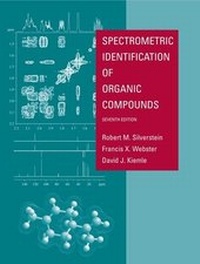
Spectrometric Identification of Organic Compounds
7th Edition
Published on 11. October 2005
Book
Hardback
512 pages
978-0-471-39362-7 (ISBN)
Description
Originally published in 1962, this was the first book to explore teh identification of organic compounds using spectroscopy. It provides a thorough introduction to the three areas of spectrometry most widely used in spectrometric identification: mass spectrometry, infrared spectrometry, and nuclear magnetic resonance spectrometry. A how-to, hands-on teaching manual with considerably expanded NMR coverage--NMR spectra can now be intrepreted in exquisite detail. This book:
* Uses a problem-solving approach with extensive reference charts and tables.
* Offers an extensive set of real-data problems offers a challenge to the practicing chemist
Eine neue Auflage des praxistauglichen Leitfadens der spektrometrischen Identifikation organischer Verbindungen - sorgfältig überarbeitet und aktualisiert. Die Autoren konzentrieren sich in gewohnter Weise auf die drei in diesem Zusammenhang wichtigsten Verfahren: Massenspektrometrie, die NMR-Spektroskopie und die Infrarotspektroskopie.
* Uses a problem-solving approach with extensive reference charts and tables.
* Offers an extensive set of real-data problems offers a challenge to the practicing chemist
Eine neue Auflage des praxistauglichen Leitfadens der spektrometrischen Identifikation organischer Verbindungen - sorgfältig überarbeitet und aktualisiert. Die Autoren konzentrieren sich in gewohnter Weise auf die drei in diesem Zusammenhang wichtigsten Verfahren: Massenspektrometrie, die NMR-Spektroskopie und die Infrarotspektroskopie.
More details
Other editions
New editions
Robert M. Silverstein | Francis X. Webster | David Kiemle
Spectrometric Identification of Organic Compounds
Book
10/2014
8th Edition
Wiley
€249.00
Shipment within 10-20 days
Previous edition
Robert M. Silverstein | Francis X. Webster | David Kiemle
The Spectrometric Identification of Organic Compounds
International Edition
Book
08/2005
7th Edition
Wiley
€49.90
Article exhausted; check for reprint
Persons
Content
Chapter 1. Mass Spectrometry. 1.1 Introduction. 1.2 Instrumentation. 1.3 Ionization Methods. 1.4 Mass Analyzers. 1.5 Interpretation of El Mass Spectra. 1.6 Mass Spectra of Some Chemical Classes. Chapter 2. Infrared Spectrometry. 2.1 Introduction. 2.2 Theory. 2.3 Instrumentation. 2.4 Sample Handling. 2.5 Interpretations of Spectra. 2.6 Characteristic Group Absorption of Organic Molecules. Chapter 3. Proton Magnetic Resonance Spectrometry. 3.1 Introduction. 3.2 Theory. 3.3 Instrumentation and Sample Handling. 3.4 Chemical Shift. 3.5 Spin Coupling, Multiplets, Spin Systems. 3.6 Protons on Oxygen, Nitrogen, and Sulfur Atoms. Exchangeable Protons. 3.7 Coupling of Protons to Other Important Nuclei (<sup> 19</sup> F, E, <sup> 31</sup> P, <sup> 29</sup> Si, and <sup> 13</sup> C. 3.8 Chemical Shift Equivalence. 3.9 Magnetic Equivalence (Spin-Coupling Equivalence). 3.10 AMX, ABX, and ABC Rigid Systems with Three Coupling Constants. 3.11 Confirmationally Mobile, Open-Chain Systems. Virtual Coupling. 3.12 Chirality. 3.13 Vicinal and Geminal Coupling. 3.14 Low-Range Coupling. 3.15 Selective Spin Decoupling. Double Resonance. 3.16 Nuclear Overhauser Effect, Difference Spectrometry, 1H 1H Proximity Through Space. Chapter 4. Carbon-13 NMR Spectrometry. 4.1 Introduction. 4.2 Theory. 4.3 Interpretation of a Simple <sup> 13</sup> C Spectrum: Diethyl Phthalate. 4.4 Quantitative <sup> 13</sup> C Analysis. 4.5 Chemical Shift Equivalence. 4.6 DEPT. 4.7 Chemical Classes and Chemical Shifts. Chapter 5. Correlation NMR Spectrometry; 2-D NMR. 5.1 Introduction. 5.2 Theory. 5.3 Correlation Spectrometry. 5.4 Ipsenol: <sup> 1</sup> H-<sup> 1</sup> H COSY. 5.5 Caryophyllene Oxide. 5.6 <sup> 13</sup> C-<sup> 13</sup> C Correlations: Inadequate. 5.7 Lactose. 5.8 Relayed Coherence Transfer: TOCSY. 5.9 HMQC - TOCSY. 5.10 ROESY. 5.11 VGSE. 5.12 Gradient Field NMR. Chapter 6. NMR Spectrometry of Other Important Spin 1/2 Nuclei. 6.1 Introduction. 6.2 <sup> 15</sup> N Nuclear Magnetic Resonance. 6.3 <sup> 19</sup> F Nuclear Magnetic Resonance. 6.4 <sup> 29</sup> Si Nuclear Magnetic Resonance. 6.5 <sup> 31</sup> P Nuclear Magnetic Resonance. 6.6 Conclusion. Chapter 7. Solved Problems. 7.1 Introduction. Chapter 8. Assigned Problems. 8.1 Introduction.