

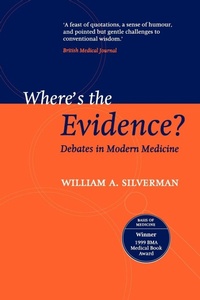
Where's the Evidence?
Debates in Modern Medicine
Published on 15. April 1999
Book
Paperback/Softback
278 pages
978-0-19-263088-9 (ISBN)
Description
The essays in Where's the Evidence? focus on problems ignored. This book is a unique collection of critical andw controversial essays on intractable ethical issues and evidence-based problems in modern medicine. Most, but notr therapeutic disasters. Although it is impossible to prevent all missteps in medicine, the author argues, a hedging strategy using concurrent controls when new therapies are introduced always reduces the number of patients killed or injured. It is dangerous to use treatments widely, he warns, before they are subject to rigorous comparative trials. Additionally, the author points out, questions have emerged about how to wield medicine's new capabilities wisely. How do we draw the line,' he asks 'between "knowing" (the acquisition of new medical information) and "doing" (the application of that new knowledge). What are the long- term consequences (moral, social, economic, and biological) of responding to a demand that medicine always do everything that can be done?' This book now issued in paperback is a collection of critical and controversial essays discussing intractable ethical issues and evidence-based problems in modern medicine. The essays together with responses were published over a ten-year period in the journal Paediatric and Perinatal Medicine. Most of the examples, but not all are taken from perinatal medicine, the field in which the author has worked for many years. The essays are thought provoking and will be of great interest to those involved in the ongoing evidence-based medicine debate. (See selected reviews)
Reviews / Votes
This is an extraordinary book!...Bill Silverman, brings to bear on contemporary medical issues the logic of science, an abiding concern for the welfare of infants, and a vigorous defense of the rights of their parents. His essays should be savored, dipped into and returned to rather than read consecutively from cover to cover, thought about, argued with, and reread. * Professor Leon Rosenberg, Department of Social Medicine, Harvard, New England Journal of Medicine (November 1998) * This book reminds me of Alastair Cooke's classic radio broadcasts "Letter from America". Like Cooke, Bill Silverman has the ability to select a topic that you didn't know you were concerned about, capture your interest with an intriguing introduction, and then hold your attention with an avuncular, reflective, and civilised commentary...A feast of quotations, a sense of humour, and pointed but gentle challenges to conventional wisdom. * Professor Tony Dixon, Family Medicine Unit, University of Hong Kong, British Medical Journal (December 1998) * These essays were written over the past decade for the medical audience, but their subject matter and the range of materials Silverman brings to the discussions make them useful, and important reading for a much larger public. As a collection of key issues in the development and application of medical knowledge, the present volume provides a wealth of case studies which could be probed by scholars in fields such as anthropology, sociology, public policy and philosophy. * Suzanne Calpestri, Librarian The George and Mary Foster Anthropology Library, University of California, Berkeley * As the parent of a child born prematurely who was damaged by modern medicine, I greatly appreciate Dr Silverman's honesty, clarity and anger.. I urge all who work with premature babies to read this book carefully. Most parents of such babies already know what Dr Silverman has discovered. * Ron Londner Miami, Florida * This compilation... deserves the widest possible readership within and beyond the medical community. As a pioneer in neonatology and controlled clinical trials, the author brings unparalleled experience to these pieces. * Robert Schlechter, MD Berkeley, California * This collection is a tribute to a wise and thoughtful physician of great distinction. We can all benefit from reading these reflections. * James McCormick, Journal of the Irish College of Physicians and Surgeons * '...fascinating book...Dr David Sackett, who wrote the foreword said "I stayed up all night reading this book. "I suspect that other readers will too.' * William Feldman, Annals of the Royal College of Physicians and Surgeons of Canada, vol.32, no.1, Feb.1999 * 'Where's the evidence? published by Oxford University Press, contains 45 essays which first appeared in Paediatric and Epidemiology, brought up to date with current comments and annotation, some by the author and some by other experts. To open a page and start reading is to be enthralled...Silverman takes up difficult problems. He does not always solve them, but he does offer challenging and sometimes unconvential points of view...Do obtain a copy, dip into it, and enjoy yourself while you stretch your mind.' * Avrum Katcher, American Academy of Paediatrics Senior Bulletin August 1999. *More details
Language
English
Place of publication
Oxford
United Kingdom
Target group
Professional and scholarly
Dimensions
Height: 234 mm
Width: 156 mm
Thickness: 15 mm
Weight
430 gr
ISBN-13
978-0-19-263088-9 (9780192630889)
Copyright in bibliographic data and cover images is held by Nielsen Book Services Limited or by the publishers or by their respective licensors: all rights reserved.
Schweitzer Classification
Persons
Content
Foreword by David L. Sackett ; Preface ; List of Respondents ; Introduction ; 1. Selective ethics ; 2. Does a difference make a difference ; 3. Prescription for disaster ; 4. Therapeutic mystique ; 5. Humane limits ; 6. Intruding in private tragedies ; 7. The glut of information ; 8. Betting on specified horses ; 9. Begin with 'if...' ; 10. Archie's scepticism ; 11. Arbitrary vs discretionary decisions ; 12. Bioengineering ; 13. '...disavowing the tree' ; 14. Diffusing responsibility Weil's reply ; 15. Hawthorne effects ; 16. Power plays ; 17. Unbridled enthusiasm ; 18. Caring and curing ; 19. On the edge ; 20. Informing and consenting Weil's reply ; 21. Lifesavers ; 22. Belief and disbelief ; 23. Preferences ; 24. Bradford Hill's doubts ; 25. More-informative abstracts ; 26. Pain control in neonates ; 27. Miraculous cures ; 28. Observer bias ; 29. The gamekeeper's brouhaha ; 30. Champing at the bit ; 31. Piecemeal skirmishes ; 32. Resolution of dilemma's Sinclair and Fowlie's reply Watts and Saigal's reply ; 33. 'Fixing' human reproduction ; 34. Justice defined as fairness ; 35. 'Methods-based' reviews ; 36. Non-replication of the replicable ; 37. Who defines 'futility' Goldworth and Benitz's reply ; 38. Fitting targets in holes ; 39. Medical 'manners' on trial ; 40. Sanction of whose beliefs and values? ; 41. Mindness existence ; 42. Interventions on an unprecedented scale ; 43. Preoccupation with 'autonomy' ; 44. A 'win' in medical Russian Roulette Lantos' reply ; Citations ; Bibliography ; Index