

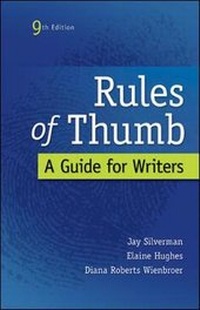
Rules of Thumb
9th Edition
Published on 24. April 2012
Book
Spiral bound
224 pages
978-0-07-340596-4 (ISBN)
More details
Edition
9th Revised edition
Language
English
Place of publication
United States
Publishing group
McGraw-Hill Education - Europe
Target group
College/higher education
US School Grade: College Freshman
Edition type
Revised edition
Dimensions
Height: 229 mm
Width: 158 mm
Thickness: 10 mm
Weight
277 gr
ISBN-13
978-0-07-340596-4 (9780073405964)
Copyright in bibliographic data and cover images is held by Nielsen Book Services Limited or by the publishers or by their respective licensors: all rights reserved.
Schweitzer Classification
Persons
A graduate of Amherst College and the University of Virginia, Jay Silverman has received fellowhsips from the Fulbright-Hayes Foundation, the Andrew Mellon Foundation, and the National Endowment for the Humanities. He has taught at Vriginia Highlands Community College and at Nassau Community College where he received the Honors Program award for Excellence in Teaching. Elaine Hughes came to New York City from Mississippi in 1979 to attend a National Endowment for the Humanities seminar at Columbia Uniersity. She has taught writing for more than 25 years--primarily at Hinds Community College in Raymond, Mississippi, and at Nassau Community College--and has conducted writing workshops for many organizations. She is the author of WRITING FROM THE INNER SELF. As Chair of the English Department of Nassau Community College for six years, Diana Roberts Wienbroer coordinated a department of 150 faculty members and served on the Executive Council of the Association of Departments of English. Besides teaching writing for over thirty years, both in Texas and New York, she has studied and taught film criticism. She is also the author of THE McGRAW-HILL GUIDE TO ELECTRONIC RESEARCH AND DOCUMENTATION, 1997.
Content
Acknowledgements
The Meaning of "Rule of Thumb"
How to Use Rules of Thumb
PART 1: THE BASICS: SPELLING, PUNCTUATION, AND GRAMMAR
A Word about Correctness
Commonly Confused Words
One Word or Two?
Spelling
Capitalization
Abbreviations and Numbers
Apostrophes
Consistent Pronouns
I vs. Me, She vs. Her, He vs. Him, Who vs. Whom
Vague Pronouns
Recognizing Complete Sentences
Run-on Sentences and Sentence Fragments
Feature: Using but, however, although
Commas
Semicolons
Colons
Dashes and Parentheses
Quotation Marks
Titles: Underlines, Italics, or Quotation Marks
Shifting Verb Tenses
Verb Agreement
Word Endings: -s and -ed
Parallel Structure
Dangling COnstructions
Mixed Sentence Patterns
PART 2: PUTTING A PAPER TOGETHER
What to Do When You're Stuck
Addressing Your Audience
Writing with a Thesis
Arguing for Your Position
Finding an Organization for Your Essay
Introductions
Paragraphs--Long and Short
Transitions
Incorporating Quotations
Conclusions
How to Make a Paper Longer (and When to Make It Shorter)
How to Work on a Second Draft
Shortcuts for "Word"
Proofreading Tips
Format of College Papers
Special Case: Writing an Essay in Class
Special Case: Writing about Literature
PART 3: THE RESEARCH PAPER
Seven Steps to a Research Paper
How to Conduct Research
Feature: Tips for Fact-Checking
Going Beyond Google and Wikipedia
Feature: When You Find Too Few or Too Many Sources
Writing the Research Paper
Feature: PowerPoint Presentations
Plagiarism (Cheating)
What Is Documentation?
Feature: Where to Find Specific Entries for Works Cited, References, and Bibliography
Documentation: The MLA Style
Documentation: The APA Style
Documentation: Endnotes and Bibliography
PART 4: STYLE
Finding Your Voice
Adding Details
Repetition: Bad, Not-So-Bad, and Good
Recognizing Cliches
Eliminating Offensive Language
Trimming Wordiness
Using Strong Verbs
Varying Your Sentences
Keeping a Journal
Postscript
A List of Valuable Sources
About the Authors
Index
Troubleshooting Guide, inside back cover
The Meaning of "Rule of Thumb"
How to Use Rules of Thumb
PART 1: THE BASICS: SPELLING, PUNCTUATION, AND GRAMMAR
A Word about Correctness
Commonly Confused Words
One Word or Two?
Spelling
Capitalization
Abbreviations and Numbers
Apostrophes
Consistent Pronouns
I vs. Me, She vs. Her, He vs. Him, Who vs. Whom
Vague Pronouns
Recognizing Complete Sentences
Run-on Sentences and Sentence Fragments
Feature: Using but, however, although
Commas
Semicolons
Colons
Dashes and Parentheses
Quotation Marks
Titles: Underlines, Italics, or Quotation Marks
Shifting Verb Tenses
Verb Agreement
Word Endings: -s and -ed
Parallel Structure
Dangling COnstructions
Mixed Sentence Patterns
PART 2: PUTTING A PAPER TOGETHER
What to Do When You're Stuck
Addressing Your Audience
Writing with a Thesis
Arguing for Your Position
Finding an Organization for Your Essay
Introductions
Paragraphs--Long and Short
Transitions
Incorporating Quotations
Conclusions
How to Make a Paper Longer (and When to Make It Shorter)
How to Work on a Second Draft
Shortcuts for "Word"
Proofreading Tips
Format of College Papers
Special Case: Writing an Essay in Class
Special Case: Writing about Literature
PART 3: THE RESEARCH PAPER
Seven Steps to a Research Paper
How to Conduct Research
Feature: Tips for Fact-Checking
Going Beyond Google and Wikipedia
Feature: When You Find Too Few or Too Many Sources
Writing the Research Paper
Feature: PowerPoint Presentations
Plagiarism (Cheating)
What Is Documentation?
Feature: Where to Find Specific Entries for Works Cited, References, and Bibliography
Documentation: The MLA Style
Documentation: The APA Style
Documentation: Endnotes and Bibliography
PART 4: STYLE
Finding Your Voice
Adding Details
Repetition: Bad, Not-So-Bad, and Good
Recognizing Cliches
Eliminating Offensive Language
Trimming Wordiness
Using Strong Verbs
Varying Your Sentences
Keeping a Journal
Postscript
A List of Valuable Sources
About the Authors
Index
Troubleshooting Guide, inside back cover