

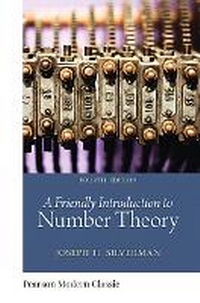
Friendly Introduction to Number Theory, A (Classic Version)
4th Edition
Published on 28. August 2017
Book
Paperback/Softback
432 pages
978-0-13-468946-3 (ISBN)
Description
A Friendly Introduction to Number Theory, 4th Edition introduces students to the overall themes and methodology of mathematics through the detailed study of one particular facet-number theory. Starting with nothing more than basic high school algebra, students are gradually led to the point of actively performing mathematical research while getting a glimpse of current mathematical frontiers. The writing is appropriate for the undergraduate audience and includes many numerical examples, which are analyzed for patterns and used to make conjectures. Emphasis is on the methods used for proving theorems rather than on specific results.
This title is part of the Pearson Modern Classics series. Pearson Modern Classics are acclaimed titles at a value price.
This title is part of the Pearson Modern Classics series. Pearson Modern Classics are acclaimed titles at a value price.
More details
Series
Edition
4th edition
Language
English
Place of publication
United States
Publishing group
Pearson Education (US)
Target group
College/higher education
Dimensions
Height: 226 mm
Width: 152 mm
Thickness: 25 mm
Weight
460 gr
ISBN-13
978-0-13-468946-3 (9780134689463)
Copyright in bibliographic data and cover images is held by Nielsen Book Services Limited or by the publishers or by their respective licensors: all rights reserved.
Schweitzer Classification
Other editions
Previous edition
Joseph H. Silverman
A Friendly Introduction to Number Theory
Book
03/2012
4th Edition
Pearson
€136.17
Article exhausted; check for reprint
Person
About our author Joseph H. Silverman is a Professor of Mathematics at Brown University. He received his Sc.B. at Brown and his Ph.D. at Harvard, after which he held positions at MIT and Boston University before joining the Brown faculty in 1988. He has published more than 100 peer-reviewed research articles and 7 books in the fields of number theory, elliptic curves, arithmetic geometry, arithmetic dynamical systems, and cryptography. He is a highly regarded teacher, having won teaching awards from Brown University and the Mathematical Association of America, as well as a Steele Prize for Mathematical Exposition from the American Mathematical Society. He has supervised the theses of more than 25 Ph.D. students, is a co-founder of NTRU Cryptosystems, Inc., and has served as an elected member of the American Mathematical Society Council and Executive Committee.
Content
Preface Flowchart of Chapter Dependencies Introduction
What Is Number Theory?
Pythagorean Triples
Pythagorean Triples and the Unit Circle
Sums of Higher Powers and Fermat's Last Theorem
Divisibility and the Greatest Common Divisor
Linear Equations and the Greatest Common Divisor
Factorization and the Fundamental Theorem of Arithmetic
Congruences
Congruences, Powers, and Fermat's Little Theorem
Congruences, Powers, and Euler's Formula
Euler's Phi Function and the Chinese Remainder Theorem
Prime Numbers
Counting Primes
Mersenne Primes
Mersenne Primes and Perfect Numbers
Powers Modulo m and Successive Squaring
Computing kth Roots Modulo m
Powers, Roots, and "Unbreakable" Codes
Primality Testing and Carmichael Numbers
Squares Modulo p
Is -1 a Square Modulo p? Is 2?
Quadratic Reciprocity
Proof of Quadratic Reciprocity
Which Primes Are Sums of Two Squares?
Which Numbers Are Sums of Two Squares?
As Easy as One, Two, Three
Euler's Phi Function and Sums of Divisors
Powers Modulo p and Primitive Roots
Primitive Roots and Indices
The Equation X4 + Y4 = Z4
Square - Triangular Numbers Revisited
Pell's Equation
Diophantine Approximation
Diophantine Approximation and Pell's Equation
Number Theory and Imaginary Numbers
The Gaussian Integers and Unique Factorization
Irrational Numbers and Transcendental Numbers
Binomial Coefficients and Pascal's Triangle
Fibonacci's Rabbits and Linear Recurrence Sequences
Oh, What a Beautiful Function
Cubic Curves and Elliptic Curves
Elliptic Curves with Few Rational Points
Points on Elliptic Curves Modulo p
Torsion Collections Modulo p and Bad Primes
Defect Bounds and Modularity Patterns
Elliptic Curves and Fermat's Last Theorem
The Topsy-Turvey World of Continued Fractions [online]
Continued Fractions, Square Roots, and Pell's Equation [online]
Generating Functions [online]
Sums of Powers [online]
Further Reading Index A. Factorization of Small Composite Integers [online] B. A List of Primes [online]
What Is Number Theory?
Pythagorean Triples
Pythagorean Triples and the Unit Circle
Sums of Higher Powers and Fermat's Last Theorem
Divisibility and the Greatest Common Divisor
Linear Equations and the Greatest Common Divisor
Factorization and the Fundamental Theorem of Arithmetic
Congruences
Congruences, Powers, and Fermat's Little Theorem
Congruences, Powers, and Euler's Formula
Euler's Phi Function and the Chinese Remainder Theorem
Prime Numbers
Counting Primes
Mersenne Primes
Mersenne Primes and Perfect Numbers
Powers Modulo m and Successive Squaring
Computing kth Roots Modulo m
Powers, Roots, and "Unbreakable" Codes
Primality Testing and Carmichael Numbers
Squares Modulo p
Is -1 a Square Modulo p? Is 2?
Quadratic Reciprocity
Proof of Quadratic Reciprocity
Which Primes Are Sums of Two Squares?
Which Numbers Are Sums of Two Squares?
As Easy as One, Two, Three
Euler's Phi Function and Sums of Divisors
Powers Modulo p and Primitive Roots
Primitive Roots and Indices
The Equation X4 + Y4 = Z4
Square - Triangular Numbers Revisited
Pell's Equation
Diophantine Approximation
Diophantine Approximation and Pell's Equation
Number Theory and Imaginary Numbers
The Gaussian Integers and Unique Factorization
Irrational Numbers and Transcendental Numbers
Binomial Coefficients and Pascal's Triangle
Fibonacci's Rabbits and Linear Recurrence Sequences
Oh, What a Beautiful Function
Cubic Curves and Elliptic Curves
Elliptic Curves with Few Rational Points
Points on Elliptic Curves Modulo p
Torsion Collections Modulo p and Bad Primes
Defect Bounds and Modularity Patterns
Elliptic Curves and Fermat's Last Theorem
The Topsy-Turvey World of Continued Fractions [online]
Continued Fractions, Square Roots, and Pell's Equation [online]
Generating Functions [online]
Sums of Powers [online]
Further Reading Index A. Factorization of Small Composite Integers [online] B. A List of Primes [online]