

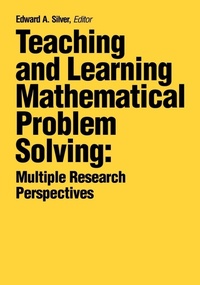
Teaching and Learning Mathematical Problem Solving
Multiple Research Perspectives
Published on 1. May 1985
Book
Paperback/Softback
484 pages
978-0-89859-759-2 (ISBN)
Description
A provocative collection of papers containing comprehensive reviews of previous research, teaching techniques, and pointers for direction of future study. Provides both a comprehensive assessment of the latest research on mathematical problem solving, with special emphasis on its teaching, and an attempt to increase communication across the active disciplines in this area.
Reviews / Votes
"...a valuable resource for anyone interested in human mathematical performance."-Contemporary Psychology
"...it is always a pleasure to find and read a well-planned, well-written, and well-organized book on the subject...it would be very helpful to anyone pursuing research in mathematical problem solving."
-Mathematics Teacher
More details
Language
English
Place of publication
Mahwah
United States
Publishing group
Taylor & Francis Inc
Target group
College/higher education
Professional and scholarly
Dimensions
Height: 254 mm
Width: 178 mm
Thickness: 26 mm
Weight
902 gr
ISBN-13
978-0-89859-759-2 (9780898597592)
Copyright in bibliographic data and cover images is held by Nielsen Book Services Limited or by the publishers or by their respective licensors: all rights reserved.
Schweitzer Classification
Other editions
Additional editions
Book
04/2016
1st Edition
Routledge
€206.50
Shipment within 10-20 days
E-Book
04/2013
1st Edition
Routledge
€125.99
Available for download
E-Book
04/2013
1st Edition
Routledge
€125.99
Available for download
Person
Edward A. Silver
Content
Part A. Problem-Solving Research: Mathematics Education Perspectives. A Retrospective Account of the Past Twenty-five Years of Research on Teaching Mathematical Problem Solving; Learning to Add and Subtract: An Exercise in Problem Solving; Methodological Considerations in Research on Mathematical Problem-Solving Instruction; Mathematical Problem Solving: Lessons from the British Experience; Part B. Problem-Solving Research: Cross-Discipline Perspectives; Implications for Mathematics Instruction of Research on Scientific Problem Solving; Thinking Scientifically and Thinking Mathematically: A Discussion of the Paper by Heller and Hungate; Implications of Cognitive Psychology for Instruction in Mathematical Problem Solving; Cognitive Psychology and Mathematical Problem Solving: A Discussion of Mayer's Paper; Artificial Intelligence and the Learning of Mathematics: A Tutorial Sampling; Artificial Intelligence and Mathematics Education: A Discussion of Rissland's Paper; Experience, Problem Solving, and Learning Mathematics: Considerations in Developing Mathematics Curricula; Cognitive Theory and Curriculum Design: A Discussion of Thompson's Paper; Part C. Problem-Solving Research: Themes and Directions Research on Teaching Mathematical Problem Solving: Some Underrepresented Themes and Needed Directions; Affective Issues in Research on Teaching Mathematical Problem Solving; Teacher's Conceptions of Mathematics and the Teaching of Problem Solving; The Teacher and Classroom Instruction: Neglected Themes in Problem-Solving Research; Conceptual Analyses of Problem-Solving Performance; Individual Differences and Mathematical Problem Solving; Small Groups as a Setting for Research on Mathematical Problem Solving; Metacognitive and Epistemological Issues in Mathematical Understanding; Representation and Problem Solving: Methodological Issues Related to Modeling; Problem-Solving Derailers: The Influence of Misconceptions on Problem[1]Solving Performance; Computers in Research on Mathematical Problem Solving