

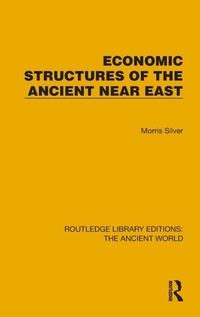
Economic Structures of the Ancient Near East
1st Edition
Published on 28. August 2024
Book
Hardback
224 pages
978-1-032-76534-1 (ISBN)
Description
Economic Structures of the Ancient Near East (1985) is a political economy of antiquity which applies the universal conclusions of theoretical economics to the interpretation of economic life. The first part of the book shows that the analysis of transaction costs - that is, the resources used up in exchanging ownership rights including costs of communication and of designing and enforcing contracts - provides numerous insights into the structure of the ancient economy. The role of temples as centres of commerce, inculcation of professional standards by gods, elevation of technology to the status of divine gift, religious syncretism and fetishism and many more seemingly exotic practices are comprehended as elements in a strategy to cope with high transaction costs by increasing the stock of what might be called trust capital. It is shown that similar considerations lie behind the ubiquity of diversified, multinational family firms, the prominent entrepreneurial role of high-born women, the prominence within the contractual process of publicly performed conventional gestures and recitations, and the intrusion of gifts, friendship, and other manifestations of personal economics into exchange relationships. The book goes on to examine carefully, and then reject, the view of economic historian Karl Polanyi and others that the ancient Near East lacked true markets for consumer goods and productive factors. The direct evidence of market exchange (local and long distance), occupational specialisation, supply-demand determined prices, investment in material and human capital, production for the market, and other 'modern' traits is uneven with respect to place and time, but nevertheless abundant. The requisite market functions demanded by Polanyi, including a market for labour (slave and free) and elaborate credit and investment markets, can be seen plainly from very early times. Finally, the book deals with the impact on the ancient Near Eastern economy of changes in economic incentives and of changes in economic policy. It becomes evident that ancient economies were capable of making profound alterations in order to take advantage of new economic opportunities. It is also shown that the ancient Near East was not static, as is usually asserted: periods of pervasive economic regulation by the state are interspersed with lengthy periods of relatively unfettered market activity and growth.
More details
Series
Language
English
Place of publication
London
United Kingdom
Publishing group
Taylor & Francis Ltd
Target group
College/higher education
Postgraduate, Undergraduate Advanced, and Undergraduate Core
Dimensions
Height: 240 mm
Width: 161 mm
Thickness: 17 mm
Weight
511 gr
ISBN-13
978-1-032-76534-1 (9781032765341)
Copyright in bibliographic data and cover images is held by Nielsen Book Services Limited or by the publishers or by their respective licensors: all rights reserved.
Schweitzer Classification
Other editions
Additional editions
Morris Silver
Economic Structures of the Ancient Near East
Book
approx. 12/2025
1st Edition
Routledge
€37.50
Not yet published
Morris Silver
Economic Structures of the Ancient Near East
E-Book
08/2024
1st Edition
Routledge
€39.49
Available for download
Morris Silver
Economic Structures of the Ancient Near East
E-Book
08/2024
1st Edition
Routledge
€39.49
Available for download
Person
Morris Silver
Content
Part 1. Structural Characteristics of the Ancient Economy 1. Gods as Inputs and Outputs of the Ancient Economy 2. Adaptations of Markets and Hierarchical Relationships to Transaction Costs 3. The Redistributionist or Temple-State Hypothesis 4. Commercial Transport, Gains from Trade and Storage Part 2. Markets in the Ancient Near East: The Challenge of the Evidence 5. The Existence of Markets 6. The Credibility of Markets Part 3. The Response to Changes in Economic Incentives and Public Policy 7. New Markets and Land Consolidation 8. Changes in Economic Policy and Organisation 9. Concluding Remarks