

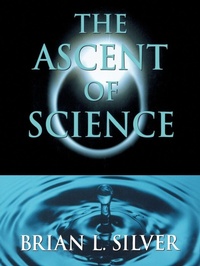
The Ascent of Science
Published on 16. March 2000
Book
Paperback/Softback
552 pages
978-0-19-513427-8 (ISBN)
Description
"Despite the shelves of 'popular' books on quantum mechanics, the Big Bang, chaos, black holes and so on," writes Brian Silver, "the average reader finds himself in a state akin to that of a medieval peasant attending mass in a great gothic cathedral: he is awed, he knows that something terribly important is being said, but he understands very little because it's all in Latin. He takes the wafer and remains mystified." In The Ascent of Science, Silver provides a sweeping and dynamic history of the whole of Western science, from the Renaissance to the present. In it, he translates the most profoundly important, and often impenetrably obscure, scientific developments into a vernacular that is not only accessible and illuminating but highly enjoyable as well.
In the tradition of Jacob Bronowski, Stephen Jay Gould, and Carl Sagan, Silver writes with extraordinary grace and sparkling wit--and with a comprehensiveness unparalleled in science writing. From the revolutionary discoveries of Galileo and Newton to the mind-bending theories of Einstein and Heisenberg; from plate tectonics to particle physics; from the origin of life to universal entropy; from biology to cosmology, Silver takes the reader on a guided tour not only of the history of science but of the very nature of scientific inquiry and its role in our society. Thus, while explaining with great clarity the scientific breakthroughs that have shaped and often shaken our world, Silver places each in a broad historical context and supplies a keen awareness of parallel developments in art, literature, music, politics and philosophy. He also argues forcefully that it is the open-mindedness of science, its ability to subject itself to continual validation, and its willingness to abandon scientific beliefs when they are undercut by new facts or better theories, that has accounted for the magnificent success of science. Silver does realize that science can have disastrous consequences--that breakthroughs in nuclear physics can lead to Hiroshimas--and he insists on a more fruitful dialogue between science and ethical philosophy, an insistence that takes on greater urgency given the current advances in genetics. But he ably defends the scientific method from recent arguments that characterize science as merely one more socially constructed and fatally flawed way of knowing, or that suggest that the Age of Science is nearing its end. Throughout the book, it is science as the height of human reason, and reason as the surest guide to truth, that enlivens the story of our emergence from ignorance and superstition to the ability to fathom the deepest mysteries of nature.
For anyone interested in but intimidated by the scientific enterprise, The Ascent of Science provides a vivid history of the discipline. That it does so without diminishing either the complexity or the awe-inspiring power of science is a major accomplishment, one that opens the door to humanity's greatest intellectual adventure and reveals the many ways science has altered forever the way we see the world and ourselves.
In the tradition of Jacob Bronowski, Stephen Jay Gould, and Carl Sagan, Silver writes with extraordinary grace and sparkling wit--and with a comprehensiveness unparalleled in science writing. From the revolutionary discoveries of Galileo and Newton to the mind-bending theories of Einstein and Heisenberg; from plate tectonics to particle physics; from the origin of life to universal entropy; from biology to cosmology, Silver takes the reader on a guided tour not only of the history of science but of the very nature of scientific inquiry and its role in our society. Thus, while explaining with great clarity the scientific breakthroughs that have shaped and often shaken our world, Silver places each in a broad historical context and supplies a keen awareness of parallel developments in art, literature, music, politics and philosophy. He also argues forcefully that it is the open-mindedness of science, its ability to subject itself to continual validation, and its willingness to abandon scientific beliefs when they are undercut by new facts or better theories, that has accounted for the magnificent success of science. Silver does realize that science can have disastrous consequences--that breakthroughs in nuclear physics can lead to Hiroshimas--and he insists on a more fruitful dialogue between science and ethical philosophy, an insistence that takes on greater urgency given the current advances in genetics. But he ably defends the scientific method from recent arguments that characterize science as merely one more socially constructed and fatally flawed way of knowing, or that suggest that the Age of Science is nearing its end. Throughout the book, it is science as the height of human reason, and reason as the surest guide to truth, that enlivens the story of our emergence from ignorance and superstition to the ability to fathom the deepest mysteries of nature.
For anyone interested in but intimidated by the scientific enterprise, The Ascent of Science provides a vivid history of the discipline. That it does so without diminishing either the complexity or the awe-inspiring power of science is a major accomplishment, one that opens the door to humanity's greatest intellectual adventure and reveals the many ways science has altered forever the way we see the world and ourselves.
Reviews / Votes
Silver, a physical chemist, is good on the molecular basis of thermodynamics * Nature * it's by far the most eccentric, opinionated and bizarre I've come across. It is also one of the best * New Scientist * succeeds handsomely in presenting most of the big ides in science, together with a stimulating overview of its history and some well-informed commedntary on science in the 1990s * New Scientist * The Ascent of Science is an intriguingly orginal introduction to science and will be a boon to those of us who make a living out of making science accessible to nonspecialists...many teachers of Science for Poets course, so popular in the US, will find plenty of rewarding ideas here, not least Silver's outspoken views on current science policy * New Scientist * Most enjoyable of all is Silver's spicy accessible style * New Scientist * Brian Silver's book is an enormously ambitious project,and might well be subtitled "Everything you always wanted to know about science" * Physics World * this book is a wonderful refresher course; it is full of unexpected bits of history and is remarkably readable * Physics World * a fine book, explaining what it covers with care, thoughtfulness what it covers with care, thoughtfulness and wit * Physics World * Silver's wicked way with words explains the most important discoveries of science in everyday language and periodically illustrates the points with reference to contemporary culture....Throughout this mighty book I was laughing....I shall never think about atoms in the same way again!...By the breadth and vision of his book, the power of his pen, his ability to explain extraordinary and difficult concepts by reference to the ordinary and the ability to appear to lose that sense of awe and wonderment at the greatness of it all...pass it on to your scientifically illiterate friends. Stand proud. And admit that yes, you too are a scientist s ChemWeb Inc - Paul Board Silver writes with extraordinary grace and sparkling wit - and with a comprehensiveness unparalleled in science writing. * Research and Innovation *More details
Language
English
Place of publication
New York
United States
Illustrations
75 Schaubilder
line figures
Dimensions
Height: 280 mm
Width: 210 mm
Thickness: 30 mm
Weight
1342 gr
ISBN-13
978-0-19-513427-8 (9780195134278)
Copyright in bibliographic data and cover images is held by Nielsen Book Services Limited or by the publishers or by their respective licensors: all rights reserved.
Schweitzer Classification
Other editions
Additional editions
Brian L. Silver
The Ascent of Science
E-Book
12/2000
1st Edition
Oxford University Press
€15.49
Available for download
Brian L. Silver
The Ascent of Science
E-Book
04/2000
1st Edition
OUP eBook
€15.49
Available for download
Person
Brian Silver was Professor of Physical Chemistry, Israel Institute of Technology (now deceased)
Content
Preface ; Introduction ; Part 1 ; 1. Newton Gets It Completely Wrong ; 2. I Believe ; Part 2 ; 3. Thomas Aquinas Vs. Neil Armstrong ; 4. The Second Law ; 5. Predicting Catstrophe ; 6. From Newton to de Sade - The Partial Triumph of Reason ; 7. From Rousseau to Blake - The Revolt Against Reason ; Part 3 ; 8. Lodestone, Amber, and Lightning ; 9. Belief and Action ; Part 4 ; 10. The Demise of Alchemy ; 11. The Nineteenth Century ; 12. The Material Trinity - The Atom ; 13. The Stuff of Existence ; 14. Scipio's Dream ; Part 5 ; 15. Making Waves ; 16. The Ubiquity of Motion ; 17. Energy ; 18. Entropy - Intimations of Immortality ; 19. Chaos ; Part 6 ; 20. The Slow Birth of Biology ; 21. In A Monastery Garden ; 22. Evolution ; 23. The Descent of Man ; 24. The Gene Machine ; 25. The Lords of Nature? ; 26. Life - The Molecular Battle ; 27. The Origin of Life? Take your Choice ; Part 7 ; 28. The Inexplicable Quantum ; 29. New Ways of Thinking ; 30. The Land of Pradox ; 31. The Elementary Particles ; Part 8 ; 32. Relativity ; 33. Cosmology ; 34. The Cosmos and Peeping Tom ; 35. The Impossibility of Creation ; Part 9 ; 36. The Tree of Death ; 37. "What the Devil Does it All Mean?" ; Part 10 ; 38. The Future