

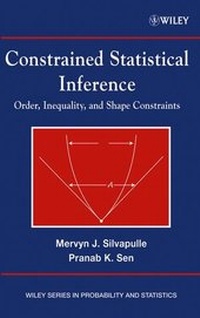
Constrained Statistical Inference
Order, Inequality, and Shape Constraints
Published on 19. November 2004
Book
Hardback
532 pages
978-0-471-20827-3 (ISBN)
Description
This volumes focuses on the theory of statistical inference under inequality constraints, providing a unified and up-to-date treatment of the methodology. The scope of applications of the presented methodology and theory in different fields is clearly illustrated by using examples from several areas, especially sociology, econometrics, and biostatistics. The authors also discuss a broad range of other inequality constrained inference problems, which do not fit well in the contemplated unified framework, providing meaningful access to comprehend methodological resolutions.
Reviews / Votes
"This monograph provides an excellent coverage of the last twenty years of constrained statistical inference." (Journal of the American Statistical Association, March 2006) "...an invaluable resource for any researcher with interests in constrained problems...it is easy to conclude that any statistical library would be incomplete without it." (Biometrics, December 2005)"...a valuable source of information for statisticians working in any area..." (Mathematical Reviews, 2005k)
More details
Series
Edition
1. Auflage
Language
English
Place of publication
United States
Publishing group
John Wiley & Sons Inc
Target group
Professional and scholarly
Product notice
sewn/stitched
Cloth over boards
Illustrations
Drawings: 24 B&W, 0 Color; Graphs: 31 B&W, 0 Color
Dimensions
Height: 240 mm
Width: 161 mm
Thickness: 34 mm
Weight
1000 gr
ISBN-13
978-0-471-20827-3 (9780471208273)
Schweitzer Classification
Other editions
Additional editions
Mervyn J. Silvapulle | Pranab Kumar Sen
Constrained Statistical Inference
Order, Inequality, and Shape Constraints
E-Book
09/2011
Wiley
€152.99
Available for download
Persons
MERVYN J. SILVAPULLE, PhD, is an Associate Professor in the Department of Statistical Science at La Trobe University in Bundoora, Australia. He received his PhD in statistics from the Australian National University in 1981.
PRANAB K. SEN, PhD, is a Professor in the Departments of Biostatistics and Statistics and Operations Research at the University of North Carolina at Chapel Hill. He received his PhD in 1962 from Calcutta University, India.
Content
Dedication.
Preface.
1. Introduction.
1.1 Preamble.
1.2 Examples.
1.3 Coverage and Organization of the Book.
2. Comparison of Population Means and Isotonic Regression.
2.1 Ordered Hypothesis Involving Population Means.
2.2 Test of Inequality Constraints.
2.3 Isotonic Regression.
2.4 Isotonic Regression: Results Related to Computational Formulas.
3. Two Inequality Constrained Tests on Normal Means.
3.1 Introduction.
3.2 Statement of Two General Testing Problems.
3.3 Theory: The Basics in 2 Dimensions.
3.4 Chi-bar-square Distribution.
3.5 Computing the Tail Probabilities of chi-bar-square Distributions.
3.6 Detailed Results relating to chi-bar-square Distributions.
3.7 LRT for Type A Problems: V is known.
3.8 LRT for Type B Problems: V is known.
3.9 Inequality Constrained Tests in the Linear Model.
3.10 Tests When V is known.
3.11 Optimality Properties.
3.12 Appendix 1: Convex Cones.
3.13 Appendix B. Proofs.
4. Tests in General Parametric Models.
4.1 Introduction.
2.2 Preliminaries.
4.3 Tests of R¸ = 0 against R¸ >= 0.
4.4 Tests of h(¸) = 0.
4.5 An Overview of Score Tests with no Inequality Constraints.
4.6 Local Score-type Tests of H_o : È = 0 vs H_1 : È epsis ¨.
4.7 Approximating Cones and Tangent Cones.
4.8 General Testing Problems.
4.9 Properties of the mle When the True Value is on the Boundary.
5. Likelihood and Alternatives.
5.1 Introduction.
5.2 The Union-Intersection principle.
5.3 Intersection Union Tests (IUT).
5.4 Nanparametrics.
5.5 Restricted Alternatives and Simes-type Procedures.
5.6 Concluding Remarks.
6. Analysis of Categorical Data.
6.1 Motivating Examples.
6.2 Independent Binomial Samples.
6.3 Odds Ratios and Monotone Dependence.
6.4 Analysis of 2 x c Contingency Tables.
6.5 Test to Establish that Treatment is Better than Control.
6.6 Analysis of r x c Tables.
6.7 Square Tables and Marginal Homogeneity.
6.8 Exact Conditional Tests.
6.9 Discussion.
7. Beyond Parametrics.
7.1 Introduction.
7.2 Inference on Monotone Density Function.
7.3 Inference on Unimodal Density Function.
7.4 Inference on Shape Constrained Hazard Functionals.
7.5 Inference on DMRL Functions.
7.6 Isotonic Nonparametric Regression: Estimation.
7.7 Shape Constraints: Hypothesis Testing.
8. Bayesian Perspectives.
8.1 Introduction.
8.2 Statistical Decision Theory Motivations.
8.3 Stein's Paradox and Shrinkage Estimation.
8.4 Constrained Shrinkage Estimation.
8.5 PC and Shrinkage Estimation in CSI.
8.6 Bayes Tests in CSI.
8.7 Some Decision Theoretic Aspects: Hypothesis Testing.
9. Miscellaneous Topics.
9.1 Two-sample Problem with Multivariate Responses.
9.2 Testing that an Identified Treatment is the Best: The mini-test.
9.3 Cross-over Interaction.
9.4 Directed Tests.
Bibliography.
Index.