

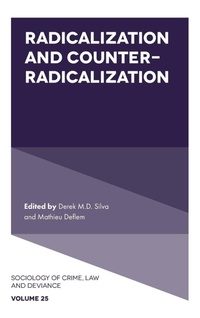
Radicalization and Counter-Radicalization
Published on 9. September 2020
Book
Hardback
304 pages
978-1-83982-989-5 (ISBN)
Description
The field of radicalization studies, which intersects within the fields of sociology, law, criminology, and criminal justice, focuses particularly on the social dynamics of terrorism from different theoretical, conceptual, and methodological perspectives. It is a fast-growing field in which many areas remain to be explored.
In Radicalization and Counter-Radicalization, Derek Silva and Mathieu Deflem have gathered an interdisciplinary team of leading experts to make a valuable contribution to the existing literature. This book covers themes such as the notion of risk, security, and surveillance, crime and deviance, gender, political propaganda, media, and cultural representations of radicalization. The volume is divided into theoretical and epistemological interventions aimed at understanding radicalization and counter-radicalization, the historical origins of radicalization, how scholars within the social sciences measure processes and pathways toward radicalization, the policing of, and law enforcement strategies aimed at, combatting radicalization, policy developments in the field of counter-radicalization, and discussions related to the future of radicalization studies within sociology, legal studies, and criminal justice.
For its breadth and depth of research, this volume of Sociology of Crime, Law and Deviance is essential reading for researchers and students of, law, criminology, and criminal justice.
In Radicalization and Counter-Radicalization, Derek Silva and Mathieu Deflem have gathered an interdisciplinary team of leading experts to make a valuable contribution to the existing literature. This book covers themes such as the notion of risk, security, and surveillance, crime and deviance, gender, political propaganda, media, and cultural representations of radicalization. The volume is divided into theoretical and epistemological interventions aimed at understanding radicalization and counter-radicalization, the historical origins of radicalization, how scholars within the social sciences measure processes and pathways toward radicalization, the policing of, and law enforcement strategies aimed at, combatting radicalization, policy developments in the field of counter-radicalization, and discussions related to the future of radicalization studies within sociology, legal studies, and criminal justice.
For its breadth and depth of research, this volume of Sociology of Crime, Law and Deviance is essential reading for researchers and students of, law, criminology, and criminal justice.
More details
Series
Language
English
Place of publication
Bingley
United Kingdom
Target group
Professional and scholarly
Dimensions
Height: 235 mm
Width: 157 mm
Thickness: 21 mm
Weight
594 gr
ISBN-13
978-1-83982-989-5 (9781839829895)
Copyright in bibliographic data and cover images is held by Nielsen Book Services Limited or by the publishers or by their respective licensors: all rights reserved.
Schweitzer Classification
Other editions
Additional editions
Derek M.D. Silva | Mathieu Deflem
Radicalization and Counter-Radicalization
E-Book
09/2020
1st Edition
Emerald Publishing Limited
€98.99
Available for download
Persons
Derek M.D. Silva, Department of Sociology, King's University College at Western University (Canada), specializes in radicalization and violent extremism, policing, sport, and social control. His most recent work can be found in peer-reviewed journals Crime, Media, Culture, Punishment & Society, Sociological Forum, Race & Class, and the Sociology of Sport Journal.
Mathieu Deflem, Department of Sociology, University of South Carolina (USA), specializes in the sociology of social control, terrorism, policing, sociology of law, and sociological theory. He is the author of four books, including The Policing of Terrorism (Routledge, 2010) and Sociology of Law (Cambridge University Press, 2008).
Mathieu Deflem, Department of Sociology, University of South Carolina (USA), specializes in the sociology of social control, terrorism, policing, sociology of law, and sociological theory. He is the author of four books, including The Policing of Terrorism (Routledge, 2010) and Sociology of Law (Cambridge University Press, 2008).
Content
PART I. THEORETICAL AND CONCEPTUAL ADVANCES
Chapter 1. Does deradicalization work?; John Horgan, Katharina Meredith, and Katerina Papatheodorou
Chapter 2. Navigating radicalization concepts: a role for the harm principle; Keiran Hardy
Chapter 3. Radicalization as transformative learning: a theoretical and illustrative exploration; Alex Wilner and Claire-Jehanne Dubouloz;
Chapter 4. Advances in violent extremist risk analysis; Paul Gill, Zoe Marchment, Sanaz Zolghadriha, Nadine Salman, Bettina Rottweiler, Caitlin Clemmow, and Isabelle Van Der Vegt;
PART II. STATE AND CIVIL SOCIETY
Chapter 5. Counter-radicalization as civic integration; Therese o' Toole;
Chapter 6. The role of state violence in the adoption of terrorism; Stephen Chicoine
Chapter 7. The securitization of Muslim civil society in Canada; Fahad Ahmad;
Chapter 8. Countering violent extremism, safeguarding and the law: a practitioner's perspective on protecting young and vulnerable people from exploitation; Carys Evans
PART III. THE ONLINE SPACE AND RADICALIZATION
Chapter 9. Clearing the smoke and breaking the mirrors: using attitudinal inoculation to challenge online disinformation by extremists; Kurt Braddock
Chapter 10. Learning to hate: explaining participation in online extremism; James Hawdon and Matthew Costello
Chapter 11. Hatred she wrote: a comparative topic analysis of extreme right and Islamic state women-only forums; Ayse Lokmanoglu and Yannick Veilleux-Lepage
PART IV. FORMER EXTREMISTS, PREVENTION, AND PUNISHMENT
Chapter 12. Former extremists in radicalization and counter-radicalization research; Ryan Scrivens, Steven Windisch, and Pete Simi;
Chapter 13. Examining & prevent' from a former combatant perspective; Tom Pettinger
Chapter 14. Engagement, desistance, and revolt: what do we know about terrorists who turn into informants?; Stefano Bonino
Chapter 15. "We wouldn't let known terrorists live here": impediments to radicalization in western Canadian prisons; William Schultz, Sandra M. Bucerius, and Kevin D. Haggerty
Chapter 1. Does deradicalization work?; John Horgan, Katharina Meredith, and Katerina Papatheodorou
Chapter 2. Navigating radicalization concepts: a role for the harm principle; Keiran Hardy
Chapter 3. Radicalization as transformative learning: a theoretical and illustrative exploration; Alex Wilner and Claire-Jehanne Dubouloz;
Chapter 4. Advances in violent extremist risk analysis; Paul Gill, Zoe Marchment, Sanaz Zolghadriha, Nadine Salman, Bettina Rottweiler, Caitlin Clemmow, and Isabelle Van Der Vegt;
PART II. STATE AND CIVIL SOCIETY
Chapter 5. Counter-radicalization as civic integration; Therese o' Toole;
Chapter 6. The role of state violence in the adoption of terrorism; Stephen Chicoine
Chapter 7. The securitization of Muslim civil society in Canada; Fahad Ahmad;
Chapter 8. Countering violent extremism, safeguarding and the law: a practitioner's perspective on protecting young and vulnerable people from exploitation; Carys Evans
PART III. THE ONLINE SPACE AND RADICALIZATION
Chapter 9. Clearing the smoke and breaking the mirrors: using attitudinal inoculation to challenge online disinformation by extremists; Kurt Braddock
Chapter 10. Learning to hate: explaining participation in online extremism; James Hawdon and Matthew Costello
Chapter 11. Hatred she wrote: a comparative topic analysis of extreme right and Islamic state women-only forums; Ayse Lokmanoglu and Yannick Veilleux-Lepage
PART IV. FORMER EXTREMISTS, PREVENTION, AND PUNISHMENT
Chapter 12. Former extremists in radicalization and counter-radicalization research; Ryan Scrivens, Steven Windisch, and Pete Simi;
Chapter 13. Examining & prevent' from a former combatant perspective; Tom Pettinger
Chapter 14. Engagement, desistance, and revolt: what do we know about terrorists who turn into informants?; Stefano Bonino
Chapter 15. "We wouldn't let known terrorists live here": impediments to radicalization in western Canadian prisons; William Schultz, Sandra M. Bucerius, and Kevin D. Haggerty