

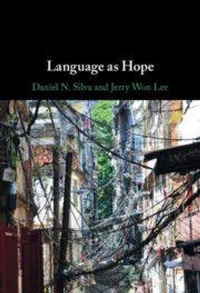
Language as Hope
Published on 1. February 2024
Book
Hardback
200 pages
978-1-009-30652-2 (ISBN)
Description
Although it feels like we live in a time of seeming hopelessness, this pioneering book illustrates what language can teach us about the practice, logic, and feasibility of hope in the twenty-?rst century. Silva and Lee highlight how people living in Brazilian urban peripheries, who have grown accustomed to unrelenting prejudice and violence on an everyday basis, use language to survive and imagine futures that are worth aspiring to. In so doing, this book foregrounds how language becomes a matter of survival for these communities. It provides a thorough theorization of how language can produce conditions of hope, moving away from the idea of language merely as a tool of communication and toward something that can meaningfully impact social realities. Innovative and engaging, it is essential reading for researchers and students in applied linguistics, sociolinguistics and linguistic anthropology. This title is also available as open access on Cambridge Core.
Reviews / Votes
'Consider the variety of language-games we play: forming and testing hypotheses; making up stories; offending; humiliating ... hoping. This volume argues compellingly for the centrality of language in the study of hope. By focusing on those who dare to hope amidst all forms of contemporary violence, it will certainly provide deep sources of inspiration to imagine new paths forward.' Branca Falabella Fabricio, Associate Professor, Universidade Federal do Rio de Janeiro 'With rare theoretical and ethnographic finesse, Silva and Lee show that hope isn't merely expressed through language. Language is itself a reason for hope - a form of practical reasoning with which speakers regenerate shattered worlds. Hope, thus, must be a prime focus of sociolinguists' attention if we want to understand how lives are lived against the vicious forces of capital and neoliberalism. This book enlivens sociolinguistics and makes one feel hopeful about its future.' Rodrigo Borba, Associate Professor of Applied Linguistics, Universidade Federal do Rio de Janeiro 'Language as Hope creatively fuses new literatures in sociolinguistics with insights forged by 'citizen sociolinguistics' in Brazilian favelas. Its careful argumentation and bold confrontation of the politics of oppression and despair challenge scholars to join their interlocutors in creating more just, hopeful worlds.' Charles L. Briggs, author of Unlearning: Rethinking Poetics, Pandemics, and the Politics of Knowledge 'Through this account, Silva & Lee demonstrate how language provides a unique perspective to understand hope as both the reason and resource for social change. Their work teaches us about hoping in hopelessness and how researchers can trace this process through individuals' most intricate and high-stakes social pursuits.' Yunpeng Du, Language in SocietyMore details
Language
English
Place of publication
Cambridge
United Kingdom
Target group
College/higher education
Product notice
sewn/stitched
Cloth over boards
Illustrations
Worked examples or Exercises
Dimensions
Height: 229 mm
Width: 152 mm
Thickness: 13 mm
Weight
435 gr
ISBN-13
978-1-009-30652-2 (9781009306522)
Copyright in bibliographic data and cover images is held by Nielsen Book Services Limited or by the publishers or by their respective licensors: all rights reserved.
Schweitzer Classification
Other editions
Additional editions
Daniel N. Silva | Jerry Won Lee
Language as Hope
Book
08/2025
Cambridge University Press
€28.50
Available immediately
Daniel N. Silva | Jerry Won Lee
Language as Hope
E-Book
01/2024
Cambridge University Press
€117.99
Available for download
Daniel N. Silva | Jerry Won Lee
Language as Hope
E-Book
01/2024
Cambridge University Press
€117.99
Available for download
Persons
Daniel N. Silva is a professor at the Universidade Estadual de Campinas - Unicamp, Brazil. His research focuses on language, violence, and hope in Rio de Janeiro's favelas.
Content
List of Figures; Acknowledgements; Notes on the Text; Introduction; 1. Language as Hope; 2. 'Pais do Futuro' and Present-Day Communities of Hope; 3. Hope in the Present; 4. The Enregisterment of Hope; 5. Scaling Hope; Conclusion; Bibliography; Index.