

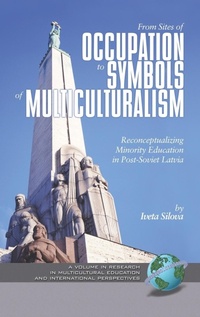
From Sites of Occupation to Symbols of Multiculturalism
Re-Conceptualizing Minority Education in Post-Soviet Latvia
Will be published approx. on 1. February 2006
Book
Hardback
256 pages
978-1-59311-462-6 (ISBN)
Description
Rarely do we find books in educational research that are both thick in context and rich in theory. Usually books emphasize one over the other. Authors that engage in thick descriptions tend to fall short of explaining what larger theoretical issue their case stands for. Vice versa, authors who make a case for a particular theory do not always describe their case in sufficient detail. From Sites to Occupation to Symbols of Multiculturalism is a remarkable exception. The book is a major break-through in case study methodology, multiculturalism and policy borrowing/lending research.
The book investigates a puzzle: how is it that one and the same system, the system of separate schooling for Latvian and Russian speakers, is seen as a site of occupation during one period (1987-1990) and as a symbol of multiculturalism in the next (1991-1999)? The system has stayed in place, but the meaning attached to it has been completely inverted. Is cultural change without structural change possible? Does it mean that the dual school system has become anachronistic, and will eventually disappear in light of the cultural changes of the past decade? The book is the story of a great metamorphosis of one and the same system of separate schooling that, at first unbelievable, gradually makes sense.
The book investigates a puzzle: how is it that one and the same system, the system of separate schooling for Latvian and Russian speakers, is seen as a site of occupation during one period (1987-1990) and as a symbol of multiculturalism in the next (1991-1999)? The system has stayed in place, but the meaning attached to it has been completely inverted. Is cultural change without structural change possible? Does it mean that the dual school system has become anachronistic, and will eventually disappear in light of the cultural changes of the past decade? The book is the story of a great metamorphosis of one and the same system of separate schooling that, at first unbelievable, gradually makes sense.
More details
Series
Language
English
Place of publication
Charlotte
United States
Publishing group
Emerald Publishing Inc
Target group
College/higher education
Professional and scholarly
Dimensions
Height: 240 mm
Width: 161 mm
Thickness: 18 mm
Weight
552 gr
ISBN-13
978-1-59311-462-6 (9781593114626)
Copyright in bibliographic data and cover images is held by Nielsen Book Services Limited or by the publishers or by their respective licensors: all rights reserved.
Schweitzer Classification
Other editions
Additional editions
Iveta Silova
From Sites of Occupation to Symbols of Multiculturalism
Re-Conceptualizing Minority Education in Post-Soviet Latvia
E-Book
03/2006
1st Edition
Information Age Publishing
from
€62.33
Available for download
Content
List of Acronyms.
List of Tables.
List of Figures.
Foreword; Gita Steiner-Khamsi.
Acknowledgments.
Introduction: Between The (Soviet) Past and The (Western) Future: Education Reform During Political Transformation.
Chapter 1. Legacies of the Past: The Historical Context of Minority Education Reform.
Chapter 2. Re-Creating European Space in Latvian Education.
Chapter 3. The New Meanings of Minority Education During the Transition Period: Global Pressures, Local Politics, and Conceptual Disputes.
Chapter 4. Institutionalizing Integration in Education Policy and Practice: Rebellion Under the Radar.
Chapter 5. Education Reform at a Crossroads: Broken Promises, Lost Opportunities.
Conclusion: Reconciling International Pressures with Domestic Politics: The "National Problem" Re-Conceptualized.
List of Tables.
List of Figures.
Foreword; Gita Steiner-Khamsi.
Acknowledgments.
Introduction: Between The (Soviet) Past and The (Western) Future: Education Reform During Political Transformation.
Chapter 1. Legacies of the Past: The Historical Context of Minority Education Reform.
Chapter 2. Re-Creating European Space in Latvian Education.
Chapter 3. The New Meanings of Minority Education During the Transition Period: Global Pressures, Local Politics, and Conceptual Disputes.
Chapter 4. Institutionalizing Integration in Education Policy and Practice: Rebellion Under the Radar.
Chapter 5. Education Reform at a Crossroads: Broken Promises, Lost Opportunities.
Conclusion: Reconciling International Pressures with Domestic Politics: The "National Problem" Re-Conceptualized.