

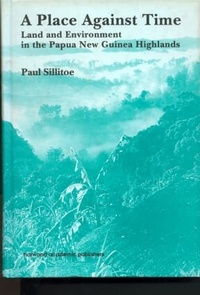
A Place Against Time
Land and Environment in the Papua New Guinea Highlands
1st Edition
Published on 15. January 1997
Book
Hardback
464 pages
978-3-7186-5925-8 (ISBN)
Description
A Place Against Time is an ethnographically focused environmental study of Montane, New Guinea, where people were among the world's first to cultivate crops some ten millennia ago, and where today an enduring agricultural condition continues. It arranges its account of climate, vegetation topography and geology according to their relationship with the soils of the region occupied by Wola speakers in the Southern Highlands Province of Papua New Guinea, in the Western Pacific. This book breaks new intellectual ground as an ethno-environmental investigation with a soils perspective, ethno-pedology being a little researched topic to date.
Reviews / Votes
'Probably the most comprehensive, ethnographically rich environmental anthropology book ever written. It has the scope of classic works by Malinowski, with a much greater knowledge of ecology. I do not recall being as impressed by the ethnographic depth and the sophistication of environmental expertise in decades.' - Emilio Moran, Indiana University in American AnthropologistMore details
Series
Language
English
Place of publication
Chur
Switzerland
Target group
College/higher education
Dimensions
Height: 246 mm
Width: 174 mm
Weight
1224 gr
ISBN-13
978-3-7186-5925-8 (9783718659258)
Copyright in bibliographic data and cover images is held by Nielsen Book Services Limited or by the publishers or by their respective licensors: all rights reserved.
Schweitzer Classification
Other editions
Additional editions
Book
05/2016
1st Edition
Routledge
€59.60
Shipment within 10-20 days
E-Book
10/2013
1st Edition
Routledge
€41.99
Available for download
E-Book
10/2013
1st Edition
Routledge
€41.99
Available for download
Person
Paul Sillitoe
Content
I: Introduction; 1: Environmental Ethnoscience: Land Use, Soils and Society; 2: Rotating Land not Crops: Shifting Cultivation and Sweet Potato; II: The Climate Factor; 3: Ethnometeorology: The Climate; 4: Coping with Climatic Variations: The Spectre of Famine; III: The Land Resources Factor; 5: Ethnogeoscience: Topography and Geology; 6: Living with Land Loss: The Costs of Erosion; IV: The Biotic Factors; 7: Ethnobotany: Plants and Vegetation Communities; 8: Contending with Forest and Fallow: Demons to Regrowth; 9: Into the Soil: Nutrient Cycling and Decomposition; V: The Soil; 10: Ethnopedology: The Soils; 11: Keeping Up with Soil Status: The Implications of Variability; 12: Out of the Soil: Fertility Under Cultivation; VI: Conclusion; 13: Mounds of Soil: Grounds for Sound Land Resource Management; 14: Racing with Time: Degradation or Conservation?