

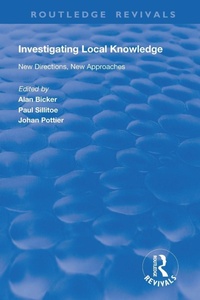
Investigating Local Knowledge
New Directions, New Approaches
1st Edition
Published on 7. December 2020
Book
Paperback/Softback
252 pages
978-1-138-35618-4 (ISBN)
Description
Originally published in 2004. Local knowledge reflects many generations of experience and problem solving by people around the world, increasingly affected by globalizing forces. Such knowledge is far more sophisticated than development professionals previously assumed and, as such, represents an immensely valuable resource. A growing number of governments and international development agencies are recognizing that local-level knowledge and organizations offer the foundation for new participatory models of development that are both cost-effective and sustainable, and ecologically and socially sound.
This book provides a timely overview of new directions and new approaches to investigating the role of rural communities in generating knowledge founded on their sophisticated understandings of their environments, devising mechanisms to conserve and sustain their natural resources, and establishing community-based organizations that serve as forums for identifying problems and dealing with them through local-level experimentation, innovation, and exchange of information with other societies. These studies show that development activities that work with and through local knowledge and organizations have several important advantages over projects that operate outside them. Local knowledge informs grassroots decision-making, much of which takes place through indigenous organizations and associations at the community level as people seek to identify and determine solutions to their problems.
This book provides a timely overview of new directions and new approaches to investigating the role of rural communities in generating knowledge founded on their sophisticated understandings of their environments, devising mechanisms to conserve and sustain their natural resources, and establishing community-based organizations that serve as forums for identifying problems and dealing with them through local-level experimentation, innovation, and exchange of information with other societies. These studies show that development activities that work with and through local knowledge and organizations have several important advantages over projects that operate outside them. Local knowledge informs grassroots decision-making, much of which takes place through indigenous organizations and associations at the community level as people seek to identify and determine solutions to their problems.
More details
Series
Language
English
Place of publication
London
United Kingdom
Publishing group
Taylor & Francis Ltd
Target group
College/higher education
Dimensions
Height: 234 mm
Width: 156 mm
Thickness: 14 mm
Weight
389 gr
ISBN-13
978-1-138-35618-4 (9781138356184)
Copyright in bibliographic data and cover images is held by Nielsen Book Services Limited or by the publishers or by their respective licensors: all rights reserved.
Schweitzer Classification
Other editions
Additional editions
Book
06/2019
1st Edition
Routledge
€215.41
Shipment within 15-20 days
E-Book
05/2019
1st Edition
Routledge
€47.49
Available for download
E-Book
05/2019
1st Edition
Routledge
€47.49
Available for download
Person
Paul Sillitoe
Content
1. Local knowledge theory and methods: an urban model from Indonesia, Christoph Antweiler. 2. Doing and knowing: questions about studies of local knowledge, Andrew P. Vayda, Bradley B. Walters and Indah Setyawati. 3. A decision model for the incorporation of indigenous knowledge into development projects, Paul Sillitoe and Julian Barr. 4. Triangulation with tecnicos: a method for rapid assessment of local knowledge, Jeffery W. Bentley, Eric Boa, Percy Vilca and John Stonehouse. 5. Local history as 'indigenous knowledge': aeroplanes, conservation and development in Haia and Maimafu, Papua New Guinea, David Ellis and Paige West. 6. The INGO, the project and the investigation of 'indigenous knowledge': the case of non-timber forest product (NTFP), Sebastian Taylor. 7. Indigenous views on the terms of participation in the development of biodiversity conservation in Nepal, Ben Campbell. 8. Negotiating change, maintaining continuity: science education and indigenous knowledge in Eastern Canada, Trudy Sable. 9. The re-emergence of traditional medicine and health care in post-colonial India and national identity, Subhadra Mitra Channa. 10. In dialogue with indigenous knowledge: sharing research to promote empowerment of rural communities in India, R. Baumgartner, G.K. Karanth, G.S. Aurora and V. Ramaswamy.