

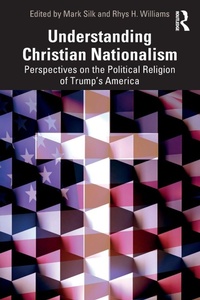
Understanding Christian Nationalism
Perspectives on the Political Religion of Trump's America
1st Edition
Will be published approx. on 19. June 2026
Book
Paperback/Softback
260 pages
978-1-041-08492-1 (ISBN)
Description
Offering the first comprehensive, interdisciplinary account of what Christian nationalism in America is and isn't, and how it became the political religion of Donald Trump's MAGA movement, the chapters in this book describe the way Christian nationalism has embedded itself in American politics.
Understanding Christian Nationalism emphasizes that Christian nationalism's sacralization of the United States must be seen against the backdrop of American civil religion, which since the founding of the republic has represented the country in sacred terms that transcend political partisanship. By contrast, partisanship is central to the Christian nationalist enterprise. Although Christian nationalist politics can be found in the nineteenth century, this book shows that the Christian nationalism experienced in today's America derives from the rise of the religious right in the late 1970s. Adapting civil religious language to advance the electoral success of the Republican Party, the religious right set the stage for the MAGA movement by promoting the restoration of a country dominated by White, heterosexual men, when Protestant Christianity enjoyed favored status as the country's effective religious establishment. This collection makes clear that the use of religious language to characterize the United States is not exclusively an expression of Christian nationalism. It also demonstrates that many Christian nationalists in America see themselves as part of an international movement to restore Christian values around the world.
Featuring chapters that use historical methods, media analysis, survey data, interviews, and ethnographic observations, this book is essential to students, instructors, and readers in sociology, social theory, sociology of religion, cultural sociology, US history, and politics to understand the Christian nationalism integral to Trump's appeal and electoral success.
Understanding Christian Nationalism emphasizes that Christian nationalism's sacralization of the United States must be seen against the backdrop of American civil religion, which since the founding of the republic has represented the country in sacred terms that transcend political partisanship. By contrast, partisanship is central to the Christian nationalist enterprise. Although Christian nationalist politics can be found in the nineteenth century, this book shows that the Christian nationalism experienced in today's America derives from the rise of the religious right in the late 1970s. Adapting civil religious language to advance the electoral success of the Republican Party, the religious right set the stage for the MAGA movement by promoting the restoration of a country dominated by White, heterosexual men, when Protestant Christianity enjoyed favored status as the country's effective religious establishment. This collection makes clear that the use of religious language to characterize the United States is not exclusively an expression of Christian nationalism. It also demonstrates that many Christian nationalists in America see themselves as part of an international movement to restore Christian values around the world.
Featuring chapters that use historical methods, media analysis, survey data, interviews, and ethnographic observations, this book is essential to students, instructors, and readers in sociology, social theory, sociology of religion, cultural sociology, US history, and politics to understand the Christian nationalism integral to Trump's appeal and electoral success.
Reviews / Votes
"Christian nationalism is one of the most consequential topics in the social scientific study of religion and politics. At present, however, much of the research on this topic has been exclusively quantitative and focused on recent data. Missing from this research are accounts of Christian nationalism that place it in a broader social and historical context, or that consider its diverse expressions across different faith communities. This book addresses both shortcomings, making it a valuable contribution to work in this area."Joseph O. Baker, Professor of Sociology, East Tenneesee State University
"This book directly addresses two of the most important concepts for understanding the connection between religion and politics. However, no good account to date relates these concepts historically or theoretically. This book does exactly that from multiple comparative angles. The first, historical section uses historical development to find roots of Christian Nationalism without projecting the contemporary concept backward. The second section, focused on distinct religious traditions, turns our attention beyond the usual suspects of the generic term 'white evangelicals.' The book's contributors are not only top notch, but they represent an interdisciplinary range of voices that have rarely been brought together. This volume should go a long way toward facilitating crucial cross-disciplinary discussion in a very focused, productive way. This book is quite exciting for these reasons!"
Gary A. Adler, Jr., Associate Professor of Sociology, Penn State University
"Featuring a stellar lineup of distinguished scholars tracing the evolution of faith-based social conservatism over the last half-century, this outstanding volume demonstrates how Christian nationalism has emerged as a totalistic political theology. American civil religion has long functioned as a wide, inclusive umbrella, extending a shared moral canopy over the nation. Christian nationalism, by contrast, operates as a fortress-defining who belongs within the nation and who is excluded. With extraordinary depth and range, this volume is an indispensable resource for understanding the sacralization of modern partisan politics."
Gerardo Marti, William R. Kenan, Jr. Professor of Sociology at Davidson College and author of American Blindspot: Race, Class, Religion, and the Trump Presidency
"The authors bring conceptual clarity, and an oft-neglected historical and institutional focus, to the study of contemporary white Christian nationalism in the US. An important work that sharpens the distinctions between MAGA-movement religious nationalism and other American expressions of politicized religion, including civil religion and Black religious nationalism. A must read for students of religion and politics in the United States."
Penny Edgell, Professor of Sociology at the University of Minnesota. Editor of Religion is Raced, and the author of Congregations in Conflict: Cultural Models of Local Religious Life and Religion and Family in a Changing Society
"This volume offers a welcome intervention into current debates over Christian nationalism and its influence on American politics. Bringing together leading scholars from across several disciplines-including history, sociology, political science, and religious studies-the essays collected here provide a historically grounded, analytically rigorous, and politically sober examination of American Christian nationalism's origins, ideology, and institutional structures, and its role as the political religion of the contemporary MAGA movement."
Jerome Copulsky, Berkeley Center for Religion, Peace, and World Affairs, Georgetown University, USA
More details
Language
English
Place of publication
London
United Kingdom
Publishing group
Taylor & Francis Ltd
Target group
College/higher education
Professional and scholarly
Academic, Postgraduate, and Undergraduate Advanced
Illustrations
2 s/w Tabellen, 6 s/w Abbildungen, 6 s/w Zeichnungen
2 Tables, black and white; 6 Line drawings, black and white; 6 Illustrations, black and white
Dimensions
Height: 232 mm
Width: 156 mm
Thickness: 17 mm
Weight
436 gr
ISBN-13
978-1-041-08492-1 (9781041084921)
Copyright in bibliographic data and cover images is held by Nielsen Book Services Limited or by the publishers or by their respective licensors: all rights reserved.
Schweitzer Classification
Other editions
Additional editions
Mark Silk | Rhys H. Williams
Understanding Christian Nationalism
Perspectives on the Political Religion of Trump's America
E-Book
approx. 06/2026
Routledge
€55.49
Available for download
Mark Silk | Rhys H. Williams
Understanding Christian Nationalism
Perspectives on the Political Religion of Trump's America
Book
approx. 06/2026
1st Edition
Routledge
€191.50
Not yet published
Mark Silk | Rhys H. Williams
Understanding Christian Nationalism
Perspectives on the Political Religion of Trump's America
E-Book
approx. 06/2026
Routledge
€55.49
Available for download
Persons
Mark Silk is Professor Emeritus of Religion in Public Life at Trinity College in Hartford, Connecticut, where he served as Director of the Leonard E. Greenberg Center for the Study of Religion in Public Life. Since 2012 he has been a columnist and contributing editor at the Religion News Service. His most recent book, with Jerome A. Chanes, is The Future of Judaism in America (2023).
Rhys H. Williams is Professor Emeritus of Sociology from Loyola University, Chicago, Illinois and Visiting Scholar in Sociology at the University of Massachusetts, Amherst. His most recent book, with R. Haberski and P. Goff, is Civil Religion Today: Religion and the American Nation in the Twenty-First Century (2021).
Rhys H. Williams is Professor Emeritus of Sociology from Loyola University, Chicago, Illinois and Visiting Scholar in Sociology at the University of Massachusetts, Amherst. His most recent book, with R. Haberski and P. Goff, is Civil Religion Today: Religion and the American Nation in the Twenty-First Century (2021).
Content
Introduction: Making Sense of Christian Nationalism; Part 1: Historical Perspectives; 1. "Christian Nationalism" and "Civil Religion" in the Nineteenth Century; 2. One Nation Under God? The Rise and Decline of Civil Religion in Mid-Twentieth Century America; 3. A Restorationist Political Religion; 4. The Tea Party Movement as Gateway to White Christian Nationalism; Part 2: Key Religious Traditions; 5. Southern Baptists and the Evolution of White Evangelical Politics; 6. "Pick One of Those Pieces Up and Begin Again": The New Integralism and the Persistence of a Dream of Christendom; 7. "God bless the Red, White, and Blue": Eastern Orthodoxy and Internationalization of Christian Nationalism; 8. "A Vision for America That Includes All of Us": Black Christian Universalism vs. White Christian Nationalism with a Meditation on Black Nation-Consciousness; Part 3: The Contemporary Scene; 9. You Got Your Political Religion in my Civil Religion! The Development of Christian Nationalist Belief Networks in the United States; 10. Religious Language in Progressive Politics: From Civil Religion to Moral Redistribution; 11. Civil Religion vs. Christian Nationalism: A Distinction with a Difference and Why it Matters; 12. How Joe Biden's "Build Back Better" Failed to Build Back the Old-Time Civil Religion; Conclusion: Looking Forward; Appendix