

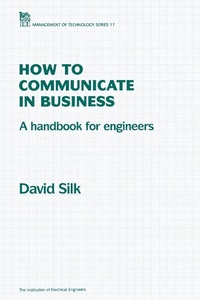
How to Communicate in Business
A handbook for engineers
Published on 15. November 1995
Book
Paperback/Softback
176 pages
978-0-85296-878-9 (ISBN)
Description
This is a practical handbook. Its aim is to help engineers and others with a technical background to communicate effectively with non-technical people. Effective communication is essential for both individual and corporate success in business.
The book gives a framework for planning a business communication: deciding its purpose, aim, scope and structure. It deals with spoken and written communication, with presentations and meetings, and with the use of modern IT systems. There are questions to help you use the book effectively and to construct an action plan for further reading.
Effective communication is a skill: we can all do better if we try. This book will help you to improve, thus bridging some of the common barriers in business.
The book gives a framework for planning a business communication: deciding its purpose, aim, scope and structure. It deals with spoken and written communication, with presentations and meetings, and with the use of modern IT systems. There are questions to help you use the book effectively and to construct an action plan for further reading.
Effective communication is a skill: we can all do better if we try. This book will help you to improve, thus bridging some of the common barriers in business.
More details
Series
Language
English
Place of publication
Stevenage
United Kingdom
Target group
Professional and scholarly
Product notice
Paperback (trade)
Unsewn / adhesive bound
Dimensions
Height: 234 mm
Width: 156 mm
Thickness: 9 mm
Weight
278 gr
ISBN-13
978-0-85296-878-9 (9780852968789)
Copyright in bibliographic data and cover images is held by Nielsen Book Services Limited or by the publishers or by their respective licensors: all rights reserved.
Schweitzer Classification
Person
David Silk graduated from Cambridge University and went on to become a research fellow at Queen's College, studying the control of communication networks. As an engineering officer in the RAF he specialised in telecommunications, and became a deputy director in the Ministry of Defence. In 1984 he joined Henley Management College, becoming the lead tutor in information management, a director of studies and a faculty group leader. In 1991 he left Henley to become an independent management consultant and tutor.
Dr Silk is an associate faculty member of Henley, and of Lancaster University. He has written widely about telecommunications, information management and general management: this is his fourth published book. He is a Fellow of the IEE.
Dr Silk is an associate faculty member of Henley, and of Lancaster University. He has written widely about telecommunications, information management and general management: this is his fourth published book. He is a Fellow of the IEE.
Content
Chapter 1: Introduction
Chapter 2: Communication and management
Chapter 3: Saying it
Chapter 4: Writing it
Chapter 5: Presenting it
Chapter 6: Business meetings
Chapter 7: Using information technology
Chapter 8: Conclusion
Chapter 2: Communication and management
Chapter 3: Saying it
Chapter 4: Writing it
Chapter 5: Presenting it
Chapter 6: Business meetings
Chapter 7: Using information technology
Chapter 8: Conclusion