

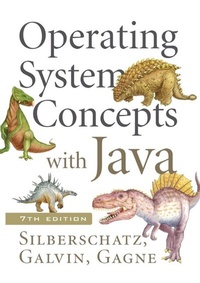
Operating System Concepts with Java
7th Edition
Published on 5. December 2006
Book
Hardback
992 pages
978-0-471-76907-1 (ISBN)
Description
Get inside today's most popular operating systems
How do today's operating systems work? The award-winning team of Abraham Silberschatz, Peter Galvin, and Greg Gagne gets you right up to speed on all the key concepts of computer operating systems. Employing the familiar Java programming language, this new edition of their popular guide gives you a thorough theoretical foundation that you can apply to a wide variety of systems as you progress to the next level of your computer work.
Operating System Concepts with Java, Seventh Edition, has been updated to cover the most current topics and applications and designed to help you bridge the gap between concepts and implementations. Integrating the client-server model throughout, the text takes you step-by-step through all the major aspects of programming, including:
* Several new Java example programs including features in Java 5.
* Increased coverage of user perspective in Chapter 1.
* Increased coverage of OS design throughout.
* A new chapter on real-time and embedded systems (Chapter 19).
* A new chapter on multimedia (Chapter 20).
* Additional coverage of security and protection.
* Additional coverage of distributed programming.
* New exercises, programming assignments, and projects at the end of each chapter.
* New student-focused pedagogy and a new two-color design to enhance the learning process.
* Linux, Windows XP, Mac OS X, and other influential operating systems.
Whether you're already adept at Java or new to it, you'll appreciate the Java Primer that's thoughtfully included. The two-color design makes it easier for you to navigate through the chapters, and a plethora of examples, programming exercises, and supplementary online tests and exercises (available through WileyPLUS) help you absorb and reinforce what you've learned. With such complete support, you'll soon be ready to enter the world of operating systems design with confidence.
More details
Edition
7., Auflage
Language
English
Place of publication
New York
United States
Publishing group
John Wiley and Sons Ltd
Target group
Professional and scholarly
Edition type
Revised edition
Dimensions
Height: 25.6 cm
Width: 18.8 cm
Thickness: 33 mm
Weight
1681 gr
ISBN-13
978-0-471-76907-1 (9780471769071)
Schweitzer Classification
Persons
Abraham Silberschatz is the Sidney J. Weinberg Professor and Chair of the Computer Science Department at Yale University. He is the former vice president of the Information Sciences Research Center at Bell Laboratories in Murray Hill, New Jersey. He previously held a chaired professorship in the Department of Computer Science at the University of Texas at Austin. He is an ACM Fellow and an IEEE Fellow. He received the 2002 IEEE Taylor L. Booth Education Award, the 1998 ACM Karl V. Karlstrom Outstanding Educator Award, the 1997 ACM SIGMOD Contribution Award, and the IEEE Computer Society Outstanding Paper award
Peter Baer Galvin is the chief technologist for Corporate Technologies of Burlington, Massachusetts, where he designs and implements complex computing facilities. Previously, he was systems manager for the department of Computer Science at Brown University. He speaks and teaches worldwide on the topics of system management, security, and performance. Mr. Galvin also writes a column on systems administration for SysAdmin Magazine, and is co-author of Operating System Concepts.
Greg Gagne is chair of the Computer Science department at Westminster College in Salt Lake City where he has been teaching since 1990. In addition to teaching operating systems, he also teaches courses in computer networks, distributed systems, and software engineering. He also provides workshops to computer science educators and industry professionals.
Content
* Introduction
* Operating System Structures
* Processes
* Threads
* CPU Scheduling
* Process Synchronization
* Deadlocks
* Memory Management
* Virtual Memory
* File System Interface
* File System Implementation
* Mass Storage Structure
* I/O Systems
* Protection
* Security
* Distributed System Structures
* Distributed File Systems
* Distributed Coordination
* Real-time and Embedded Systems
* Multimedia Systems
* The Linux System
* Windows XP
* Influential Operating Systems
Appendix A The FreeBSD System (online)
Appendix B The Mach System (online)
Appendix C The Nachos System (online)