

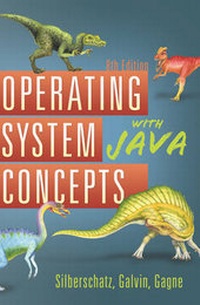
Operating System Concepts with Java
Published on 29. October 2009
Book
Hardback
1040 pages
978-0-470-50949-4 (ISBN)
Description
The award-winning team of Abraham Silberschatz, Peter Galvin, and Greg Gagne gets system administrators right up to speed on all the key concepts of computer operating systems. This new edition gives them a thorough theoretical foundation that they can apply to a wide variety of systems as they progress to the next level of their computer work. It presents several new Java example programs including features in Java 7. Increased coverage is offered on user perspective, OS design, security, and distributed programming. New exercises are also provided to reinforce the concepts and enable system administrators to design with confidence.
More details
Language
English
Place of publication
Chichester
United Kingdom
Publishing group
John Wiley and Sons Ltd
Target group
College/higher education
Dimensions
Height: 255 mm
Width: 186 mm
Thickness: 40 mm
Weight
1603 gr
ISBN-13
978-0-470-50949-4 (9780470509494)
Copyright in bibliographic data and cover images is held by Nielsen Book Services Limited or by the publishers or by their respective licensors: all rights reserved.
Schweitzer Classification
Persons
Abraham Silberschatz is the Sidney J. Weinberg Professor and
Chair of Computer Science at Yale University. Prior to joining
Yale, he was Vice President of the Information Sciences Research
Center at Bell Laboratories. Prior to that, he held a chaired
professorship in the Depart of Computer Sciences at the University
of Texas at Austin.
Professor Silberschatz is an ACM Fellow and an IEEE Fellow. He
received the 2002 IEEE Taylor L. Booth Education Award, the 1998
ACM Karl V. Karlstrom Outstanding Education Award, and the 1997 ACM
SIGMOD Contribution Award. In recognition of his outstanding level
of innovation and technical excellence, he was awarded the Bell
Laboratories President?s Award for three different Projects
? the QTM Project (1998), the DataBlitz Project (1999), and
the NetInventory Project (2004).
Professor Silberschatz?s writings have appeared in
numerous AVM and IEEE publications and other professional
conferences and journals. He is a coauthor of the textbook
Database Systems Concepts. He has also written Op-Ed
articles for the New York Times, the Boston Globe, and the Hartford
Courant, among others.
Peter Baer Galvin is the chief technologist for Corporate
Technologies (www.cptech.com),
a computer facility reseller and integrator. Before that, Mr.
Galvin was systems manager for Brown University?s Computer
Science Department. He is also Sun columnist for ;login: magazine.
Mr. Galvin has written articles for Byte and other magazines, and
has written columns for SunWorld and SysAdmin magazines. As a
consultant and trainer, he has given talks and taught tutorials on
security and system administration worldwide.
Greg Gagne is chair of the Computer Science department at
Westminister College in Salt Lake City where he has been teaching
since 1990. In addition to teaching operating systems, he also
teaches computer networks, distributed systems, and software
engineering. He also provides workshops to computer science
educators and industry professionals.
Chair of Computer Science at Yale University. Prior to joining
Yale, he was Vice President of the Information Sciences Research
Center at Bell Laboratories. Prior to that, he held a chaired
professorship in the Depart of Computer Sciences at the University
of Texas at Austin.
Professor Silberschatz is an ACM Fellow and an IEEE Fellow. He
received the 2002 IEEE Taylor L. Booth Education Award, the 1998
ACM Karl V. Karlstrom Outstanding Education Award, and the 1997 ACM
SIGMOD Contribution Award. In recognition of his outstanding level
of innovation and technical excellence, he was awarded the Bell
Laboratories President?s Award for three different Projects
? the QTM Project (1998), the DataBlitz Project (1999), and
the NetInventory Project (2004).
Professor Silberschatz?s writings have appeared in
numerous AVM and IEEE publications and other professional
conferences and journals. He is a coauthor of the textbook
Database Systems Concepts. He has also written Op-Ed
articles for the New York Times, the Boston Globe, and the Hartford
Courant, among others.
Peter Baer Galvin is the chief technologist for Corporate
Technologies (www.cptech.com),
a computer facility reseller and integrator. Before that, Mr.
Galvin was systems manager for Brown University?s Computer
Science Department. He is also Sun columnist for ;login: magazine.
Mr. Galvin has written articles for Byte and other magazines, and
has written columns for SunWorld and SysAdmin magazines. As a
consultant and trainer, he has given talks and taught tutorials on
security and system administration worldwide.
Greg Gagne is chair of the Computer Science department at
Westminister College in Salt Lake City where he has been teaching
since 1990. In addition to teaching operating systems, he also
teaches computer networks, distributed systems, and software
engineering. He also provides workshops to computer science
educators and industry professionals.
Content
Part One. Overview.
Chapter 1. Introduction.
Chapter 2. Operating-System Structures.
Part Two. Process Management.
Chapter 3. Processes.
Chapter 4. Threads.
Chapter 5. CPU Scheduling.
Chapter 6. Process Synchronization.
Chapter 7. Deadlocks.
Part Three. Memory Management.
Chapter 8. Main Memory.
Chapter 9. Virtual Memory.
Part Four. Storage Management.
Chapter 10. File-System Interface.
Chapter 11. File-System Implementation.
Chapter 12. Mass-Storage Structure.
Chapter 13. I/O Systems.
Part Five. Protection and Security.
Chapter 14. Protection.
Chapter 15. Security.
Part Six. Distributed Systems.
Chapter 16. Distributed System Structures.
Chapter 17. Distributed File Systems.
Chapter 18. Distributed Coordination.
Part Seven. Special Purpose Systems.
Chapter 19. Real-Time Systems.
Chapter 20. Multimedia Systems.
Part Eight. Case Studies.
Chapter 21. The Linux System.
Chapter 22. Windows XP.
Chapter 23. Influential Operating Systems.
Part Nine. Appendices.
Appendix A. BSD UNIX (contents online).
Appendix B. The Mach System (contents online).
Appendix C. Windows 2000 (contents online).
Appendix D. Distributed Communication (contents online).
Appendix E. Java Primer (contents online).
Bibliography.
Index.
Chapter 1. Introduction.
Chapter 2. Operating-System Structures.
Part Two. Process Management.
Chapter 3. Processes.
Chapter 4. Threads.
Chapter 5. CPU Scheduling.
Chapter 6. Process Synchronization.
Chapter 7. Deadlocks.
Part Three. Memory Management.
Chapter 8. Main Memory.
Chapter 9. Virtual Memory.
Part Four. Storage Management.
Chapter 10. File-System Interface.
Chapter 11. File-System Implementation.
Chapter 12. Mass-Storage Structure.
Chapter 13. I/O Systems.
Part Five. Protection and Security.
Chapter 14. Protection.
Chapter 15. Security.
Part Six. Distributed Systems.
Chapter 16. Distributed System Structures.
Chapter 17. Distributed File Systems.
Chapter 18. Distributed Coordination.
Part Seven. Special Purpose Systems.
Chapter 19. Real-Time Systems.
Chapter 20. Multimedia Systems.
Part Eight. Case Studies.
Chapter 21. The Linux System.
Chapter 22. Windows XP.
Chapter 23. Influential Operating Systems.
Part Nine. Appendices.
Appendix A. BSD UNIX (contents online).
Appendix B. The Mach System (contents online).
Appendix C. Windows 2000 (contents online).
Appendix D. Distributed Communication (contents online).
Appendix E. Java Primer (contents online).
Bibliography.
Index.