

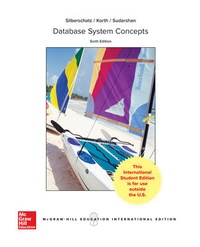
Database System Concepts
Description
The text is designed for a first course in databases at the junior/senior undergraduate level or the first year graduate level. It also contains additional material that can be used as supplements or as introductory material for an advanced course. Because the authors present concepts as intuitive descriptions, a familiarity with basic data structures, computer organization, and a high-level programming language are the only prerequisites. Important theoretical results are covered, but formal proofs are omitted. In place of proofs, figures and examples are used to suggest why a result is true.
<b>Database System Concepts</b> by Silberschatz, Korth and Sudarshan is now in its 6th edition and is one of the cornerstone texts of database education. It presents the fundamental concepts of database management in an intuitive manner, geared toward allowing students to begin working with databases as quickly as possible.
The text is designed for a first course in databases at the junior/senior undergraduate level or the first year graduate level. It also contains additional material that can be used as supplements or as introductory material for an advanced course. Because the authors present concepts as intuitive descriptions, a familiarity with basic data structures, computer organization, and a high-level programming language are the only prerequisites. Important theoretical results are covered, but formal proofs are omitted. In place of proofs, figures and examples are used to suggest why a result is true.
More details
Other editions
New editions
Persons
Henry F. (Hank) Korth is a Professor of Computer Science and Engineering and co-director of the Computer Science and Business program at Lehigh University. Prior to joining Lehigh, he was director of Database Principles Research at Bell Labs, a vice president of Panasonic Technologies, an associate professor at the University of Texas at Austin, and a research staff member at IBM Research. Korth is a fellow of the ACM and of the IEEE and a winner of the 10-Year Award at the VLDB Conference. His numerous research publications span a wide range of aspects of database systems, including transaction management in parallel and distributed systems, real-time systems, query processing, and the influence on these areas from modern computing architectures. Most recently, his research has addressed issues in the application of blockchains in enterprise databases.
S. Sudarshan is currently the Subrao M. Nilekani Chair Professor at the Indian Institute of Technology, Bombay. He received his Ph.D. at the University of Wisconsin in 1992, and he was a member of the technical staff at Bell Labs before joining IIT Bombay. Sudarshan is a fellow of the ACM. His research spans several areas of database systems, with a focus on query processing and query optimization. His paper on keyword search in databases published in 2002 won the IEEE ICDEMost Influential Paper Award in 2012, and his work on main-memory databases received the Bell Laboratories Presidents Award in 1999. His current research areas include testing and grading of SQL queries, optimization of database applications by rewriting of imperative code, and query optimization for parallel databases. He has published over 100 papers and obtained 15 patents.
Abraham (Avi) Silberschatz is the Sidney J. Weinberg Professor of Computer Science at Yale University. Prior to coming to Yale in 2003, he was the vice president of the Information Sciences Research Center at Bell Labs. He previously held an endowed professorship at the University of Texas at Austin, where he taught until 1993. Silberschatz is a fellow of the ACM, a fellow of the IEEE, and a member of the Connecticut Academy of Science and Engineering. He received the 2002 IEEE Taylor L. Booth Education Award, the 1998 ACM Karl V. Karlstrom Outstanding Educator Award, and the 1997 ACM SIGMOD Contribution Award. Silberschatz was awarded the Bell Laboratories Presidents Award three times, in 1998, 1999 and 2004. His writings have appeared in numerous journals, conferences, workshops, and book chapters. He has obtained over 48 patents and over 24 grants. He is an author of the textbook Operating System Concepts.
Henry F. (Hank) Korth is a Professor of Computer Science and Engineering and co-director of the Computer Science and Business program at Lehigh University. Prior to joining Lehigh, he was director of Database Principles Research at Bell Labs, a vice president of Panasonic Technologies, an associate professor at the University of Texas at Austin, and a research staff member at IBM Research. Korth is a fellow of the ACM and of the IEEE and a winner of the 10-Year Award at the VLDB Conference. His numerous research publications span a wide range of aspects of database systems, including transaction management in parallel and distributed systems, real-time systems, query processing, and the influence on these areas from modern computing architectures. Most recently, his research has addressed issues in the application of blockchains in enterprise databases.
S. Sudarshan is currently the Subrao M. Nilekani Chair Professor at the Indian Institute of Technology, Bombay. He received his Ph.D. at the University of Wisconsin in 1992, and he was a member of the technical staff at Bell Labs before joining IIT Bombay. Sudarshan is a fellow of the ACM. His research spans several areas of database systems, with a focus on query processing and query optimization. His paper on keyword search in databases published in 2002 won the IEEE ICDEMost Influential Paper Award in 2012, and his work on main-memory databases received the Bell Laboratories Presidents Award in 1999. His current research areas include testing and grading of SQL queries, optimization of database applications by rewriting of imperative code, and query optimization for parallel databases. He has published over 100 papers and obtained 15 patents.
Content
<b>Chapter 1: Introduction</b>
<b>Part 1:Relational Databases</b>
<b>Chapter 2:Introduction to the Relational Model</b>
<b>Chapter 3:Introduction to SQL</b>
<b>Chapter 4:Intermediate SQL</b>
<b>Chapter 5:Advanced SQL</b>
<b>Chapter 6:Formal Relational Query Languages</b>
<b>Part II:Database Design</b>
<b>Chapter 7:Database Design and the E-R Model</b>
<b>Chapter 8:Relational Database Design</b>
<b>Chapter 9:Application Design and Development</b>
<b>Part III: DataStorage and Querying</b>
<b>Chapter 10:Storage and File Structure</b>
<b>Chapter 11:Indexing and Hashing</b>
<b>Chapter 12:Query Processing</b>
<b>Chapter 13:Query Optimization</b>
<b>Part IV:Transaction Management</b>
<b>Chapter 14:Transactions</b>
<b>Chapter 15:Concurrency Control</b>
<b>Chapter 16:Recovery System</b>
<b>Part V: SystemArchitecture</b>
<b>Chapter 17:Database-System Architectures</b>
<b>Chapter 18:Parallel Databases</b>
<b>Chapter 19:Distributed Databases</b>
<b>Part VI: DataMining and Information Retrieval</b>
<b>Chapter 20:Data Mining</b>
<b>Chapter 21:Information Retrieval</b>
<b>Part VII:Specialty Databases</b>
<b>Chapter 22:Object-Based Databases</b>
<b>Chapter 23: XML</b>
<b>Chapter 24:Advanced Application Development</b>
<b>Chapter 25:Advanced Data Types and New Applications</b>
<b>Chapter 26:Advanced Transaction Processing</b>
<b>Part IX: CaseStudies</b>
<b>Chapter 27:PostgreSQL</b>
<b>Chapter 28:Oracle</b>
<b>Chapter 29: IBMDB2 Universal Database</b>
<b>Chapter 30:Microsoft SQL Server</b>
<b>Part X:Appendices</b>
<b>Appendix A:Detailed University Schema</b>
<b>Appendix B:Other Relational Query Languages</b>
<b>Appendix C:Advanced Relational Database Design</b>
<b>Appendix D:Network Model</b>
<b>Appendix E:Hierarchical Model</b>