

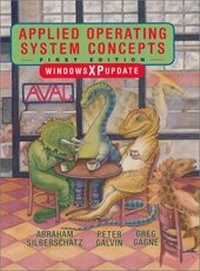
Applied Operating System Concepts
Windows XP Update
1st Edition
Published on 30. May 2002
Book
Hardback
966 pages
978-0-471-26314-2 (ISBN)
Description
Applied Operating Systems Concepts, 1/e Windows XP Update Edition is based on the best selling text Operating System Concepts, 6/e, 2001 by Abraham Silberschatz, Peter Baer Galvin and Greg Gagne. Like OSC, Applied provides a clear description of the concepts that underlie operating systems. One of the key differences is that Java is used to present many of these ideas and included are numerous examples that pertain specifically to popular operating systems such as UNIX, Solaris 2, Windows NT, Mach, the Apple Macintosh OS, IBM's OS/2 and Linux. The 1/e Update Edition offers improved conceptual coverage, added content to bridge the gap between concepts and actual implementations and a new chapter on the newest Operating System to capture the attention of critics, consumers, and industry alike: Windows XP. The advent of Java technology has given the authors an excellent vehicle to illustrate many of the most important concepts in modern operating systems today. Topics like multitasking, CPU scheduling, process synchronization, deadlock, security, and distributed systems lend themselves very well to demonstrations using Java technology.
More details
Edition
1., Aufl.
Language
English
Place of publication
New York
United States
Publishing group
John Wiley and Sons Ltd
Target group
College/higher education
Professional and scholarly
Illustrations
Illustrations
Dimensions
Height: 24.6 cm
Width: 19.5 cm
Weight
1559 gr
ISBN-13
978-0-471-26314-2 (9780471263142)
Schweitzer Classification
Other editions
New editions
Abraham Silberschatz | Greg Gagne | Peter B. Galvin
Operating Systems Concepts with Java
International Edition
Book
11/2003
6th Edition
Wiley
€57.90
Article is exhausted; no reprint
Previous edition

Book
10/2011
Wiley
€76.70
Article exhausted; check for reprint
Content
Part I: Overview. 1. Introduction. 2. Computer--System Structures. 3. Operating--System Structures. Part II: Process Management. 4. Processes. 5. Threads. 6. CPU Scheduling. 7. Process Synchronization. 8. Deadlocks. Part III: Storage Management. 9. Memory Management. 10. Virtual Memory. 11. File Systems. 12. I/O Systems. 13. Mass--Storage Structure. Part IV: Distributed Systems. 14. Network Structures. 15. Distributed Communication. 16. Distributed Coordination. 17. Distributed File System. Part V: Protection and Security. 18. Protection. 19. Security. Part VI: Case Studies. 20. The UNIX System. 21. The Linux System. 22. Windows NT. Appendix: A Java Primer.