

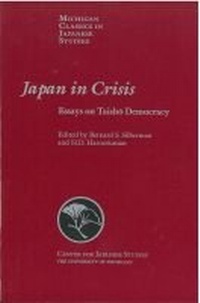
Japan in Crisis
Essays on Taisho Democracy
Will be published approx. on 1. January 1999
Book
Paperback/Softback
480 pages
978-0-939512-97-3 (ISBN)
Description
The transition between the reign of the powerful Emperor Meiji and that of his weak successor Taisho was marked by the emergence of a new individualism in Japanese society, a separation of culture and politics that led to the demise of the traditional Japanese self-dedication to the interests of the state and to a corresponding dedication to modernization in all spheres of existence. The widespread social, political, economic, and cultural changes that occurred during the years of Japan's modernization movement in the early twentieth century are discussed in thirteen essays by Japanese and American scholars. The contributors employ a diversity of disciplinary and historical approaches: the volume contains essays on intellectual, literary, economic, diplomatic, political, and social history covering the period from 1900 to 1945. The essays relate the new individualism of the Taisho years to such phenomena as literary naturalism, political socialism, the failure of economic expansion, and industrial and agricultural unrest.
More details
Series
Language
English
Place of publication
Michigan
United States
Publishing group
The University of Michigan Press
Dimensions
Height: 229 mm
Width: 152 mm
Thickness: 28 mm
ISBN-13
978-0-939512-97-3 (9780939512973)
Copyright in bibliographic data and cover images is held by Nielsen Book Services Limited or by the publishers or by their respective licensors: all rights reserved.
Schweitzer Classification
Persons
Bernard S. Silberman is Director of the Workshop on East Asia and Professor of Political Science, University of Chicago. H. D. Harootunian is Director of the Program in East Asian Studies and Professor of History, New York University.