

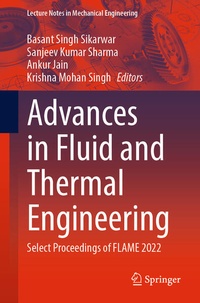
Advances in Fluid and Thermal Engineering
Description
This volume comprises the select proceedings of the 3rd Biennial International Conference on Future Learning Aspects of Mechanical Engineering (FLAME-2022). It aims to provide a comprehensive and broad-spectrum picture of state-of-the-art research and development in thermal and fluid engineering. Various topics covered include flow analysis, thermal systems, flow instability, renewable energy, hydel and wind power systems, heat transfer augmentation, biomimetic/ bioinspired engineering, heat pipes, heat pumps, multiphase flow/ heat transfer, energy conversion, thermal hydraulics of nuclear systems, refrigeration, and HVAC systems, computational fluid dynamics, fluid-structure interaction, etc. This volume will prove a valuable resource for those in academia and industry.
More details
Other editions
Additional editions
Persons
Dr. Sanjeev Kumar Sharma completed his Ph.D. (Solar-Thermal) from the Indian Institute of Technology IIT(ISM) Dhanbad. He did his M.Tech. (Energy Management) from IIT Delhi in 2008 and B.Tech. (Mechanical Engineering) from G.B. Pant University of Agriculture & Technology, India in 2003. He has more than nineteen years of experience in teaching undergraduate and postgraduate courses. He is presently working as an Assistant Professor in the Department of Mechanical Engineering of Amity University, India. His area of research includes food-energy-water nexus, novel desalination techniques, solar thermal engineering water/air heating systems, and hybrid photovoltaic thermal systems. He has authored books and many research papers in esteemed journals with high-impact factors. Dr. Ankur Jain directs the microscale thermo-physics laboratory at the University of Texas at Arlington, USA. He is a recipient of the NSF CAREER Award (2016), Lockheed Martin Excellence in Teaching Award (2018), and UTA College of Engineering Outstanding Early Career Award (2017). His research interests include microscale thermal transport, electrochemical energy conversion, and bioheat transfer. His research has received funding support from NSF, ONR, DoE, and other non-federal sources. He received his Ph.D. (2007) and M.S. (2003) from Stanford University, and his B.S. (2001) with highest honors from the Indian Institute of Technology (IIT), Delhi. Dr. Krishna Mohan Singh is working as a Professor with the Department of Mechanical and Industrial Engineering at the Indian Institute of Technology (IIT) Roorkee. Before this position, he worked as an Assistant Professor, at Shinshu University, Japan. He completed his Ph.D. at the Indian Institute of Technology (IIT) Kanpur in 1993. His research areas are fluid dynamics, numerical simulation of turbulent flows in complex geometries, computational mechanics, parallel numerical algorithms for continuum problems, mesh-free methods, modeling, simulation, and CAD of thermo-fluid and multiphysics systems (energy systems). He received the HIVIPS (Hitachi Research Visit Programs) Fellowship from Hitachi Research Group, Hitachi Ltd., Japan. He has published more than 100 research papers in various journals of national and international repute.