

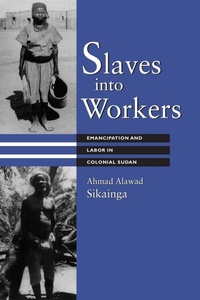
Slaves Into Workers
Emancipation and Labor in Colonial Sudan
Published on 1. June 1996
Book
Paperback/Softback
304 pages
978-0-292-76395-1 (ISBN)
Description
Unlike African slavery in Europe and the Americas, slavery in the Sudan and other parts of Africa persisted well into the twentieth century. Sudanese slaves served Sudanese masters until the region was conquered by the Turks, who practiced slavery on a larger, institutional scale. When the British took over the Sudan in 1898, they officially emancipated the slaves, yet found it impossible to replace their labor in the country's economy.
This pathfinding study explores the process of emancipation and the development of wage labor in the Sudan under British colonial rule. Ahmad Sikainga focuses on the fate of ex-slaves in Khartoum and on the efforts of the colonial government to transform them into wage laborers. He probes into what colonial rule and city life meant for slaves and ex-slaves and what the city and its people meant for colonial officials.
This investigation sheds new light on the legacy of slavery and the status of former slaves and their descendants. It also reveals how the legacy of slavery underlies the current ethnic and regional conflicts in the Sudan. It will be vital reading for students of race relations and slavery, colonialism and postcolonialism, urbanization, and labor history in Africa and the Middle East.
This pathfinding study explores the process of emancipation and the development of wage labor in the Sudan under British colonial rule. Ahmad Sikainga focuses on the fate of ex-slaves in Khartoum and on the efforts of the colonial government to transform them into wage laborers. He probes into what colonial rule and city life meant for slaves and ex-slaves and what the city and its people meant for colonial officials.
This investigation sheds new light on the legacy of slavery and the status of former slaves and their descendants. It also reveals how the legacy of slavery underlies the current ethnic and regional conflicts in the Sudan. It will be vital reading for students of race relations and slavery, colonialism and postcolonialism, urbanization, and labor history in Africa and the Middle East.
More details
Series
Language
English
Place of publication
Austin, TX
United States
Target group
Professional and scholarly
Dimensions
Height: 229 mm
Width: 152 mm
Thickness: 18 mm
Weight
500 gr
ISBN-13
978-0-292-76395-1 (9780292763951)
Copyright in bibliographic data and cover images is held by Nielsen Book Services Limited or by the publishers or by their respective licensors: all rights reserved.
Schweitzer Classification
Person
Ahmad Alawad Sikainga is Professor of History at the Ohio State University.
Content
List of Tables and Maps
A Note on Transliteration
Abbreviations
Acknowledgments
Introduction
Photo section
Chapter 1. Slavery and Labor in Precolonial Sudan
Chapter 2. Slavery and Labor in the Sudan, 1898-1919
Chapter 3. Slavery and Labor in Khartoum, 1898-1919
Chapter 4. Emancipation and the Legacy of Slavery, 1920-1956
Chapter 5. The Development of the Labor Force, 1920-1956
Chapter 6. Ex-Slaves and Workers in Khartoum, 1920-1956
Conclusion
Appendices
Notes
Glossary
Bibliography
Index
A Note on Transliteration
Abbreviations
Acknowledgments
Introduction
Photo section
Chapter 1. Slavery and Labor in Precolonial Sudan
Chapter 2. Slavery and Labor in the Sudan, 1898-1919
Chapter 3. Slavery and Labor in Khartoum, 1898-1919
Chapter 4. Emancipation and the Legacy of Slavery, 1920-1956
Chapter 5. The Development of the Labor Force, 1920-1956
Chapter 6. Ex-Slaves and Workers in Khartoum, 1920-1956
Conclusion
Appendices
Notes
Glossary
Bibliography
Index