

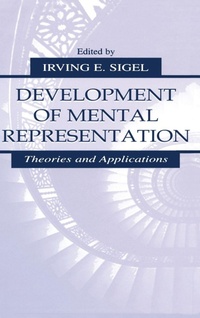
Development of Mental Representation
Theories and Applications
Published on 1. January 1999
Book
Hardback
504 pages
978-0-8058-2228-1 (ISBN)
Description
There is a general and extensive literature in the development of representational thought and symbolic processes because of its centrality in human evolution. However, the umbrella of science and its method does not necessarily lead to a coherent conceptual model, or agreements among scholars. These basic differences among various disciplines have led to the creation of new and exciting realms of research. This book considers how representational or symbolic thought develops for children's use in a wide array of these circumstances.
Reviews / Votes
"This volume brings together divergent perspectives and encourages readers to think through the many ways of conceptualizing representation. Most readers will learn about lines of research with which they have had little contact. The conscientious reader may find ways of linking disparate research paradigms in a fruitful manner."-Contemporary Psychology
More details
Language
English
Place of publication
Philadelphia
United States
Publishing group
Taylor & Francis Inc
Target group
College/higher education
Professional and scholarly
Dimensions
Height: 235 mm
Width: 157 mm
Thickness: 31 mm
Weight
873 gr
ISBN-13
978-0-8058-2228-1 (9780805822281)
Copyright in bibliographic data and cover images is held by Nielsen Book Services Limited or by the publishers or by their respective licensors: all rights reserved.
Schweitzer Classification
Other editions
Additional editions
Book
08/2014
1st Edition
Psychology Press Ltd
€85.80
Shipment within 10-20 days
E-Book
06/2013
1st Edition
Psychology Press
€106.79
Available for download
E-Book
06/2013
1st Edition
Psychology Press Ltd
€77.99
Available for download
E-Book
06/2013
Psychology Press Ltd
€77.99
Available for download
Person
Irving E. Sigel
Content
Contents: R.R. Cocking, Preface. Part I:Theories of Representation.I.E. Sigel, Approaches to Representation as a Psychological Construct: A Treatise in Diversity. M.E. Martinez, Cognitive Representations: Distinctions, Implications, and Elaborations. A.A. Benasich, H.L. Read, Representation: Picture or Process? J.S. DeLoache, C.M. Smith, Early Symbolic Representation. S.A. Gelman, G. Diesendruck, What's in a Concept? Context, Variability, and Psychological Essentialism. E.K. Scholnick, Representing Logic. J.I.M. Carpendale, Constructivism, Communication, and Cooperation: Implications of Michael Chapman's "Epistemic Triangle." G.S Halford, The Properties of Representations Used in Higher Cognitive Processes: Developmental Implications. J. Pascual-Leone, J. Johnson, A Dialectical Constructivist View of Representation: Role of Mental Attention, Executives, and Symbols. M.J. Chandler, B.W. Sokol, Representation Once Removed: Children's Developing Conceptions of Representational Life. M.F. Mascolo, K.W. Fischer, The Development of Representation as the Coordination of Component Systems of Action. B. Dorval, A Bakhtinian View of Egocentric Speech. J.P. Byrnes, The Nature and Development of Representation: Forging a Synthesis of Competing Approaches. Part II:Application of Representation in Practice.L.S. Liben, Developing an Understanding of External Spatial Representations. R. Lesh, The Development of Representational Abilities in Middle School Mathematics. D.H. Gitomer, L.S. Steinberg, Representational Issues in Assessment Design. U. Shafrir, Representational Competence. J.E. Marcia, Representational Thought in Ego Identity, Psychotherapy, and Psychosocial Developmental Theory. L.R. Herrenkohl, J.V. Wertsch, The Use of Cultural Tools: Mastery and Appropriation. J. McLellan, J.E. Youniss, A Representational System for Peer Crowds. Part III:Visual Representation as Pictoral.S.L. Calvert, The Form of Thought.