

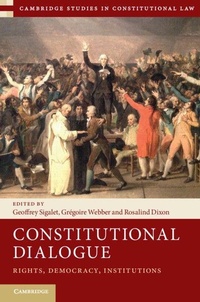
Constitutional Dialogue
Rights, Democracy, Institutions
Published on 2. May 2019
Book
Hardback
484 pages
978-1-108-41758-7 (ISBN)
Description
The metaphor of 'dialogue' has been put to different descriptive and evaluative uses by constitutional and political theorists studying interactions between institutions concerning rights. It has also featured prominently in the opinions of courts and the rhetoric and deliberations of legislators. This volume brings together many of the world's leading constitutional and political theorists to debate the nature and merits of constitutional dialogues between the judicial, legislative, and executive branches. Constitutional Dialogue explores dialogue's democratic significance, examines its relevance to the functioning and design of constitutional institutions, and covers constitutional dialogues from an international and transnational perspective.
More details
Series
Language
English
Place of publication
Cambridge
United Kingdom
Target group
Professional and scholarly
Illustrations
Worked examples or Exercises
Dimensions
Height: 235 mm
Width: 157 mm
Thickness: 31 mm
Weight
848 gr
ISBN-13
978-1-108-41758-7 (9781108417587)
Copyright in bibliographic data and cover images is held by Nielsen Book Services Limited or by the publishers or by their respective licensors: all rights reserved.
Schweitzer Classification
Other editions
Additional editions
Geoffrey Sigalet | Gregoire Webber | Rosalind Dixon
Constitutional Dialogue
Rights, Democracy, Institutions
Book
11/2020
Cambridge University Press
€60.80
Shipment within 15-20 days
E-Book
05/2019
Cambridge University Press
€26.99
Available for download
Persons
Geoffrey Sigalet is a post-doctoral fellow in the Faculty of Law at Queen's University and a non-resident fellow at Stanford Law School's Constitutional Law Center. He completed his PhD in political theory and public law at Princeton University, where his dissertation developed a neo-republican political theory of 'dialogical' judicial review and constitutional interpretation. Gregoire Webber holds the Canada Research Chair in Public Law and Philosophy of Law at Queen's University and is a Visiting Senior Fellow at the London School of Economics and Political Science. He is the author of The Negotiable Constitution: On the Limitation of Rights (Cambridge University Press 2012), joint editor of Proportionality and the Rule of Law: Rights, Justification, Reasoning (Cambridge University Press 2016), and joint author of Legislated Rights: Securing Human Rights through Legislation (Cambridge University Press 2018). Rosalind Dixon is a Professor of Law, at UNSW Sydney, and Co-President of the International Society of Public Law. Her work has been published in leading journals in the US, Canada, the UK, and Australia. She was previously an assistant professor at the University of Chicago Law School, and has been a visiting professor at the University of Chicago, Columbia Law School, Harvard Law School, and the National University of Singapore.
Content
1. Introduction: the 'what' and 'why' of constitutional dialogue Geoffrey Sigalet, Gregoire Webber and Rosalind Dixon; Part I. Dialogue and Democracy: 2. Dialogue and its myths Alison Young; 3. Departmentalism and dialogue Jacob T. Levy; 4. On dialogue and domination Geoffrey Sigalet; Part II. Dialogue and Institutions: 5. Past, present, and justice in the exercise of judicial responsibility Gregoire Webber; 6. Dialogue and deference Rosalind Dixon; 7. Dialogue, finality, and legality Jeff King; Part III. Dialogue and Rights: 8. Canada's notwithstanding clause, dialogue, and constitutional identities Dwight Newman; 9. Intra-parliamentary dialogues in New Zealand and the UK Janet L. Hiebert and James B. Kelly; 10. Dialogue in Canada and the dangers of simplified comparative law and populism Kent Roach; 11. Bills of rights with strings attached: protecting the past from judicial review Rivka Weill; Part IV. Case Studies of Dialogue: 12. Prisoners' voting and judges' powers John Finnis; 13. 'All's well that ends well?' Same-sex marriage and constitutional dialogue Stephen Macedo; 14. A feature, not a bug: a co-ordinate moment in Canadian constitutionalism Dennis Baker; Part V. International and Transnational Dialogues: 15. Dialogue and its discontents Frederick Schauer; 16. Constitutional conversations in Britain (and Europe) Richard Ekins.