

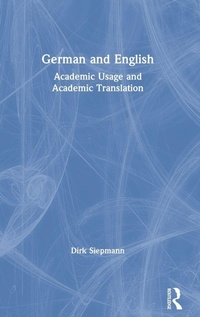
German and English
Academic Usage and Academic Translation
1st Edition
Published on 30. November 2020
Book
Hardback
276 pages
978-0-367-61904-6 (ISBN)
Description
German and English: Academic Usage and Academic Translation focuses on academic and popular scientific/academic usage.
This book's brief is both theoretical and practical: on the theoretical side, it aims to provide a systematic, corpus-based account of current academic usage in English and in German as well as of the translation problems associated with various academic genres; on the practical side, it seeks to equip academic translators with the skills required to produce target-language text in accordance with disciplinary conventions. The main perspective taken is that of a translator working from German into English, but the converse direction is also regularly taken into account. Most of the examples used are based on errors that occurred in real-life translation jobs. Additional practice materials and sample translations are available as eResources here: www.routledge.com/9780367619022.
This book will be an important resource for professionals aspiring to translate academic texts, linguists interested in academic usage, translation scholars, and graduate and post-graduate students.
This book's brief is both theoretical and practical: on the theoretical side, it aims to provide a systematic, corpus-based account of current academic usage in English and in German as well as of the translation problems associated with various academic genres; on the practical side, it seeks to equip academic translators with the skills required to produce target-language text in accordance with disciplinary conventions. The main perspective taken is that of a translator working from German into English, but the converse direction is also regularly taken into account. Most of the examples used are based on errors that occurred in real-life translation jobs. Additional practice materials and sample translations are available as eResources here: www.routledge.com/9780367619022.
This book will be an important resource for professionals aspiring to translate academic texts, linguists interested in academic usage, translation scholars, and graduate and post-graduate students.
More details
Language
English
Place of publication
London
United Kingdom
Publishing group
Taylor & Francis Ltd
Target group
College/higher education
Illustrations
20 s/w Abbildungen, 17 s/w Photographien bzw. Rasterbilder, 3 s/w Zeichnungen, 198 s/w Tabellen
198 Tables, black and white; 3 Line drawings, black and white; 17 Halftones, black and white; 20 Illustrations, black and white
Dimensions
Height: 240 mm
Width: 161 mm
Thickness: 20 mm
Weight
584 gr
ISBN-13
978-0-367-61904-6 (9780367619046)
Copyright in bibliographic data and cover images is held by Nielsen Book Services Limited or by the publishers or by their respective licensors: all rights reserved.
Schweitzer Classification
Other editions
Additional editions
Book
11/2020
1st Edition
Routledge
€63.50
Shipment within 15-20 days
E-Book
11/2020
1st Edition
Routledge
€55.49
Available for download
E-Book
11/2020
1st Edition
Routledge
€55.49
Available for download
Person
Dirk Siepmann is Professor of English at Osnabrueck University. His research interests are translation, contrastive linguistics, corpus linguistics, and language teaching.
Content
Contents
Preamble
Acknowledgements
1. Introduction: academic language today
2. Academic grammar
2.1 Number and countability: making abstractions concrete
2.2 Determiner use: using fewer articles
2.2.1 English zero article
2.2.2 German zero article
2.3 Phrasal complexity: packing information into word groups
2.3.1 Predicative nouns and their complementation
2.3.2 Non-predicative nouns
2.3.3 Compounds and multi-word expressions
2.3.4 Nominal compounds
2.3.5 Adjectival compounds
2.3.6 Complex postmodification in English and German
2.3.7 German premodification vs. English postmodification
2.4 Clausal complexity: making information flow
2.4.1 Basic word order rules and clause-initial framing
2.4.2 Countervailing tendencies in clause structure
2.4.3 Elaboration: Relative clauses and supplements
3. Academic vocabulary
3.1 General-language items
3.1.1 Nouns
3.1.2 Verbs
3.1.3 Adjectives
3.1.4 Small words: adverbs and particles
3.1.5 Informal words and expressions
3.2 Learned words (Bildungssprache)
3.3 General academic words and phraseology
3.3.1 Simplexes
3.3.2 Compounds
3.3.3 Particle constructions and spatial metaphor
3.4 Sub-technical vocabulary used in one or more disciplines
3.5 Subject-specific terminology
3.6 Subject-specific phraseology
4. Vocabulary and grammar: constructions
4.1 Lexicon and grammar vs. constructicon
4.1.1 Constructions and creativity
4.1.2 Nominal vs. verbal constructions
4.2 Constructions and word combining
4.3 Common constructions in academic text
5. Communicative purpose and linguistic form
6. Language use in the disciplines
6.1 Literary and cultural studies, art and art history: research proposal (abstract), talk
6.2 History: monograph
6.3 Sociology: journal article and monograph
6.4 Economics: textbook and research report
6.5 Philosophy: popularizing book
6.6 Geography: journal article
6.7 Musicology: journal article and abstract
Appendix I
Index
Preamble
Acknowledgements
1. Introduction: academic language today
2. Academic grammar
2.1 Number and countability: making abstractions concrete
2.2 Determiner use: using fewer articles
2.2.1 English zero article
2.2.2 German zero article
2.3 Phrasal complexity: packing information into word groups
2.3.1 Predicative nouns and their complementation
2.3.2 Non-predicative nouns
2.3.3 Compounds and multi-word expressions
2.3.4 Nominal compounds
2.3.5 Adjectival compounds
2.3.6 Complex postmodification in English and German
2.3.7 German premodification vs. English postmodification
2.4 Clausal complexity: making information flow
2.4.1 Basic word order rules and clause-initial framing
2.4.2 Countervailing tendencies in clause structure
2.4.3 Elaboration: Relative clauses and supplements
3. Academic vocabulary
3.1 General-language items
3.1.1 Nouns
3.1.2 Verbs
3.1.3 Adjectives
3.1.4 Small words: adverbs and particles
3.1.5 Informal words and expressions
3.2 Learned words (Bildungssprache)
3.3 General academic words and phraseology
3.3.1 Simplexes
3.3.2 Compounds
3.3.3 Particle constructions and spatial metaphor
3.4 Sub-technical vocabulary used in one or more disciplines
3.5 Subject-specific terminology
3.6 Subject-specific phraseology
4. Vocabulary and grammar: constructions
4.1 Lexicon and grammar vs. constructicon
4.1.1 Constructions and creativity
4.1.2 Nominal vs. verbal constructions
4.2 Constructions and word combining
4.3 Common constructions in academic text
5. Communicative purpose and linguistic form
6. Language use in the disciplines
6.1 Literary and cultural studies, art and art history: research proposal (abstract), talk
6.2 History: monograph
6.3 Sociology: journal article and monograph
6.4 Economics: textbook and research report
6.5 Philosophy: popularizing book
6.6 Geography: journal article
6.7 Musicology: journal article and abstract
Appendix I
Index