

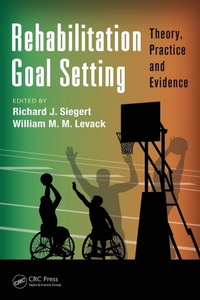
Rehabilitation Goal Setting
Theory, Practice and Evidence
1st Edition
Published on 10. July 2014
Book
Hardback
412 pages
978-1-4398-6329-9 (ISBN)
Description
Written to provide clinicians, educators, researchers, and students in rehabilitation with a comprehensive overview of the theory, practice, and evidence base of goal setting, this first-of-its-kind reference provides an authoritative, state-of-the-art knowledge of the practice. The authors cover a broad range of different approaches to goal setting, with input from experts from North America, Europe, and Australia. This book is applicable to patients with stroke, traumatic brain injury, neurological disorders, spinal cord injury, and other conditions.
Reviews / Votes
"... up-to-date, evidence based, and client and family centred. It will help clinicians to work with clients to make their rehabilitation goals more meaningful and achievable, thereby leading to more effective treatment planning and outcomes."-Canadian Journal of Occupational Therapy
"... a unique and important contribution to the literature. ... [covering] a wide variety of relevant topics. ... [The editors] have assembled a substantial group of authors, especially from the UK and New Zealand. A worthy endeavor."
- Jeffrey S. Kreutzer, Virginia Commonwealth University, Richmond, USA
"Goal setting is used in just about every service, but it is something that is done in many different ways. This book provides the theory as to why goal setting should be used, as well as discusses how to use it in a wide range of clinical services. Therefore, this is definitely a book that everybody who works in a rehabilitation service should read. In fact, all rehabilitation teams should probably take the opportunity to read this book and review their practices having done so!"
-Prof. Jonathan Evans, University of Glasgow, UK
More details
Series
Language
English
Place of publication
Bosa Roca
United States
Publishing group
Taylor & Francis Inc
Target group
Professional and scholarly
Academic and Professional Practice & Development
Illustrations
24 s/w Abbildungen, 23 s/w Tabellen
23 Tables, black and white; 24 Illustrations, black and white
Dimensions
Height: 260 mm
Width: 183 mm
Thickness: 27 mm
Weight
970 gr
ISBN-13
978-1-4398-6329-9 (9781439863299)
Copyright in bibliographic data and cover images is held by Nielsen Book Services Limited or by the publishers or by their respective licensors: all rights reserved.
Schweitzer Classification
Other editions
Additional editions
Book
10/2017
1st Edition
CRC Press
€110.90
Shipment within 10-20 days
E-Book
07/2014
1st Edition
CRC Press
€85.99
Available for download
Persons
Richard J. Siegert, BSc, PGDipPsych (Clin), MSocSci, PhD, is professor of psychology and rehabilitation, Person Centred Research Centre, School of Rehabilitation and Occupation Studies, Auckland University of Technology, Auckland, New Zealand. Siegert trained in clinical psychology and completed his PhD in psychology at Victoria University of Wellington. His research interests include neuropsychology, neurological rehabilitation, psychology applied to rehabilitation, and psychometrics. Siegert is an author of 90 peer-reviewed journal articles, four invited articles, six book chapters, and a popular undergraduate rehabilitation textbook. His current interests include the application of mindfulness techniques for people with neurological conditions and outcome measurement in neuro-rehabilitation.
William M.M. Levack, BPhty, MHealSc (Rehabilitation), PhD, is associate dean for research and postgraduate studies, and senior lecturer in rehabilitation, University of Otago, Wellington, New Zealand. In 2003, Levack was employed as a lecturer at the University of Otago, teaching interdisciplinary, postgraduate courses in rehabilitation by distance, and in 2008 he completed his PhD. His current projects include work on the development of a clinical measure of loss and reconstruction of self-identity after traumatic brain injury, qualitative research into the barriers and facilitator of access to evidence-based rehabilitation, and the use of kinetic video games as a form of therapeutic exercise for people with chronic respiratory disease.
William M.M. Levack, BPhty, MHealSc (Rehabilitation), PhD, is associate dean for research and postgraduate studies, and senior lecturer in rehabilitation, University of Otago, Wellington, New Zealand. In 2003, Levack was employed as a lecturer at the University of Otago, teaching interdisciplinary, postgraduate courses in rehabilitation by distance, and in 2008 he completed his PhD. His current projects include work on the development of a clinical measure of loss and reconstruction of self-identity after traumatic brain injury, qualitative research into the barriers and facilitator of access to evidence-based rehabilitation, and the use of kinetic video games as a form of therapeutic exercise for people with chronic respiratory disease.
Content
Section I Goal Theory in Rehabilitation. Challenges in Theory, Practice and Evidence. Evidence-Based Goal Setting: Cultivating the Science of Rehabilitation. Psychology, Goals and Rehabilitation: Providing a Theoretical Foundation. Ethics and Goal Setting. Goal Setting as Shared Decision Making. MEANING as a Smarter Approach to Goals in Rehabilitation. Section II Goal Setting in Clinical Practice. Goal Attainment Scaling in Adult Neurorehabilitation. Goal Attainment Scaling in Paediatric Rehabilitation. Applying the International Classification of Functioning, Disability and Alexandra Rauch and Anke Scheel-Sailer. Occupation-Based, Client-Centred Approach to Goal Planning and Measurement. Theory-Based Approach to Goal Setting. Goal Orientation and Goal Setting in German Medical Rehabilitation Research. Section III Specific Applications. Goal Setting in Social Competence Treatment after Brain Injury. Self-Management for People with Chronic Conditions. Goal Setting in Paediatric Rehabilitation. Use of Goals as a Focus for Services for Community-Dwelling Older People. Goals and Goal Setting for People with Aphasia, Their Family Members and Clinicians. Goal Setting in Stroke Rehabilitation: Theory, Practice and Future Directions. Section IV Conclusion. Concluding Comments, Current Trends and Future Directions. Index.