

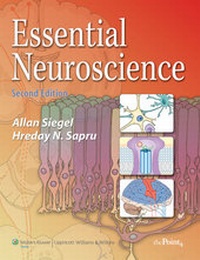
Essential Neuroscience
2nd Edition
Published on 19. April 2010
Book
Paperback/Softback
592 pages
978-0-7817-8383-5 (ISBN)
Description
Delivers subject matter simply yet meaningfully ...As burgeoning research advances the field of neuroscience, instructors face the formidable challenge of imparting this ever-increasing and heterogenous body of information to students. "Essential Neuroscience, Second Edition" is the coherent, balanced solution. Rated outstanding with highest 5-star ranking in the Mayo Clinic Proceedings, this highly acclaimed second edition covers fundamental neuroscience topics, integrating essential information with clinical and physiological considerations, providing students with multiple opportunities for review and self-testing, and presenting the latest relevant developments in neuroscience. Proven building-block approach preferred by faculty and students alike. Beginning with the building block of neuroscience, the neuron, the text unfolds the story of human brain function. From analysis of a single neuron, the authors enlarge the discussion to neuronal communication; guide us through the essentials of spinal cord and brain anatomy; detail the sensory, motor, and integrative systems; and finally illustrate the most complex functions and dysfunctions of the nervous system.
This stepwise, basic-to-complex approach is the synthesis of 30 years of teaching experience and improves student performance on exams. New features: enhanced topics throughout Integration of material where sequentially and functionally relevant; more than 50 revised and 8 all-new illustrations; Chapter Summary Tables; Expanded Glossary; and, in-depth study of selected topics to accommodate dental students. Inside you'll find: Six sections organize chapters into cohesive blocks of information; Learning Objectives launch each chapter by focusing students on key chapter information; Updated, full-color art program abounds with more than 400 illustrations and neuroimaging that reflect appropriate detail and complement the text; Tables and outlines organize chapter material in high-yield format for effective student review; Concise yet comprehensive presentation of material ensures that students learn what they need to know without bogging them down with excess information; and, Balanced integration of anatomy, biology, physiology, and chemistry gives students a well-rounded understanding of neuroscience.
It includes in-depth coverage of topics frequently tested on the United States Medical Licensing Examination (USMLE) - including structure, function, and deficits of individual cranial nerves; vascular syndromes of the brainstem; and behavioral disorders - gives students an edge in test prep. Latest developments in neuroscience keep students at the front of discovery. Clinical Cases provide the clinical application of chapter concepts. USMLE-style and course review-style questions test retention of key concepts in each chapter and help students prepare for course and board examinations. Comprehensive Glossary defines key terms and concepts bolded throughout the text. It has online access via thePoint to the fully searchable text (including images), an image bank for faculty with labels on/off, interactive Q&A, and more.
Delivers subject matter simply yet meaningfully ...As burgeoning research advances the field of neuroscience, instructors face the formidable challenge of imparting this ever-increasing and heterogenous body of information to students. "Essential Neuroscience, Second Edition" is the coherent, balanced solution. Rated outstanding with highest 5-star ranking in the Mayo Clinic Proceedings, this highly acclaimed second edition covers fundamental neuroscience topics, integrating essential information with clinical and physiological considerations, providing students with multiple opportunities for review and self-testing, and presenting the latest relevant developments in neuroscience. Proven building-block approach preferred by faculty and students alike. Beginning with the building block of neuroscience, the neuron, the text unfolds the story of human brain function. From analysis of a single neuron, the authors enlarge the discussion to neuronal communication; guide us through the essentials of spinal cord and brain anatomy; detail the sensory, motor, and integrative systems; and finally illustrate the most complex functions and dysfunctions of the nervous system.
This stepwise, basic-to-complex approach is the synthesis of 30 years of teaching experience and improves student performance on exams. New features: enhanced topics throughout Integration of material where sequentially and functionally relevant; more than 50 revised and 8 all-new illustrations; Chapter Summary Tables; Expanded Glossary; and, in-depth study of selected topics to accommodate dental students. Inside you'll find: Six sections organize chapters into cohesive blocks of information; Learning Objectives launch each chapter by focusing students on key chapter information; Updated, full-color art program abounds with more than 400 illustrations and neuroimaging that reflect appropriate detail and complement the text; Tables and outlines organize chapter material in high-yield format for effective student review; Concise yet comprehensive presentation of material ensures that students learn what they need to know without bogging them down with excess information; and, Balanced integration of anatomy, biology, physiology, and chemistry gives students a well-rounded understanding of neuroscience.
It includes in-depth coverage of topics frequently tested on the United States Medical Licensing Examination (USMLE) - including structure, function, and deficits of individual cranial nerves; vascular syndromes of the brainstem; and behavioral disorders - gives students an edge in test prep. Latest developments in neuroscience keep students at the front of discovery. Clinical Cases provide the clinical application of chapter concepts. USMLE-style and course review-style questions test retention of key concepts in each chapter and help students prepare for course and board examinations. Comprehensive Glossary defines key terms and concepts bolded throughout the text. It has online access via thePoint to the fully searchable text (including images), an image bank for faculty with labels on/off, interactive Q&A, and more.
This stepwise, basic-to-complex approach is the synthesis of 30 years of teaching experience and improves student performance on exams. New features: enhanced topics throughout Integration of material where sequentially and functionally relevant; more than 50 revised and 8 all-new illustrations; Chapter Summary Tables; Expanded Glossary; and, in-depth study of selected topics to accommodate dental students. Inside you'll find: Six sections organize chapters into cohesive blocks of information; Learning Objectives launch each chapter by focusing students on key chapter information; Updated, full-color art program abounds with more than 400 illustrations and neuroimaging that reflect appropriate detail and complement the text; Tables and outlines organize chapter material in high-yield format for effective student review; Concise yet comprehensive presentation of material ensures that students learn what they need to know without bogging them down with excess information; and, Balanced integration of anatomy, biology, physiology, and chemistry gives students a well-rounded understanding of neuroscience.
It includes in-depth coverage of topics frequently tested on the United States Medical Licensing Examination (USMLE) - including structure, function, and deficits of individual cranial nerves; vascular syndromes of the brainstem; and behavioral disorders - gives students an edge in test prep. Latest developments in neuroscience keep students at the front of discovery. Clinical Cases provide the clinical application of chapter concepts. USMLE-style and course review-style questions test retention of key concepts in each chapter and help students prepare for course and board examinations. Comprehensive Glossary defines key terms and concepts bolded throughout the text. It has online access via thePoint to the fully searchable text (including images), an image bank for faculty with labels on/off, interactive Q&A, and more.
Delivers subject matter simply yet meaningfully ...As burgeoning research advances the field of neuroscience, instructors face the formidable challenge of imparting this ever-increasing and heterogenous body of information to students. "Essential Neuroscience, Second Edition" is the coherent, balanced solution. Rated outstanding with highest 5-star ranking in the Mayo Clinic Proceedings, this highly acclaimed second edition covers fundamental neuroscience topics, integrating essential information with clinical and physiological considerations, providing students with multiple opportunities for review and self-testing, and presenting the latest relevant developments in neuroscience. Proven building-block approach preferred by faculty and students alike. Beginning with the building block of neuroscience, the neuron, the text unfolds the story of human brain function. From analysis of a single neuron, the authors enlarge the discussion to neuronal communication; guide us through the essentials of spinal cord and brain anatomy; detail the sensory, motor, and integrative systems; and finally illustrate the most complex functions and dysfunctions of the nervous system.
This stepwise, basic-to-complex approach is the synthesis of 30 years of teaching experience and improves student performance on exams. New features: enhanced topics throughout Integration of material where sequentially and functionally relevant; more than 50 revised and 8 all-new illustrations; Chapter Summary Tables; Expanded Glossary; and, in-depth study of selected topics to accommodate dental students. Inside you'll find: Six sections organize chapters into cohesive blocks of information; Learning Objectives launch each chapter by focusing students on key chapter information; Updated, full-color art program abounds with more than 400 illustrations and neuroimaging that reflect appropriate detail and complement the text; Tables and outlines organize chapter material in high-yield format for effective student review; Concise yet comprehensive presentation of material ensures that students learn what they need to know without bogging them down with excess information; and, Balanced integration of anatomy, biology, physiology, and chemistry gives students a well-rounded understanding of neuroscience.
It includes in-depth coverage of topics frequently tested on the United States Medical Licensing Examination (USMLE) - including structure, function, and deficits of individual cranial nerves; vascular syndromes of the brainstem; and behavioral disorders - gives students an edge in test prep. Latest developments in neuroscience keep students at the front of discovery. Clinical Cases provide the clinical application of chapter concepts. USMLE-style and course review-style questions test retention of key concepts in each chapter and help students prepare for course and board examinations. Comprehensive Glossary defines key terms and concepts bolded throughout the text. It has online access via thePoint to the fully searchable text (including images), an image bank for faculty with labels on/off, interactive Q&A, and more.
More details
Edition
2nd Revised edition
Language
English
Place of publication
Philadelphia
United States
Target group
College/higher education
Edition type
Revised edition
Product notice
Paperback (trade)
Dimensions
Height: 254 mm
Width: 203 mm
Weight
1361 gr
ISBN-13
978-0-7817-8383-5 (9780781783835)
Copyright in bibliographic data and cover images is held by Nielsen Book Services Limited or by the publishers or by their respective licensors: all rights reserved.
Schweitzer Classification
Other editions
New editions
Allan Siegel | Hreday N. Sapru
Essential Neuroscience
Book
09/2018
4th Edition
Lippincott Williams and Wilkins
€88.00
Shipment within 10-20 days
Allan Siegel | Hreday N. Sapru
Essential Neuroscience
Book
06/2014
3rd Edition
Lippincott Williams and Wilkins
€89.33
Article exhausted; check for reprint
Previous edition
Allan Siegel | Hreday N. Sapru
Essential Neuroscience
Book
10/2007
Lippincott Williams and Wilkins
€63.32
Article exhausted; check for reprint
Content
Section I: GROSS ANATOMY OF THE BRAIN 1: Overview of the Central Nervous System 2: Development of the Nervous System 3: Meninges and Cerebrospinal Fluid 4: Blood Supply of the Central Nervous System Section II: THE NEURON 5: Histology of the Nervous System 6: Electrophysiology of Neurons 7: Synaptic Transmission 8: Neurotransmitters Section III: ORGANIZATION OF THE CENTRAL NERVOUS SYSTEM 9: The Spinal Cord 10: Brainstem I: The Medulla 11: Brainstem II: Pons and Cerebellum 12: Brainstem III: The Midbrain 13: The Forebrain 14: The Cranial Nerves Section IV: SENSORY SYSTEMS 15: Somatosensory System 16: Visual System 17: Auditory and Vestibular Systems 18: Olfaction and Taste Section V: MOTOR SYSTEMS 19: The Upper Motor Neurons 20: The Basal Ganglia 21: The Cerebellum Section VI: INTEGRATIVE SYSTEMS 22: The Autonomic Nervous System 23: The Reticular Formation 24: The Hypothalamus 25: The Limbic System 26: The Thalamus and Cerebral Cortex 27: Vascular Syndromes 28: Behavioral and Psychiatric Disorders Glossary Index