

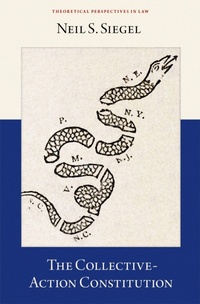
The Collective-Action Constitution
Published on 29. August 2024
Book
Hardback
520 pages
978-0-19-776096-3 (ISBN)
Description
The United States Constitution was established primarily because of the widely recognized failures of its predecessor, the Articles of Confederation, to adequately address "collective-action problems" facing the states. These problems included funding the national government, regulating foreign and interstate commerce, and defending the nation from attack. Meeting such challenges required the states to cooperate or coordinate their behavior, but they often struggled to do so both inside and outside the Confederation Congress. By empowering Congress to solve collective-action problems, and by creating a national executive and judiciary to enforce federal law, the Constitution promised a substantially more effective federal government.
An important read for scholars, lawyers, judges, and students alike, Neil Siegel's The Collective-Action Constitution addresses how the U.S. Constitution is, in a fundamental sense, the Collective-Action Constitution. Any faithful account of what the Constitution is for and how it should be interpreted must include the primary structural purpose of empowering the federal government to solve collective-action problems for the states and preventing them from causing such problems. This book offers a thorough examination of the collective-action principles animating the structure of the Constitution and how they should be applied to meet many of the most daunting challenges facing American society today.
An important read for scholars, lawyers, judges, and students alike, Neil Siegel's The Collective-Action Constitution addresses how the U.S. Constitution is, in a fundamental sense, the Collective-Action Constitution. Any faithful account of what the Constitution is for and how it should be interpreted must include the primary structural purpose of empowering the federal government to solve collective-action problems for the states and preventing them from causing such problems. This book offers a thorough examination of the collective-action principles animating the structure of the Constitution and how they should be applied to meet many of the most daunting challenges facing American society today.
Reviews / Votes
Neil Siegel's Collective Action Constitution is a terrific book. Its underpinning is an idea that is as basic as it is important: government exists to deal with problems that come from people living together in less-than-perfect harmony. Professor Siegel molds that general idea into a more precise claim. * David A. Strauss * The Collective-Action Constitution is a book that should be read at home and abroad. Its insights go well beyond the U.S. Constitution: It makes a clear contribution to federal theory and will greatly enrich comparative debates. * Erin F. Delaney, Balkinization Blog *More details
Series
Language
English
Place of publication
New York
United States
Target group
College/higher education
Professional and scholarly
Product notice
sewn/stitched
Cloth over boards
Dimensions
Height: 226 mm
Width: 152 mm
Thickness: 38 mm
Weight
839 gr
ISBN-13
978-0-19-776096-3 (9780197760963)
Copyright in bibliographic data and cover images is held by Nielsen Book Services Limited or by the publishers or by their respective licensors: all rights reserved.
Schweitzer Classification
Other editions
Additional editions
Neil S. Siegel
The Collective-Action Constitution
E-Book
04/2024
OUP eBook
€32.99
Available for download
Neil S. Siegel
The Collective-Action Constitution
E-Book
04/2024
OUP eBook
€32.99
Available for download
Person
Neil S. Siegel is the David W. Ichel Professor of Law and Professor of Political Science at Duke Law School, where he also serves as Associate Dean for Intellectual Life and Director of the Summer Institute on Law and Policy. He has been writing, teaching, speaking, debating, and testifying about the U.S. Constitution, constitutional law, and the federal courts since 2004. A former law clerk to Associate Justice Ruth Bader Ginsburg, he has worked in the United States Senate on the nominations of six current Justices of the Supreme Court of the United States.
Content
Introduction
Part I: Thinking Constitutionally, and Collectively
1. Foundations: McCulloch
2. The New
Part I: Thinking Constitutionally, and Collectively
1. Foundations: McCulloch
2. The New