

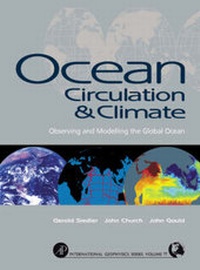
Ocean Circulation and Climate: Volume 103
Observing and Modelling the Global Ocean
Published on 27. March 2001
Book
Hardback
715 pages
978-0-12-641351-9 (ISBN)
Description
The book represents all the knowledge we currently have on ocean circulation. It presents an up-to-date summary of the state of the science relating to the role of the oceans in the physical climate system.The book is structured to guide the reader through the wide range of World Ocean Circulation Experiment (WOCE) science in a consistent way. Cross-references between contributors have been added, and the book has a comprehensive index and unified reference list.The book is simple to read, at the undergraduate level. It was written by the best scientists in the world who have collaborated to carry out years of experiments to better understand ocean circulation.
Reviews / Votes
"Ocean Circulation and Climate' is the culmination of a multi-national, multi-decadal program designed to observe the global ocean. ...a voluminous book, unique in that there is no other single volume to which one can turn as a source for the cutting edge of knowledge of the large-scale circulation and properties of the ocean. ...lays the foundation for the daunting challenge of understanding the future of the world oceans and their role in climate change."-EPISODES - JOURNAL OF INTERNATIONAL GEOSCIENCE
"...excellent editing and production quality plus hundreds of diagrams and dozens of color plates. It will be essential for ocean and climate scientists for years to come."
--NEW SCIENTIST, October 2001
"This compilation addresses such topics as the role of the oceans in climate, ocean-atmosphere coupling, water mass formation, and the transport of momentum, heat, and freshwater throughout the global ocean. Interwoven into the narrative is a rich history of the development of modern oceanography, and beautiful color plates... This volume will serve as a resource for graduate students in oceanography and climatology and as a reference for researchers and professionals, including meteorologists."
--CHOICE, December 2001
"Oceanographers, meteorologists, and climate scientists will find this book to be of particular value."
--NORTHEASTERN NATURALIST, 2005
More details
Series
Language
English
Place of publication
San Diego
United States
Publishing group
Elsevier Science Publishing Co Inc
Target group
College/higher education
Graduate students, practitioners, researchers in oceanographic fields, atmospheric and meteorological studies.
Dimensions
Height: 270 mm
Width: 200 mm
Weight
2220 gr
ISBN-13
978-0-12-641351-9 (9780126413519)
Copyright in bibliographic data and cover images is held by Nielsen Book Services Limited or by the publishers or by their respective licensors: all rights reserved.
Schweitzer Classification
Other editions
New editions
Gerold Siedler | Stephen M. Griffies | John Gould
Ocean Circulation and Climate: Volume 103
A 21st Century Perspective
Book
11/2013
2nd Edition
Academic Press
€138.50
Shipment within 15-20 days
Additional editions
Ocean Circulation and Climate
Observing and Modelling the Global Ocean
E-Book
03/2001
1st Edition
Academic Press
€98.95
Available for download
Persons
Gerold Siedler is a physical oceanographer at the marine research institute in Kiel/Germany. He established a highly regarded ocean observing unit and participated in almost 30 research cruises. His research focused on ocean processes and circulation in all three oceans. He was professor at Kiel University, Director of the marine research institute IfM (1976-1978) and Dean of the Faculty of Mathematics and Sciences (1991-1992) at Kiel University. In addition he worked as visiting investigator abroad, in particular at the Woods Hole Oceanographic Institution in the USA, including teaching in the WHOI/MIT joint program. He performed research at the University of Miami, the Jet Propulsion Laboratory/Pasadena, the University of Hawaii in the USA, the Laboratory for the Physics of the Ocean, Paris and Ifremer/Brest in France, and as a Humboldt researcher at the University of Cape Town in South Africa. He served in leading functions in major international ocean/climate programs, in particular GATE and WOCE. He was a vice-president of the Association for the Physical Sciences of the Ocean (IAPSO, 1975-1979) and a president of the Scientific Committee on Oceanic Research (SCOR, 1983-1988) at ICSU. He published 77 peer-reviewed papers, authored or edited 4 books and contributed to 18 books. He is now Emeritus Professor at Kiel University. John Gould (sometimes known as W. John) has had a long career in ocean research mostly focused on the collection and interpretation of ocean current measurements. His career started with working with John Swallow, who first developed the neutrally buoyant float at the UK National Institute of Oceanography. He led many research cruises in the North Atlantic Ocean. He was Project Director of the World Climate Research Programme's World Ocean Circulation Experiment- WOCE (1993-2002) and of its Climate Variability and Predictability Study -CLIVAR (1998-2002). From 2002-2006 he directed the international Argo profiling float project. At various times he has chaired the ICES Oceanic Hydrography Working Group and been a member of the executive of the International Association for the Physical Sciences of the Ocean and a member of the advisory board for Australia's Integrated Marine Observing System (IMOS). He has an interest in widening public awareness of marine science and of the oceans' role in climate. He is a member of the International Union of Geodesy and Geophysic's History Working Group and is a visiting scientist at the UK's National Oceanography Centre. John Church is a CSIRO Fellow with the Centre for Australian Weather and Climate Research. His area of expertise is the role of the ocean in climate, particularly anthropogenic climate change and sea-level rise. He has been a Principal Investigator on NASA/CNES satellite altimeter Science Working Teams since 1987. He was co-convening lead author for the Chapter on Sea Level in the IPCC Third and Fifth Assessment Reports. He Co-Chaired the international Scientific Steering Group for the World Ocean Circulation Experiment from 1994 to 1998 and Chaired the Joint Scientific Committee of the World Climate Research Programme from 2006 to 2008. He was awarded the 2006 Roger Revelle Medal by the Intergovernmental Oceanographic Commission, was a winner of a CSIRO Medal for Research Achievement in 2006, won the 2007 Eureka Prize for Scientific Research and presented the 2008 AMOS R.H. Clarke Lecture. He is the author of over 120 refereed publications, 80 other reports and co-edited three books. He is a Fellow of the Australian Academy of Science and the Australian Academy of Technological Sciences and Engineering.
Content
The Ocean and Climate:
Climate and Oceans
Ocean Processes and Climate Phenomena
The Origins, Development, and Conduct of WOCE
Observations and Models:
Global Problems and Global Observations
High-Resolution Modeling of the Thermohaline and Wind-Driven Circulation
Coupled Ocean-Atmosphere Models
New Ways of Observing the Ocean:
Shipboard Observations during WOCE
Subsurface Lagrangian Observations During the 1990s
Ocean Circulation and Variability from Satellite Altimetry
Air-Sea Fluxes from Satellite Data
Developing the WOCE Global Data System
The Global Flow Field:
The World Ocean Surface Circulation
The Interior Circulation of the Ocean
The Tropical Ocean Circulation
Tropical-Extratropical Oceanic Exchange Pathways
Quantification of the Deep Circulation
The Antarctic Circumpolar Current System
Interocean Exchange
Formation and Transport of Water Masses:
Ocean Surface Water Mass Transformation
Mixing and Stirring in the Ocean Interior
Subduction
Mode Waters
Deep Convection
The Dense Northern Overflows
Mediterranean Water and Global Circulation
Transformation and Age of Water Masses
Large-Scale Ocean Transports:
Ocean Heat Transport
Ocean Transport of Fresh Water
Storage and Transport of Excess CO2 in the Oceans, The JGOFS/WOCE Global CO2 Survey
Insights for the Future
Towards a WOCE Synthesis
Numerical Ocean Circulation Modeling, Present Status and Future Directions
The World During WOCE
Climate and Oceans
Ocean Processes and Climate Phenomena
The Origins, Development, and Conduct of WOCE
Observations and Models:
Global Problems and Global Observations
High-Resolution Modeling of the Thermohaline and Wind-Driven Circulation
Coupled Ocean-Atmosphere Models
New Ways of Observing the Ocean:
Shipboard Observations during WOCE
Subsurface Lagrangian Observations During the 1990s
Ocean Circulation and Variability from Satellite Altimetry
Air-Sea Fluxes from Satellite Data
Developing the WOCE Global Data System
The Global Flow Field:
The World Ocean Surface Circulation
The Interior Circulation of the Ocean
The Tropical Ocean Circulation
Tropical-Extratropical Oceanic Exchange Pathways
Quantification of the Deep Circulation
The Antarctic Circumpolar Current System
Interocean Exchange
Formation and Transport of Water Masses:
Ocean Surface Water Mass Transformation
Mixing and Stirring in the Ocean Interior
Subduction
Mode Waters
Deep Convection
The Dense Northern Overflows
Mediterranean Water and Global Circulation
Transformation and Age of Water Masses
Large-Scale Ocean Transports:
Ocean Heat Transport
Ocean Transport of Fresh Water
Storage and Transport of Excess CO2 in the Oceans, The JGOFS/WOCE Global CO2 Survey
Insights for the Future
Towards a WOCE Synthesis
Numerical Ocean Circulation Modeling, Present Status and Future Directions
The World During WOCE