

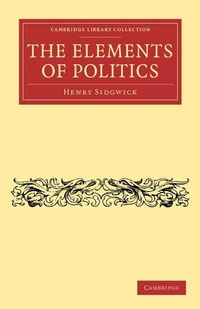
The Elements of Politics
1st Edition
Published on 26. January 2012
Book
Paperback/Softback
670 pages
978-1-108-04393-9 (ISBN)
Description
One of the most influential of the Victorian philosophers, Henry Sidgwick (1838-1900) also made important contributions to fields such as economics, political theory and classics. A proponent of the utilitarianism of Jeremy Bentham and John Stuart Mill, which he analysed in his classic work The Methods of Ethics (1874; also reissued in this series), he later turned to the practical side of politics in this work, published in 1891. His aim was to have a 'rational discussion of political questions in modern states', and he offers a thorough examination of Victorian politics, beginning with a discussion of political theory before moving on to more concrete matters such as property and law. The later chapters discuss the function of government through themes such as procedural matters, international affairs, war, political parties, and public participation, giving a comprehensive account of both ideas about and the functioning of late-nineteenth-century government.
More details
Series
Language
English
Place of publication
Cambridge
United Kingdom
Target group
Professional and scholarly
Product notice
Paperback (trade)
Illustrations
Worked examples or Exercises
Dimensions
Height: 216 mm
Width: 140 mm
Thickness: 39 mm
Weight
931 gr
ISBN-13
978-1-108-04393-9 (9781108043939)
Copyright in bibliographic data and cover images is held by Nielsen Book Services Limited or by the publishers or by their respective licensors: all rights reserved.
Schweitzer Classification
Content
Preface; Part I: 1. Scope and method of politics; 2. Fundamental conception of politics; 3. General principles of legislation; 4. Individualism and individualism minimum; 5. On property; 6. Contract; 7. Inheritance; 8. Remedies for wrongs; 9. Prevention of mischief and paternal interference; 10. Socialistic interference; 11. The maintenance of government; 12. Governmental encroachments and compensation; 13. Law and morality; 14. The area of government - states and districts; 15. Principles of international duty; 16. The regulation of war; 17. International law and morality; 18. Principles of external policy; Part II: 19. Methods and instruments of government; 20. The legislature; 21. The executive; 22. Relation of legislature to executive; 23. Two chambers and their functions; 24. The judiciary and its relation to other organs; 25. Local and sectional government; 26. Federal and other composite states; 27. The control of the people over government; 28. The state and voluntary associations; 29. Parties and party government; 30. Classification of governments; 31. Sovereignty and order; Index.