

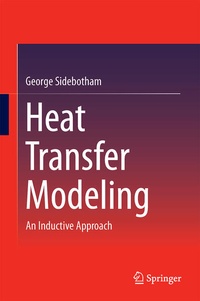
Heat Transfer Modeling
An Inductive Approach
Published on 1. March 2015
Book
Hardback
XVIII, 516 pages
978-3-319-14513-6 (ISBN)
Description
This innovative text emphasizes a "less-is-more" approach to modeling complicated systems such as heat transfer by treating them first as "1-node lumped models" that yield simple closed-form solutions. The author develops numerical techniques for students to obtain more detail, but also trains them to use the techniques only when simpler approaches fail. Covering all essential methods offered in traditional texts, but with a different order, Professor Sidebotham stresses inductive thinking and problem solving as well as a constructive understanding of modern, computer-based practice. Readers learn to develop their own code in the context of the material, rather than just how to use packaged software, offering a deeper, intrinsic grasp behind models of heat transfer. Developed from over twenty-five years of lecture notes to teach students of mechanical and chemical engineering at The Cooper Union for the Advancement of Science and Art, the book is ideal for students and practitionersacross engineering disciplines seeking a solid understanding of heat transfer.This book also:· Adopts a novel inductive pedagogy where commonly understood examples are introduced early and theory is developed to explain and predict readily recognized phenomena · Introduces new techniques as needed to address specific problems, in contrast to traditional texts' use of a deductive approach, where abstract general principles lead to specific examples· Elucidates readers' understanding of the "heat transfer takes time" idea-transient analysis applications are introduced first and steady-state methods are shown to be a limiting case of those applications · Focuses on basic numerical methods rather than analytical methods of solving partial differential equations, largely obsolete in light of modern computer power· Maximizes readers' insights to heat transfer modeling by framing theory as an engineering designtool, not as a pure science, as has been done in traditional textbooks· Integrates practical use of spreadsheets for calculations and provides many tips for their use throughout the text examples
Reviews / Votes
"The present text is a worthy addition to an already impressive list of undergraduate-oriented textbooks on the theory and application of heat transfer. . Sidebotham (Cooper Union) presents the central model of thermal resistance and capacitance to describe the transient and steady-state heat transfer processes. . Summing Up: Highly recommended. Upper-division undergraduates, researchers/faculty, and professionals/practitioners." (B. Tao, Choice, Vol. 53 (2), October, 2015)
More details
Edition
2015
Language
English
Place of publication
Cham
Switzerland
Publishing group
Springer International Publishing
Target group
Upper undergraduate
Illustrations
253 s/w Abbildungen, 56 farbige Abbildungen
XVIII, 516 p. 309 illus., 56 illus. in color.
Dimensions
Height: 241 mm
Width: 160 mm
Thickness: 35 mm
Weight
963 gr
ISBN-13
978-3-319-14513-6 (9783319145136)
DOI
10.1007/978-3-319-14514-3
Schweitzer Classification
Other editions
Additional editions
Book
10/2016
Springer
€69.54
Shipment within 10-15 days
E-Book
02/2015
Springer
€69.54
Available for download
Person
Dr. George Sidebotham is Professor of Mechanical Engineering at the Cooper Union for the Advancement of Arts and Sciences in New York City.
Content
Part I Modes of Heat Transfer.- Thermal Circuits.- Lumped Capacity Systems and Overall Heat Transfer Coefficients.- Part II Transient Conduction (with Convective/Radiative.- Boundary Conditions).- Part III Steady-State Conduction (with Convective/Radiative.- Boundary Conditions).- Part IV Heat Exchangers.- Internal Flow Models.- Heat Exchangers.