

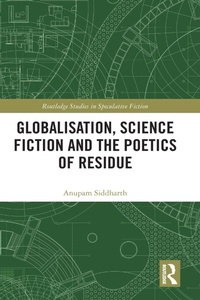
Globalisation, Science Fiction and the Poetics of Residue
1st Edition
Published on 19. May 2026
Book
Hardback
254 pages
978-1-041-11564-9 (ISBN)
Description
Globalisation, Science Fiction and the Poetics of Residue turns to science fiction as an unexpected guide for mapping globalisation's true impact. The relentless pace of global capitalism has been creating a bewildering array of changes, leaving us often disoriented and unable to fathom its true dimensions or what is at stake. Yet this book argues that possible answers lie not in chasing the latest developments but in examining what gets discarded along the way.
Science fiction has always been fascinated with the new and the futuristic. But what if we shifted gears to look instead at what gets thrown away or left behind in these imagined worlds? This book argues that by focusing on the waste and remnants of globalisation in science fiction, we can better understand how global processes actually work. The residue becomes a powerful lens for seeing patterns that traditional approaches miss. This perspective transforms how we read science fiction itself, revealing the genre's ability to illuminate the hidden costs of progress under globalisation.
Drawing on popular contemporary works, including stories that have reached mainstream audiences and are enjoying successful adaptations like Netflix's The Three-Body Problem, this book bridges academic research with broader cultural conversations. In our current moment of climate crisis and mounting environmental concerns, examining what civilisations choose to leave behind has never been more relevant.
Science fiction has always been fascinated with the new and the futuristic. But what if we shifted gears to look instead at what gets thrown away or left behind in these imagined worlds? This book argues that by focusing on the waste and remnants of globalisation in science fiction, we can better understand how global processes actually work. The residue becomes a powerful lens for seeing patterns that traditional approaches miss. This perspective transforms how we read science fiction itself, revealing the genre's ability to illuminate the hidden costs of progress under globalisation.
Drawing on popular contemporary works, including stories that have reached mainstream audiences and are enjoying successful adaptations like Netflix's The Three-Body Problem, this book bridges academic research with broader cultural conversations. In our current moment of climate crisis and mounting environmental concerns, examining what civilisations choose to leave behind has never been more relevant.
More details
Series
Language
English
Place of publication
London
United Kingdom
Publishing group
Taylor & Francis Ltd
Target group
College/higher education
Postgraduate
Product notice
Laminated cover
Dimensions
Height: 254 mm
Width: 178 mm
Thickness: 16 mm
Weight
674 gr
ISBN-13
978-1-041-11564-9 (9781041115649)
Copyright in bibliographic data and cover images is held by Nielsen Book Services Limited or by the publishers or by their respective licensors: all rights reserved.
Schweitzer Classification
Other editions
Additional editions
Anupam Siddharth
Globalisation, Science Fiction and the Poetics of Residue
E-Book
05/2026
Routledge
€60.49
Available for download
Anupam Siddharth
Globalisation, Science Fiction and the Poetics of Residue
E-Book
05/2026
Routledge
€60.49
Available for download
Person
Anupam Siddharth studied German literature at the University of Delhi and English and American Studies at the University of Potsdam. His research interests include science fiction, contemporary German literature and theoretical fiction.
Content
Acknowledgements Introduction 1 Becoming Residue: From Contingency to Politicisation 2 Gazing Into the Future or Looking Back 3 Transformative Mapping or Living in the Ruins of Globalisation: Residue in Georg Klein's Die Zukunft des Mars and Reinhard Jirgl's Nichts von Euch auf Erden 4 The Residual Subject in Vandana Singh's Distances 5 Of Art as Residue and Residual Art in Dietmar Dath's Feldevaye 6 Advance! Advance! Stop at Nothing to Advance!: Progress in Cixin Liu's Three-Body Series Conclusion