

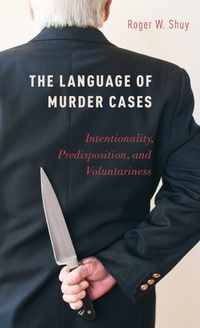
The Language of Murder Cases
Intentionality, Predisposition, and Voluntariness
Published on 15. May 2014
Book
Hardback
288 pages
978-0-19-935483-2 (ISBN)
Description
The Language of Murder Cases describes fifteen court cases for which Roger Shuy served as an expert language witness, and explains the issues at stake in those cases for lawyers and linguists. Investigations and trials in murder cases are guided by the important legal terms describing the mental states of defendants-their intentionality, predisposition, and voluntariness. Unfortunately, statutes and dictionaries can provide only loose definitions of these terms, largely because mental states are virtually impossible to define. Their meaning, therefore, must be adduced either by inferences and assumptions, or by any available language evidence-which is often the best window into a speaker's mind. Fortunately, this window of evidence exists primarily in electronically recorded undercover conversations, police interviews, and legal hearings and trials, all of which are subject to linguistic analysis during trial.
This book examines how vague legal terminology can be clarified by analysis of the language used by suspects, defendants, law enforcement officers, and attorneys. Shuy examines speech events, schemas, agendas, speech acts, conversational strategies, and smaller language units such as syntax, lexicon, and phonology, and discusses how these examinations can play a major role in deciding murder cases. After defining key terms common in murder investigations, Shuy describes fifteen fascinating cases, analyzing the role that language played in each. He concludes with a summary of how his analyses were regarded by the juries as they struggled with the equally vague concept of reasonable doubt.
This book examines how vague legal terminology can be clarified by analysis of the language used by suspects, defendants, law enforcement officers, and attorneys. Shuy examines speech events, schemas, agendas, speech acts, conversational strategies, and smaller language units such as syntax, lexicon, and phonology, and discusses how these examinations can play a major role in deciding murder cases. After defining key terms common in murder investigations, Shuy describes fifteen fascinating cases, analyzing the role that language played in each. He concludes with a summary of how his analyses were regarded by the juries as they struggled with the equally vague concept of reasonable doubt.
Reviews / Votes
My guess is that each person will take away something different from this book and may take away different things at different times... This is the book you may think you don't need, but that's exactly why you should get it. * The Journal of the Association of Anglican Musicians *More details
Language
English
Place of publication
New York
United States
Target group
College/higher education
Professional and scholarly
Dimensions
Height: 222 mm
Width: 145 mm
Thickness: 19 mm
Weight
494 gr
ISBN-13
978-0-19-935483-2 (9780199354832)
Copyright in bibliographic data and cover images is held by Nielsen Book Services Limited or by the publishers or by their respective licensors: all rights reserved.
Schweitzer Classification
Other editions
Additional editions

Roger W. Shuy
Language of Murder Cases: Intentionality, Predisposition, and Voluntariness
Intentionality, Predisposition, and Voluntariness
E-Book
03/2014
1st Edition
Oxford University Press, USA
€71.49
Available for download
Person
Roger W. Shuy is Emeritus Professor of Linguistics at Georgetown University and the author of many previous books on language and law. Over the years has consulted on some 600 civil and criminal law cases and has testified at many federal, state trials as well as at the International Criminal Tribunal and before the US Congress on impeachment hearings.
Content
1 Introduction ; 2 Murder laws and terminology ; 3 Analyzing murder law terminology and evidence ; 4 Linguistic profiling when there is no known murder suspect ; The Unabomber Case ; Gary Indiana women's medical clinic ; 5 Intentionality and predisposition in murder cases ; The State of Texas v. T. Cullen Davis ; The Crown v. Mohammed Arshad ; The State of Washington v. Michael Mockovac ; 6 Voluntariness in murder cases ; 7 Voluntariness of mentally incapacitated suspects capacity ; The State of Florida v. Jerry Townsend ; The State of Michigan v. Benjamin Hauswirth ; The State of Alaska v. Larry Gentry ; 8 Voluntariness of suspects impaired by alcohol or drugs ; The State of Nevada v. Shelli Dewey ; The State of Florida v. Robert Alben ; The State of Ohio v. Charles Lorraine ; 9 Voluntariness of juvenile suspects ; The State of Louisiana v. Michael Carter ; The State of Texas v. Kevin Rogers ; 10 Voluntariness of emotionally distraught suspects ; The State of Okahama v. Stephen Allen ; Commonwealth of Virginia v. Beverly Monroe ; 11 Reasonable doubt in murder cases ; References ; Cases cited ; Index