

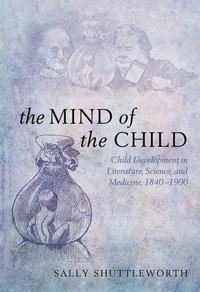
The Mind of the Child
Child Development in Literature, Science, and Medicine 1840-1900
Published on 10. October 2013
Book
Paperback/Softback
510 pages
978-0-19-968217-1 (ISBN)
Description
What is the difference between a lie and a fantasy, when the subject is a child? Moving between literary and scientific texts, Sally Shuttleworth explores a range of fascinating issues that emerge when the inner world of the child becomes, for the first time, the explicit focus of literary and medical attention. Starting in the 1840s, which saw the publication of explorations of child development by Bronte and Dickens, as well as some of the first psychiatric studies of childhood, this groundbreaking book progresses through post-Darwinian considerations of the child's relations to the animal kingdom, to chart the rise of the Child Study Movement of the 1890s.
Based on in-depth interdisciplinary research, The Mind of the Child offers detailed readings of novels by Dickens, Meredith, James, Hardy and others, as well as the first overview of the early histories of child psychology and psychiatry. Initial chapters cover issues such as fears and night terrors, imaginary lands, and the precocious child, while later ones look at ideas of child sexuality and adolescence and the relationship between child and monkey. Experiments on babies, the first baby shows, and domestic monkey keeping also feature.
Many of our current concerns with reference to childhood are shown to have their parallels in the Victorian age: from the pressures of school examinations, or the problems of adolescence, through to the disturbing issue of child suicide. Childhood, from this period, took on new importance as holding the key to the adult mind.
Based on in-depth interdisciplinary research, The Mind of the Child offers detailed readings of novels by Dickens, Meredith, James, Hardy and others, as well as the first overview of the early histories of child psychology and psychiatry. Initial chapters cover issues such as fears and night terrors, imaginary lands, and the precocious child, while later ones look at ideas of child sexuality and adolescence and the relationship between child and monkey. Experiments on babies, the first baby shows, and domestic monkey keeping also feature.
Many of our current concerns with reference to childhood are shown to have their parallels in the Victorian age: from the pressures of school examinations, or the problems of adolescence, through to the disturbing issue of child suicide. Childhood, from this period, took on new importance as holding the key to the adult mind.
Reviews / Votes
Review from previous edition pioneering study of Victorian childhood * William Baker, Years Work in English Studies * Incorporating a wide range of historical documents and literary texts, and written in a clear, engaging style...a stimulating new perspective on the history of child development, which will appeal to a broad range of readers. * Roisin McCloskey, English * This is one of those books that makes so much sense that one cannot believe it has not been written before * Charlotte Sleigh, British Journal for the History of Science * A monumental piece of scholarship, impeccably researched and full of illuminating detail. * Gregory Tate, MLR, 106.4, 2011 * In this fascinating volume a highly complex story is deployed with deceptive ease. * Metapsychology online reviews * This extremely readable, enormously wide-ranging work is a welcome addition to the shelves of literature and science scholarship * Melanie Keene, BSLS * Shuttleworth is masterful... [She] takes on an impressively wide range of topics in child-study and draws fascinating and often unexpected connections between them... In the end, The Mind of the Child prompts us to rethink our own assumptions about the history of childhood by revealing that the complexity of nineteenth-century discussions of child development is as layered and rich as is an actual human mind. * Andrea Kaston Tange, Nineteenth-Century Gender Studies *More details
Language
English
Place of publication
Oxford
United Kingdom
Target group
College/higher education
Professional and scholarly
Illustrations
17 black-and-white halftones
Dimensions
Height: 233 mm
Width: 156 mm
Thickness: 27 mm
Weight
772 gr
ISBN-13
978-0-19-968217-1 (9780199682171)
Copyright in bibliographic data and cover images is held by Nielsen Book Services Limited or by the publishers or by their respective licensors: all rights reserved.
Schweitzer Classification
Other editions
Additional editions
Sally Shuttleworth
The Mind of the Child
Child Development in Literature, Science, and Medicine, 1840-1900
Book
07/2010
Oxford University Press
€146.50
Shipment within 15-20 days
Person
Professor Sally Shuttleworth is Head of the Humanities Division at the University of Oxford. She has published widely on literature and science, including George Eliot and Nineteenth-century Science; Charlotte Bronte and Victorian Psychology and Embodied Selves: An Anthology of Psychological Texts, 1830-1890 (co-edited with Jenny Bourne Taylor). She also co-directed the Science in the Nineteenth-Century Periodical project.
Content
LIST OF ILLUSTRATIONS ; INTRODUCTION ; PART I EARLY CHILD PSYCHIATRY AND THE LITERARY IMAGINATION ; 1. The Emergence of Child Psychiatry ; 2. Fears, Phantasms, and Night Terrors ; 3. Lies and Imagination ; 4. Imaginary Lands ; 5. Passion ; PART II SYSTEMATIC EDUCATION ; 6. The Forcing Apparatus: Dombey and Son ; 7. Progress, Pressure, and Precocity ; 8. Science, System, and the Sexual Body: The Ordeal of Richard Feverel ; PART III POST-DARWINIAN CHILDHOOD: SEXUALITY AND ANIMALITY ; 9. Childhood in Post-Darwinian Psychiatry ; 10. Childhood, Sexuality, and the Novel ; 11. The Science of Child Development ; 12. Experiments on Babies ; 13. Monkeys and Children ; PART IV CHILDHOOD AT THE FIN-DE-SIECLE ; 14. Child Study in the 1890s ; 15. Autobiography and the Science of Child Study ; 16. Unnatural History: Father and Son ; 17. Childhood as Performance: What Maisie Knew ; 18. Jude the Obscure and Child Suicide ; CONCLUSION