

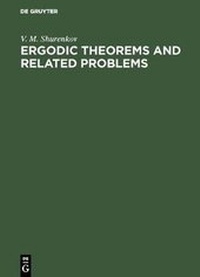
Ergodic Theorems and Related Problems
1st Edition
Will be published approx. on 1. April 1998
Book
Hardback
XII, 96 pages
978-90-6764-282-8 (ISBN)
Description
01/07 This title is now available from Walter de Gruyter. Please see www.degruyter.com for more information.
In the theory of random processes the term 'ergodicity' has a wide variety of meanings. In the theory of stationary processes ergodicity is often identified with metric transitivity. In the theory of Markov processes, the word ergodic is applied to theorems of both the existence of transition probability limits and on the convergence of mean value ratios of these transition probabilities. In addition, there are also 'ergodic theorems' on the convergence of distributions of shifted random processes.
In this monograph, the term 'ergodic' is understood in its original sense, i.e. the one it had when it was first adopted by the theory of random processes from statistical mechanics and Boltzmann's theory of gases. In this book, an ergodic theorem refers to any statement about the existence of a mean value with respect to trajectories of a random process taken with respect to time. The author takes the view that problems of the existence of time means, and their equality to phase means, are interesting without any assumptions about the distribution of the random process.
In the theory of random processes the term 'ergodicity' has a wide variety of meanings. In the theory of stationary processes ergodicity is often identified with metric transitivity. In the theory of Markov processes, the word ergodic is applied to theorems of both the existence of transition probability limits and on the convergence of mean value ratios of these transition probabilities. In addition, there are also 'ergodic theorems' on the convergence of distributions of shifted random processes.
In this monograph, the term 'ergodic' is understood in its original sense, i.e. the one it had when it was first adopted by the theory of random processes from statistical mechanics and Boltzmann's theory of gases. In this book, an ergodic theorem refers to any statement about the existence of a mean value with respect to trajectories of a random process taken with respect to time. The author takes the view that problems of the existence of time means, and their equality to phase means, are interesting without any assumptions about the distribution of the random process.
More details
Other editions
New editions
V. M. Shurenkov
Ergodic Theorems and Related Problems
Book
04/1998
1st Edition
De Gruyter
€179.95
Shipment within 7-9 days
Additional editions
V. M. Shurenkov
Ergodic Theorems and Related Problems
E-Book
11/2018
1st Edition
De Gruyter
€179.95
Available for download

V. M. Shurenkov
Ergodic Theorems and Related Problems
Book
01/2018
1st Edition
De Gruyter
€259.00
The article will not be published
V. M. Shurenkov
Ergodic Theorems and Related Problems
Book
04/1998
1st Edition
De Gruyter
€179.95
Shipment within 7-9 days
Content
Preface
Introduction
1. Stationary processes
1.1 Convergence and invariance
1.2 Translation operators
1.3 Examples
2. Markovian processes
2.1 Recurrent Markovian chains
2.2 Sometimes Markovian chains
3. A random walk on the semiaxis
3.1 Semicontinuous processes with independent increments in a random medium
3.2 Boundary-value conditions
3.3 The ergodic theorem
Short bibliographical indications
Introduction
1. Stationary processes
1.1 Convergence and invariance
1.2 Translation operators
1.3 Examples
2. Markovian processes
2.1 Recurrent Markovian chains
2.2 Sometimes Markovian chains
3. A random walk on the semiaxis
3.1 Semicontinuous processes with independent increments in a random medium
3.2 Boundary-value conditions
3.3 The ergodic theorem
Short bibliographical indications