

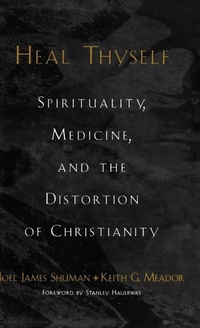
Heal Thyself
Spirituality, Medicine, and the Distortion of Christianity
Published on 16. January 2003
Book
Hardback
192 pages
978-0-19-515469-6 (ISBN)
Description
In recent years, a movement stressing a causal relationship between spirituality and good health has captured the public imagination. Told that research demonstrates that people of strong faith are healthier, physicians and clergy alike urge us to become more religious.
The religion and health movement, as it has become known, has attracted its fair share of sceptics. While most root their criticism in science or secularism, the authors of Heal Thyself, one a theological ethicist, the other a physician, instead challenge the basic precepts of the movement from the standpoint of Christian theology.
Heal Thyself argues that popular culture's fascination with the health benefits of religion reflects not the renaissance of religious tradition but the powerful combination of consumer capitalism and self-interested individualism. A faith-for-health exchange misrepresents and devalues the true meaning of faith.
For Christians, being religious does not mean enlisting faith as a vehicle to get what we want-be it health or wealth-but rather learning by faith to want the right things at the right time, and to live with a spirit of gratitude and hope.
The religion and health movement, as it has become known, has attracted its fair share of sceptics. While most root their criticism in science or secularism, the authors of Heal Thyself, one a theological ethicist, the other a physician, instead challenge the basic precepts of the movement from the standpoint of Christian theology.
Heal Thyself argues that popular culture's fascination with the health benefits of religion reflects not the renaissance of religious tradition but the powerful combination of consumer capitalism and self-interested individualism. A faith-for-health exchange misrepresents and devalues the true meaning of faith.
For Christians, being religious does not mean enlisting faith as a vehicle to get what we want-be it health or wealth-but rather learning by faith to want the right things at the right time, and to live with a spirit of gratitude and hope.
Reviews / Votes
... the moment is ripe for a sharp critique of the too-easy, too-popular attempt to marry religion and health. * Bulletin of the History of Medicine * The authors argue their case at a high theological level ... Readers who enjoy the history of ideas will find much to ponder in these pages. * Theology *More details
Language
English
Place of publication
New York
United States
Target group
Professional and scholarly
Dimensions
Height: 222 mm
Width: 145 mm
Thickness: 14 mm
Weight
377 gr
ISBN-13
978-0-19-515469-6 (9780195154696)
Copyright in bibliographic data and cover images is held by Nielsen Book Services Limited or by the publishers or by their respective licensors: all rights reserved.
Schweitzer Classification
Other editions
Additional editions
Joel James Shuman | Keith G. Meador
Heal Thyself
Spirituality, Medicine, and the Distortion of Christianity
E-Book
12/2002
1st Edition
OUP eBook
€27.49
Available for download
Persons
Author of The Body of Compassion: Ethics, Medicine, and the Church, Joel James Shuman is Assistant Professor of Theology at King's College in Wilkes-Barre, Pennsylvania. Keith G. Meador is Clinical Professor of Psychiatry and Behavioral Science at the School of Medicine, and Professor of the Practice of Pastoral Theology and Medicine and Director of the Theology and Medicine Program at The Divinity School at Duke University.
Author
Assistant Professor of TheologyAssistant Professor of Theology, King's College, Pennsylvania
Professor of the Practice of Pastoral Theology and Medicine and Director of the Theology and Medicine Program at the Divinity School and Clinical Professor of Psychiatry and Behavioral Science, School of MedicineProfessor of the Practice of Pastoral Theology and Medicine and Director of the Theology and Medicine Program at the Divinity School and Clinical Professor of Psychiatry and Behavioral Science, School of Medicine, Duke University