

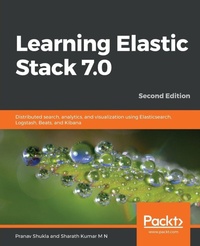
Learning Elastic Stack 7.0
Distributed search, analytics, and visualization using Elasticsearch, Logstash, Beats, and Kibana
2nd Edition
Published on 31. May 2019
Book
Paperback/Softback
474 pages
978-1-78995-439-5 (ISBN)
Description
A beginner\'s guide to storing, managing, and analyzing data with the updated features of Elastic 7.0
Key Features
Gain access to new features and updates introduced in Elastic Stack 7.0
Grasp the fundamentals of Elastic Stack including Elasticsearch, Logstash, and Kibana
Explore useful tips for using Elastic Cloud and deploying Elastic Stack in production environments
Book DescriptionThe Elastic Stack is a powerful combination of tools that help in performing distributed search, analytics, logging, and visualization of data. Elastic Stack 7.0 encompasses new features and capabilities that will enable you to find unique insights into analytics using these techniques. This book will give you a fundamental understanding of what the stack is all about, and guide you in using it efficiently to build powerful real-time data processing applications.
The first few sections of the book will help you understand how to set up the stack by installing tools and exploring their basic configurations. You'll then get up to speed with using Elasticsearch for distributed search and analytics, Logstash for logging, and Kibana for data visualization. As you work through the book, you will discover the technique of creating custom plugins using Kibana and Beats. This is followed by coverage of the Elastic X-Pack, a useful extension for effective security and monitoring. You'll also find helpful tips on how to use Elastic Cloud and deploy Elastic Stack in production environments.
By the end of this book, you'll be well-versed with fundamental Elastic Stack functionalities and the role of each component in the stack to solve different data processing problems.What you will learn
Install and configure an Elasticsearch architecture
Solve the full-text search problem with Elasticsearch
Discover powerful analytics capabilities through aggregations using Elasticsearch
Build a data pipeline to transfer data from a variety of sources into Elasticsearch for analysis
Create interactive dashboards for effective storytelling with your data using Kibana
Secure, monitor, and use Elastic Stack's alerting and reporting capabilities
Take applications to an on-premise or cloud-based production environment with Elastic Stack
Who this book is forThis book is for entry-level data professionals, software engineers, e-commerce developers, and full-stack developers who want to learn about Elastic Stack and understand how the real-time processing and search engine works for business analytics and enterprise search applications. Experience with Elastic Stack is not required, however knowledge of data warehousing and database concepts will be helpful.
Key Features
Gain access to new features and updates introduced in Elastic Stack 7.0
Grasp the fundamentals of Elastic Stack including Elasticsearch, Logstash, and Kibana
Explore useful tips for using Elastic Cloud and deploying Elastic Stack in production environments
Book DescriptionThe Elastic Stack is a powerful combination of tools that help in performing distributed search, analytics, logging, and visualization of data. Elastic Stack 7.0 encompasses new features and capabilities that will enable you to find unique insights into analytics using these techniques. This book will give you a fundamental understanding of what the stack is all about, and guide you in using it efficiently to build powerful real-time data processing applications.
The first few sections of the book will help you understand how to set up the stack by installing tools and exploring their basic configurations. You'll then get up to speed with using Elasticsearch for distributed search and analytics, Logstash for logging, and Kibana for data visualization. As you work through the book, you will discover the technique of creating custom plugins using Kibana and Beats. This is followed by coverage of the Elastic X-Pack, a useful extension for effective security and monitoring. You'll also find helpful tips on how to use Elastic Cloud and deploy Elastic Stack in production environments.
By the end of this book, you'll be well-versed with fundamental Elastic Stack functionalities and the role of each component in the stack to solve different data processing problems.What you will learn
Install and configure an Elasticsearch architecture
Solve the full-text search problem with Elasticsearch
Discover powerful analytics capabilities through aggregations using Elasticsearch
Build a data pipeline to transfer data from a variety of sources into Elasticsearch for analysis
Create interactive dashboards for effective storytelling with your data using Kibana
Secure, monitor, and use Elastic Stack's alerting and reporting capabilities
Take applications to an on-premise or cloud-based production environment with Elastic Stack
Who this book is forThis book is for entry-level data professionals, software engineers, e-commerce developers, and full-stack developers who want to learn about Elastic Stack and understand how the real-time processing and search engine works for business analytics and enterprise search applications. Experience with Elastic Stack is not required, however knowledge of data warehousing and database concepts will be helpful.
More details
Edition
2nd Revised edition
Language
English
Place of publication
Birmingham
United Kingdom
Edition type
Revised edition
Dimensions
Height: 235 mm
Width: 191 mm
Thickness: 26 mm
Weight
877 gr
ISBN-13
978-1-78995-439-5 (9781789954395)
Copyright in bibliographic data and cover images is held by Nielsen Book Services Limited or by the publishers or by their respective licensors: all rights reserved.
Schweitzer Classification
Other editions
Additional editions
Pranav Shukla | Sharath Kumar
Learning Elastic Stack 7.0
Distributed search, analytics, and visualization using Elasticsearch, Logstash, Beats, and Kibana
E-Book
06/2024
2nd Edition
Packt Publishing Limited
€27.49
Available for download
Persons
Pranav Shukla is the founder and CEO of Valens DataLabs, a technologist, husband, and father of two. He is a big data architect and software craftsman who uses JVM-based languages. Pranav has over 14 years' experience in architecting enterprise applications for Fortune 500 companies and start-ups. His core expertise lies in building JVM-based, scalable, reactive, and data-driven applications using Java/Scala, the Hadoop ecosystem, Apache Spark, and NoSQL databases. Pranav founded Valens DataLabs with the vision of helping companies to leverage data to their competitive advantage. In his spare time, he enjoys reading books, playing musical instruments, singing, listening to music, and watching cricket. Sharath Kumar M N did his master's in computer science at the University of Texas, Dallas, USA. He is currently working as a senior principal architect at Broadcom. Prior to this, he was working as an Elasticsearch solutions architect at Oracle. He has given several tech talks at conferences such as Oracle Code events. Sharath is a certified trainer Elastic Certified Instructor one of the few technology experts in the world who has been certified by Elastic Inc. to deliver their official from the creators of Elastic training. He is also a data science and machine learning enthusiast. In his free time, he likes playing with his lovely niece, Monisha; nephew, Chirayu; and his pet, Milo.
Content
Table of Contents
Introducing Elastic Stack
Getting Started with Elasticsearch
Searching-What is Relevant
Analytics with Elasticsearch
Analyzing Log Data
Building Data Pipelines with Logstash
Visualizing data with Kibana
Elastic X-Pack
Running Elastic Stack in Production
Building a Sensor Data Analytics Application
Monitoring Server Infrastructure
Introducing Elastic Stack
Getting Started with Elasticsearch
Searching-What is Relevant
Analytics with Elasticsearch
Analyzing Log Data
Building Data Pipelines with Logstash
Visualizing data with Kibana
Elastic X-Pack
Running Elastic Stack in Production
Building a Sensor Data Analytics Application
Monitoring Server Infrastructure