

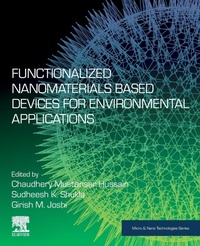
Functionalized Nanomaterials Based Devices for Environmental Applications
Published on 6. August 2021
Book
Paperback/Softback
412 pages
978-0-12-822245-4 (ISBN)
Description
Environmental devices help in monitoring the collection of one or more measurements that are used to access the status of an environment. Today, environmental monitoring and analytical methods are among the most rapidly developing branches of analysis. The functionalization of nanomaterials in the field of environmental science has increasing importance with regards to the fabrication of devices. Functionalized nanomaterials reformulate new materials and advanced characteristics for improved application in comparison to old fashion materials and open an opportunity for the development of devices for introducing new technology and techniques for monitoring environmental challenges. The monitoring of these environmental challenges in advances have direct impact on health and sustainability.
Functionalized nanomaterials have different mechanical, absorption, optical or electrical properties than original nanomaterials. In fact, major utilization of nanomaterials occurs in their functionalized forms, which are very different from the parent material. This handbook provides an overview of the different state-of-the-art materials, devices and environmental applications of functionalized nanomaterials. In addition, the information offers a platform for ongoing research in the field of environmental science and device fabrication. The main objective of this book is to cover the major areas focusing on the functionalization of nanomaterials, device fabrication along with different techniques and environmental applications of functionalized nanomaterials-based devices.
This is an important reference source for materials scientists, engineers and environmental scientsts who are looking to increase their understanding of how functionalized nanomaterial-based devices are being used for environmental monitoring applications.
Functionalized nanomaterials have different mechanical, absorption, optical or electrical properties than original nanomaterials. In fact, major utilization of nanomaterials occurs in their functionalized forms, which are very different from the parent material. This handbook provides an overview of the different state-of-the-art materials, devices and environmental applications of functionalized nanomaterials. In addition, the information offers a platform for ongoing research in the field of environmental science and device fabrication. The main objective of this book is to cover the major areas focusing on the functionalization of nanomaterials, device fabrication along with different techniques and environmental applications of functionalized nanomaterials-based devices.
This is an important reference source for materials scientists, engineers and environmental scientsts who are looking to increase their understanding of how functionalized nanomaterial-based devices are being used for environmental monitoring applications.
More details
Series
Language
English
Place of publication
United States
Target group
Professional and scholarly
Product notice
Paperback (trade)
Dimensions
Height: 235 mm
Width: 191 mm
Thickness: 22 mm
Weight
710 gr
ISBN-13
978-0-12-822245-4 (9780128222454)
Copyright in bibliographic data and cover images is held by Nielsen Book Services Limited or by the publishers or by their respective licensors: all rights reserved.
Schweitzer Classification
Other editions
Additional editions
Sudheesh K. Shukla | Girish M. Joshi | Chaudhery Mustansar Hussain
Functionalized Nanomaterials Based Devices for Environmental Applications
E-Book
08/2021
Elsevier
€230.00
Available for download
Persons
Sudheesh K. Shukla is a researcher with the Department of Chemical Sciences, University of Johannesburg, Doornfontein Campus, Johannesburg, South Africa; and Associate Professor at the School of Chemical Engineering and Physical Sciences, Lovely Professional University, Phagwara, India. His research involves real-time analysis of biochemical markers for personalized healthcare and environmental monitoring.
Girish Mukundrao Joshi is presently Associate Professor of Engineering Physics and Materials at the Institute of Chemical Technology (ICT), Mumbai, Marathwada Campus, Jalna. He has 20 years of teaching experience and was a visiting scientist to theUniversity of Castilla-La Mancha (UCLM), Spain, in 2009 and 2016. He has published more than 100 articles in reputed international journals, as well as three books on engineering physics. He also has one patent to his credit. He is a fellow of Maharashtra Academy of Sciences (2019). Dr. Joshi received the national best teacher award from the Krishnamurthy trust, Tirupati, in 2017. He was a well-known teacher at the Vellore Institute of Technology (VIT Vellore) from 2010 to 2018. He produced seven doctorates and is currently working on three more. Dr. Joshi has executed two research projects as chief investigator: Naval Research Board (NRB), DRDO (2012-2015) and Dover India Industry (2016-2017). Chaudhery Mustansar Hussain is an adjunct professor and lab director in the Department of Chemistry & Environmental Sciences at the New Jersey Institute of Technology (NJIT), United States. His research is focused on sustainability, nanotechnology & advanced materials, environmental management, analytical chemistry, and other various industries. Dr. Hussain is the author of numerous papers in peer-reviewed journals as well as a prolific author and editor of several books, including scientific monographs and handbooks in his research areas. He has published with ELSEVIER, American Chemical Society, Royal Society of Chemistry, John Wiley & Sons, CRC Press, and Springer.
Girish Mukundrao Joshi is presently Associate Professor of Engineering Physics and Materials at the Institute of Chemical Technology (ICT), Mumbai, Marathwada Campus, Jalna. He has 20 years of teaching experience and was a visiting scientist to theUniversity of Castilla-La Mancha (UCLM), Spain, in 2009 and 2016. He has published more than 100 articles in reputed international journals, as well as three books on engineering physics. He also has one patent to his credit. He is a fellow of Maharashtra Academy of Sciences (2019). Dr. Joshi received the national best teacher award from the Krishnamurthy trust, Tirupati, in 2017. He was a well-known teacher at the Vellore Institute of Technology (VIT Vellore) from 2010 to 2018. He produced seven doctorates and is currently working on three more. Dr. Joshi has executed two research projects as chief investigator: Naval Research Board (NRB), DRDO (2012-2015) and Dover India Industry (2016-2017). Chaudhery Mustansar Hussain is an adjunct professor and lab director in the Department of Chemistry & Environmental Sciences at the New Jersey Institute of Technology (NJIT), United States. His research is focused on sustainability, nanotechnology & advanced materials, environmental management, analytical chemistry, and other various industries. Dr. Hussain is the author of numerous papers in peer-reviewed journals as well as a prolific author and editor of several books, including scientific monographs and handbooks in his research areas. He has published with ELSEVIER, American Chemical Society, Royal Society of Chemistry, John Wiley & Sons, CRC Press, and Springer.
Editor
Institute of Chemical Technology Mumbai Marathwada Campus Jalna, Department of Engineering Physics and Engineering Materials, Jalna, Maharashtra, India
Adjunct Professor and Director of Chemistry & EVSC Labs, Department of Chemistry and Environmental Science, New Jersey Institute of Technology (NJIT), Newark, NJ, USA
Content
1. Impact of environmental changes on life and environmental health
Meenakshi, Bindu Mangla, Upama, Sudheesh K. Shukla, Rui Wang, Nitika Thakur, and Monika Vats
2. Prospective of functionalized nanomaterials in environmental science: A nanotechnological approach
Francis Opoku and Penny P. Govender
3. Synthesis, properties, and applications of nanomaterials: A mini review
Vedant A. Joshi, Girish M. Joshi, and Sudheesh K. Shukla
4. Carbon-based materials approach for environmental sensing
Vinod Kumar, Meenakshi, Sudheesh K. Shukla, and Nitika Thakur
5. Impacts of black carbon on environment and health
Shani Tiwari, Bing Chen, Sachchidanand Singh, A.K. Singh, and Atul K. Srivastava
6. Functionalized nanomagnetic materials for environmental applications
William Wilson Anku, Onoyivwe Monday Ama, Ikenna Chibuzor Emeji, Uyiosa Osagie Aigbe, Adelaja Otolorin Osibote, Peter Ogbemudia Osifo, and Suprakas Sinha Ray
7. Ionic liquid functionalized nanoparticles: Synthetic strategies and electrochemical applications
Subhratanu Bhattacharya, Debalina Deb, Bula Dutta, and Pallab Bose
8. Lab-on-a-chip devices-Advancement in the designing of biosensors
Mohd. Rahil Hasan, Nigar Anzar, Manshi Tyagi, Neelam Yadav, and Jagriti Narang
9. Emerging trends in lab-on-a-chip for biosensing applications
Tanvir Arfin
10. Graphene and its derivatives for environmental applications
Rahul S. Zambare and Parag R. Nemade
11. Prospects of iron oxide nanomaterial for remediation of wastewater
Vinayak V. Pathak, Ashita Rai, Sudhish K. Shukla, Saloni Jangra, and Shiksha Tiwari
12. Bio-electrochemical systems for sustainable energy production and environmental prospects
Samarjeet Singh Siwal, Vijay Kumar Thakur, and Qibo Zhang
13. Functionalized nano-magnetic materials for environmental applications
Asit Baran Samui
14. Magnetically separable Ni0.25Cu0.55Zn0.20Fe2O4 ferrite as a highly efficient photocatalyst for environmental
remediation
Kundan Jangam, Anjali Nair, Kundan Patil, Sagar Balgude, Atul Kulkarni, and Paresh More
15. The sources of heavy metals, its impact on human life and the progress in electrochemical sensor
Rahul S. Salunke and Dhammanand J. Shirale
16. Conclusion
Girish M. Joshi, Sudheesh K. Shukla, and Chaudhery Mustansar Hussain
Meenakshi, Bindu Mangla, Upama, Sudheesh K. Shukla, Rui Wang, Nitika Thakur, and Monika Vats
2. Prospective of functionalized nanomaterials in environmental science: A nanotechnological approach
Francis Opoku and Penny P. Govender
3. Synthesis, properties, and applications of nanomaterials: A mini review
Vedant A. Joshi, Girish M. Joshi, and Sudheesh K. Shukla
4. Carbon-based materials approach for environmental sensing
Vinod Kumar, Meenakshi, Sudheesh K. Shukla, and Nitika Thakur
5. Impacts of black carbon on environment and health
Shani Tiwari, Bing Chen, Sachchidanand Singh, A.K. Singh, and Atul K. Srivastava
6. Functionalized nanomagnetic materials for environmental applications
William Wilson Anku, Onoyivwe Monday Ama, Ikenna Chibuzor Emeji, Uyiosa Osagie Aigbe, Adelaja Otolorin Osibote, Peter Ogbemudia Osifo, and Suprakas Sinha Ray
7. Ionic liquid functionalized nanoparticles: Synthetic strategies and electrochemical applications
Subhratanu Bhattacharya, Debalina Deb, Bula Dutta, and Pallab Bose
8. Lab-on-a-chip devices-Advancement in the designing of biosensors
Mohd. Rahil Hasan, Nigar Anzar, Manshi Tyagi, Neelam Yadav, and Jagriti Narang
9. Emerging trends in lab-on-a-chip for biosensing applications
Tanvir Arfin
10. Graphene and its derivatives for environmental applications
Rahul S. Zambare and Parag R. Nemade
11. Prospects of iron oxide nanomaterial for remediation of wastewater
Vinayak V. Pathak, Ashita Rai, Sudhish K. Shukla, Saloni Jangra, and Shiksha Tiwari
12. Bio-electrochemical systems for sustainable energy production and environmental prospects
Samarjeet Singh Siwal, Vijay Kumar Thakur, and Qibo Zhang
13. Functionalized nano-magnetic materials for environmental applications
Asit Baran Samui
14. Magnetically separable Ni0.25Cu0.55Zn0.20Fe2O4 ferrite as a highly efficient photocatalyst for environmental
remediation
Kundan Jangam, Anjali Nair, Kundan Patil, Sagar Balgude, Atul Kulkarni, and Paresh More
15. The sources of heavy metals, its impact on human life and the progress in electrochemical sensor
Rahul S. Salunke and Dhammanand J. Shirale
16. Conclusion
Girish M. Joshi, Sudheesh K. Shukla, and Chaudhery Mustansar Hussain