

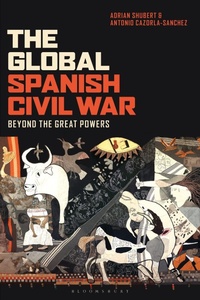
The Global Spanish Civil War
Beyond the Great Powers
Will be published approx. on 21. January 2027
Book
Paperback/Softback
272 pages
978-1-350-56630-9 (ISBN)
Description
The Spanish Civil War was a domestic conflict that had been internationalized even before the military rebellion of 18th July 1936, and the nature of international intervention was a determining factor in its outcome. Yet while policies of Great Powers such as France, Germany, Italy, the Soviet Union, the United Kingdom and the United States have received considerable attention, the global impact of the Spanish Civil War has not.
This volume brings together a team of specialists to explore that impact in 20 countries across the world; from Argentina to Australia, from China to Colombia, from Ireland to India, from Portugal to the Philippines and beyond. How did governments and civil societies around the world respond to the conflict? What was its impact on culture? How has the Spanish Civil War been remembered- or not remembered- in different corners of the globe?
With 20 chapters focusing on a particular nation-state, each one addresses the same set of issues; the local context in the 1930, government policies, the responses of civil society, the volunteers who went to Spain to fight or to serve in non-combatant capacities, the cultural impacts of the conflict, and the ways the Spanish Civil War has been remembered, they capture both the diverse responses and the shared themes. Rather than focussing on the Great Powers, The Global Spanish Civil War explores its impact beyond the "usual suspects". With two thirds of the chapters dealing with countries beyond Europe, it transcends the prevailing Eurocentric vision of the existing literature.
This volume brings together a team of specialists to explore that impact in 20 countries across the world; from Argentina to Australia, from China to Colombia, from Ireland to India, from Portugal to the Philippines and beyond. How did governments and civil societies around the world respond to the conflict? What was its impact on culture? How has the Spanish Civil War been remembered- or not remembered- in different corners of the globe?
With 20 chapters focusing on a particular nation-state, each one addresses the same set of issues; the local context in the 1930, government policies, the responses of civil society, the volunteers who went to Spain to fight or to serve in non-combatant capacities, the cultural impacts of the conflict, and the ways the Spanish Civil War has been remembered, they capture both the diverse responses and the shared themes. Rather than focussing on the Great Powers, The Global Spanish Civil War explores its impact beyond the "usual suspects". With two thirds of the chapters dealing with countries beyond Europe, it transcends the prevailing Eurocentric vision of the existing literature.
Reviews / Votes
While historians often assert the global significance of the Spanish Civil War, this book demonstrates it through revealing case studies. By bringing together countries as diverse as India, China and the Philippines the collection helps move study away from the major European powers to provide a richer view of the impact of this crucial conflict. * Peter Anderson, University of Leeds, UK * An excellent volume that moves away from the traditional powers and their response to the Civil War- France, Britain, Germany, Italy and the Soviet Union-to focus on just what a world-wide impact the Civil War had. Great case studies and interesting conclusions throughout! * David Messenger, University of South Alabama, USA *More details
Language
English
Place of publication
London
United Kingdom
Publishing group
Bloomsbury Publishing PLC
Target group
College/higher education
Professional and scholarly
Product notice
Paperback (trade)
Dimensions
Height: 234 mm
Width: 156 mm
Thickness: 14 mm
Weight
387 gr
ISBN-13
978-1-350-56630-9 (9781350566309)
Copyright in bibliographic data and cover images is held by Nielsen Book Services Limited or by the publishers or by their respective licensors: all rights reserved.
Schweitzer Classification
Persons
Adrian Shubert is University Professor of History Emeritus at York University, Canada. He is a Fellow of the Royal Society of Canada and has been decorated by both King Juan Carlos and King Felipe VI of Spain.
Antonio Cazorla Sanchez is Professor of History at Trent University, Canada. He is a Fellow of the Royal Society of Canada and was named a Commander of the Order of Isabel the Catholic by King Felipe VI of Spain.
Antonio Cazorla Sanchez is Professor of History at Trent University, Canada. He is a Fellow of the Royal Society of Canada and was named a Commander of the Order of Isabel the Catholic by King Felipe VI of Spain.
Content
Introduction: Antonio Cazorla Sanchez and Adrian Shubert (Trent University and York University, Canada)
1. Argentina: Beatriz Figallo (Academia Nacional de Historia, Argentina)
2. Australia: Judith Keene (University of Sydney, Australia)
3. Belgium: Jorge Vargas Visus (Ministere de la Federation Wallonie-Bruxelles, Belgium)
4. Brazil: Ismara Izepe de Souza (Universidade Federal de Sao Paolo (UNIFESP), Brazil)
5. Canada: Michael Petrou (Canadian War Museum, Canada)
6. China: Len Tsou and Nancy Tsou (Independent scholars)
7. Colombia: Charlotte Eaton (London School of Economics, UK)
8. Hungary: Andras Lenart (University of Szeged, Hungary)
9. India: Michael Ortiz (University of Rhode Island, USA)
10. Ireland: Fearghal McGarry (Queen's University, UK)
11. Japan: Florentino Rodao (Universidad Complutense de Madrid, Spain)
12. Mexico: David Jorge (Colegio de Mexico, Mexico)
13. New Zealand: Mark Derby (Independent Scholar, Aotearoa New Zealand)
14. Palestine-Israel: Raanan Rein (Tel Aviv University, Israel)
15. Philippines: Florentino Rodao (Universidad Complutense de Madrid, Spain)
16. Portugal: Filipe Ribeiro de Meneses (Maynooth University, Ireland)
17. Poland: Jan Ciechenowski (University of Warsaw, Poland)
18. South Africa: Jonathan Hyslop (Colgate University, USA)
19. Switzerland: Sebastien Farre (Universite de Geneve, Switzerland)
20. Yugoslavia: Vjeran Pavlakovic (University of Rijeka, Croatia)
1. Argentina: Beatriz Figallo (Academia Nacional de Historia, Argentina)
2. Australia: Judith Keene (University of Sydney, Australia)
3. Belgium: Jorge Vargas Visus (Ministere de la Federation Wallonie-Bruxelles, Belgium)
4. Brazil: Ismara Izepe de Souza (Universidade Federal de Sao Paolo (UNIFESP), Brazil)
5. Canada: Michael Petrou (Canadian War Museum, Canada)
6. China: Len Tsou and Nancy Tsou (Independent scholars)
7. Colombia: Charlotte Eaton (London School of Economics, UK)
8. Hungary: Andras Lenart (University of Szeged, Hungary)
9. India: Michael Ortiz (University of Rhode Island, USA)
10. Ireland: Fearghal McGarry (Queen's University, UK)
11. Japan: Florentino Rodao (Universidad Complutense de Madrid, Spain)
12. Mexico: David Jorge (Colegio de Mexico, Mexico)
13. New Zealand: Mark Derby (Independent Scholar, Aotearoa New Zealand)
14. Palestine-Israel: Raanan Rein (Tel Aviv University, Israel)
15. Philippines: Florentino Rodao (Universidad Complutense de Madrid, Spain)
16. Portugal: Filipe Ribeiro de Meneses (Maynooth University, Ireland)
17. Poland: Jan Ciechenowski (University of Warsaw, Poland)
18. South Africa: Jonathan Hyslop (Colgate University, USA)
19. Switzerland: Sebastien Farre (Universite de Geneve, Switzerland)
20. Yugoslavia: Vjeran Pavlakovic (University of Rijeka, Croatia)