

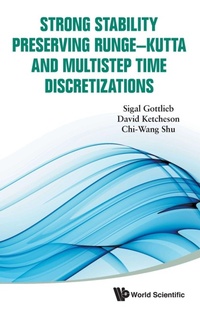
Strong Stability Preserving Runge-kutta And Multistep Time Discretizations
Published on 26. January 2011
Book
Hardback
190 pages
978-981-4289-26-9 (ISBN)
Description
This book captures the state-of-the-art in the field of Strong Stability Preserving (SSP) time stepping methods, which have significant advantages for the time evolution of partial differential equations describing a wide range of physical phenomena. This comprehensive book describes the development of SSP methods, explains the types of problems which require the use of these methods and demonstrates the efficiency of these methods using a variety of numerical examples. Another valuable feature of this book is that it collects the most useful SSP methods, both explicit and implicit, and presents the other properties of these methods which make them desirable (such as low storage, small error coefficients, large linear stability domains). This book is valuable for both researchers studying the field of time-discretizations for PDEs, and the users of such methods.
More details
Language
English
Place of publication
Singapore
Singapore
Target group
College/higher education
Professional and scholarly
Dimensions
Height: 235 mm
Width: 157 mm
Thickness: 15 mm
Weight
434 gr
ISBN-13
978-981-4289-26-9 (9789814289269)
Copyright in bibliographic data and cover images is held by Nielsen Book Services Limited or by the publishers or by their respective licensors: all rights reserved.
Schweitzer Classification
Persons
Content
The Development of SSP Methods; The Need for SSP Methods; Bounds on the SSP Coefficient for Runge-Kutta, Linear Multistep, and General Linear Methods; Explicit Strong Stability Preserving Runge-Kutta Methods; Low Storage Explicit SSP Runge-Kutta Methods; Optimal SSP Runge-Kutta Methods for Linear Constant Coefficient Problems; Optimal Implicit SSP Runge-Kutta Methods; Explicit and Implicit SSP Linear Multistep Methods; The SSP Properties of Other Methods; Optimal Multistep Multistage Methods; Applications of SSP Methods.