

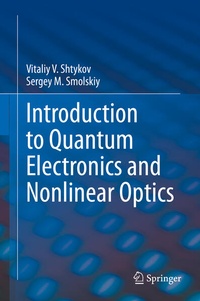
Introduction to Quantum Electronics and Nonlinear Optics
Published on 23. March 2020
Book
Hardback
XXIV, 323 pages
978-3-030-37613-0 (ISBN)
Description
This textbook, based on the authors' class-tested material, is accessible to students at the advanced undergraduate and graduate level in physics and engineering. While its primary function is didactic, this book's comprehensive choice of topics and its clear and authoritative synthesis of ideas make it a useful reference for researchers, device engineers, and course instructors who wish to consolidate their knowledge of this field. The book takes the semi-classical approach where light is treated as a wave in accordance with the classical Maxwell equations, while matter is governed by quantum theory. It begins by introducing the postulates and mathematical framework of quantum theory, followed by the formalism of the density matrix which allows the transition from microscopic (quantum) quantities to macroscopic (classical) ones. Consequently, the equations describing the reaction of matter to the electromagnetic field in the form of polarization, magnetization, and current are derived. These equations (together with the Maxwell equations) form the complete system of equations sufficient to model a wide class of problems surrounding linear and nonlinear interactions of electromagnetic fields with matter. The nonlinear character of the governing equations determines parameters of the steady-state mode of the quantum generator and is also demonstrated in harmonic generation via propagation of laser radiation in various media. The touchstone description of magnetic phenomena will be of interest to scientists who deal with applications of magneto-resonance phenomena in biology and medicine. Other advanced topics covered include electric dipole transitions, magnetic dipole transitions, plasma transitions, and the devices that can be based on these and other electro-optical and nonlinear-optical systems. This textbook features numerous exercises, some of which are investigatory and some of which require computational solutions.
Reviews / Votes
"The book has a crystal-clear style and can be understood by any student with a basic physics and mathematical background." (Mircea Dragoman, Optics & Photonics News, osa-opn.org, August 6, 2020)
More details
Edition
2020 ed.
Language
English
Place of publication
Cham
Switzerland
Publishing group
Springer International Publishing
Target group
Primary & secondary/elementary & high school
Illustrations
7 farbige Abbildungen, 139 s/w Abbildungen
XXIV, 323 p. 146 illus., 7 illus. in color.
Dimensions
Height: 241 mm
Width: 160 mm
Thickness: 25 mm
Weight
688 gr
ISBN-13
978-3-030-37613-0 (9783030376130)
DOI
10.1007/978-3-030-37614-7
Schweitzer Classification
Other editions
Additional editions
Vitaliy V. Shtykov | Sergey M. Smolskiy
Introduction to Quantum Electronics and Nonlinear Optics
Book
03/2021
Springer
€90.94
Shipment within 7-9 days
Vitaliy V. Shtykov | Sergey M. Smolskiy
Introduction to Quantum Electronics and Nonlinear Optics
E-Book
03/2020
Springer
€90.94
Available for download
Persons
Sergey M. Smolsky graduated from the Radio Engineering Faculty of Moscow Power Engineering Institute in 1970. He is Dr. Sci. (Eng), professor of the Radio Signal Generation and Processing Dept. of the Institute of Radio Engineering and Electronics in the National Research University "MPEl". His scientific interests are autodyne and radar theory, telecommunications, nonlinear oscillation theory, chaotic systems, radio physics and signal processing, radiowaves propagation.
Vitaly V. Shtykov received his Ph.D. (Techn.) in 1970. Now he works as a full-time professor at the Moscow Power Engineering Institute (MPEI). He has more than 200 publications and 21 patents.
Vitaly V. Shtykov received his Ph.D. (Techn.) in 1970. Now he works as a full-time professor at the Moscow Power Engineering Institute (MPEI). He has more than 200 publications and 21 patents.
Content
Dedication.- Acknowledgments.- About the Authors.- Preface.- Introduction.- 1: Excursus to the Atomic-Molecular Theory of Substance.- 2: Interaction of Electrical Dipoles.- 3: Magnetic Dipole Interaction.- 4: Field Interaction with "Free Charges".- 5: Quantum Amplifiers and Generators.- 6: Nonlinear Interaction of Electromagnetic Waves with a Substance.- 7: Some Types of Quantum Generators and Amplifiers.- Appendices.- - Index.