

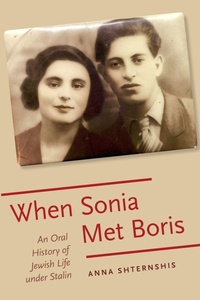
When Sonia Met Boris
An Oral History of Jewish Life under Stalin
Published on 30. September 2021
Book
Paperback/Softback
264 pages
978-0-19-760108-2 (ISBN)
Description
Russian-speaking Jews from the former Soviet Union are a peculiarity in the Jewish world. After decades living in a repressive, nominally atheistic state, these Jews did manage to retain a strong sense of Jewish identity--but one that was almost completely divorced from Judaism. Today, more than ten percent of Jews speak or understand Russian, signaling the importance of an ever-vexing question: why are Russian Jews the way they are?
In pursuit of an answer, Anna Shternshis's groundbreaking When Sonia Met Boris: An Oral History of Jewish Life under Stalin draws on nearly 500 oral history interviews on the Soviet Jewish experience with Soviet citizens who were adults by the 1940s. Soviet Jews lived through tumultuous times: the Great Terror, World War II, the anti-Semitic policies of the postwar period, and the collapse of the Soviet Union. But, like millions of other Soviet citizens, they married, raised children, and built careers, pursuing life as best they could in a profoundly hostile environment. One of the first scholars to record and analyze oral testimonies of Soviet Jews, Shternshis unearths heartbreaking, deeply poignant, and often funny stories of the everyday choices Jews were forced to navigate as a repressed minority living in a totalitarian regime. Shternshis reveals how ethnicity rapidly transformed into a disability, as well as a negative characteristic, for Soviet Jews in the postwar period, and shows how it was something they needed desperately to overcome in order to succeed.
That sense of self has persisted well into the twenty-first century, and has impacted the Jewish identities of the children and grandchildren of Shternshis's subjects, the foundational generation of contemporary Russian Jewish culture. An illuminating work of social and cultural history, When Sonia Met Boris traces the fascinating contours of contemporary Russian Jewish identity back to their very roots.
In pursuit of an answer, Anna Shternshis's groundbreaking When Sonia Met Boris: An Oral History of Jewish Life under Stalin draws on nearly 500 oral history interviews on the Soviet Jewish experience with Soviet citizens who were adults by the 1940s. Soviet Jews lived through tumultuous times: the Great Terror, World War II, the anti-Semitic policies of the postwar period, and the collapse of the Soviet Union. But, like millions of other Soviet citizens, they married, raised children, and built careers, pursuing life as best they could in a profoundly hostile environment. One of the first scholars to record and analyze oral testimonies of Soviet Jews, Shternshis unearths heartbreaking, deeply poignant, and often funny stories of the everyday choices Jews were forced to navigate as a repressed minority living in a totalitarian regime. Shternshis reveals how ethnicity rapidly transformed into a disability, as well as a negative characteristic, for Soviet Jews in the postwar period, and shows how it was something they needed desperately to overcome in order to succeed.
That sense of self has persisted well into the twenty-first century, and has impacted the Jewish identities of the children and grandchildren of Shternshis's subjects, the foundational generation of contemporary Russian Jewish culture. An illuminating work of social and cultural history, When Sonia Met Boris traces the fascinating contours of contemporary Russian Jewish identity back to their very roots.
Reviews / Votes
This page-turning, concise volume makes excellent use of oral histories to add flesh to an otherwise linear narrative of the Jewish experience in the Soviet Union and goes beyond to show how those experiences shaped the trajectories of the people who lived through not just the major historical events but also less eventful and at times mundane individual histories of their own lives. * Gegham Mughnetsyan, Oral History Review *More details
Series
Language
English
Place of publication
New York
United States
Target group
Professional and scholarly
Dimensions
Height: 234 mm
Width: 156 mm
Thickness: 14 mm
Weight
401 gr
ISBN-13
978-0-19-760108-2 (9780197601082)
Copyright in bibliographic data and cover images is held by Nielsen Book Services Limited or by the publishers or by their respective licensors: all rights reserved.
Schweitzer Classification
Other editions
Additional editions
E-Book
01/2017
1st Edition
OUP eBook
€12.99
Available for download
E-Book
01/2017
1st Edition
OUP eBook
€12.99
Available for download
Person
Anna Shternshis is the Al and Malka Green Professor in Yiddish Studies and the Director of the Anne Tanenbaum Centre for Jewish Studies at the University of Toronto. She is the author of Soviet and Kosher: Jewish Popular Culture in the Soviet Union, 1923 - 1939 .
Content
Part I: Oral History and the First Generation of Soviet Jews
Chapter 1 When Only Memories Tell the Truth
Chapter 2 Who Gets to Tell the Story: Oral Histories of the First Soviet Jewish Generation
Part II: The Making of a Soviet Jewish Family
Chapter 3 Boys are Like Glass, Girls are like Cloth: Raising Jewish Children in the 1930s
Chapter 4 Weddings between Errands: Love and Family during the Soviet Jewish Golden Age
Chapter 5 Lost, Found and Guilty: The War and the Family
Chapter 6 How Not to Learn about Antisemitism at Home: Soviet Jewish Family Values after the War
Part III: From Enthusiasm to More Enthusiasm: Jews in the Soviet Workplace
Chapter 7 What My Country Needs and Where My Aunt Lives: Choosing a Profession in Stalin's Soviet Union
Chapter 8 The Right Specialists with the Wrong Passports: The Search for Employment
Chapter 9 "You Do Not Seem like a Jew At All": The Atmosphere at Work
Chapter 10 Jewish Doctors and the Doctors' Plot
Chapter 11 The Happiest Memories: Life in the World of Soviet Yiddish Culture
Epilogue Soviet Jewish Oral Histories: Past and Future
Appendix 1 Methodology
Appendix 2 Statistical Distribution of Interviewees
Notes
Bibliography
Chapter 1 When Only Memories Tell the Truth
Chapter 2 Who Gets to Tell the Story: Oral Histories of the First Soviet Jewish Generation
Part II: The Making of a Soviet Jewish Family
Chapter 3 Boys are Like Glass, Girls are like Cloth: Raising Jewish Children in the 1930s
Chapter 4 Weddings between Errands: Love and Family during the Soviet Jewish Golden Age
Chapter 5 Lost, Found and Guilty: The War and the Family
Chapter 6 How Not to Learn about Antisemitism at Home: Soviet Jewish Family Values after the War
Part III: From Enthusiasm to More Enthusiasm: Jews in the Soviet Workplace
Chapter 7 What My Country Needs and Where My Aunt Lives: Choosing a Profession in Stalin's Soviet Union
Chapter 8 The Right Specialists with the Wrong Passports: The Search for Employment
Chapter 9 "You Do Not Seem like a Jew At All": The Atmosphere at Work
Chapter 10 Jewish Doctors and the Doctors' Plot
Chapter 11 The Happiest Memories: Life in the World of Soviet Yiddish Culture
Epilogue Soviet Jewish Oral Histories: Past and Future
Appendix 1 Methodology
Appendix 2 Statistical Distribution of Interviewees
Notes
Bibliography