

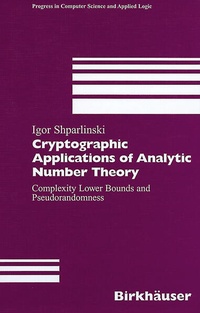
Cryptographic Applications of Analytic Number Theory
Complexity Lower Bounds and Pseudorandomness
Published on 3. October 2013
Book
Paperback/Softback
IX, 414 pages
978-3-0348-9415-9 (ISBN)
Description
The book introduces new techniques that imply rigorous lower bounds on the com plexity of some number-theoretic and cryptographic problems. It also establishes certain attractive pseudorandom properties of various cryptographic primitives. These methods and techniques are based on bounds of character sums and num bers of solutions of some polynomial equations over finite fields and residue rings. Other number theoretic techniques such as sieve methods and lattice reduction algorithms are used as well. The book also contains a number of open problems and proposals for further research. The emphasis is on obtaining unconditional rigorously proved statements. The bright side of this approach is that the results do not depend on any assumptions or conjectures. On the downside, the results are much weaker than those which are widely believed to be true. We obtain several lower bounds, exponential in terms of logp, on the degrees and orders of o polynomials; o algebraic functions; o Boolean functions; o linear recurrence sequences; coinciding with values of the discrete logarithm modulo a prime p at sufficiently many points (the number of points can be as small as pI/2+O:). These functions are considered over the residue ring modulo p and over the residue ring modulo an arbitrary divisor d of p - 1. The case of d = 2 is of special interest since it corresponds to the representation of the rightmost bit of the discrete logarithm and defines whether the argument is a quadratic residue.
Reviews / Votes
From the reviews:
"Igor Shparlinski is a very prolific mathematician and computer scientist . . The book is written at a very high level, suitable for graduate students and researchers in computer science and mathematics. . book has a unique perspective, and is not really comparable to other books in the area. . book contains many deep results, and the mathematically-sophisticated reader can find much that is novel. . this is an impressive work that will be of significant interest to researchers in cryptography and algorithmic number theory." (Jeffrey Shallit, SIGACT News, Vol. 41 (3), September, 2010)More details
Series
Edition
Softcover reprint of the original 1st ed. 2003
Language
English
Place of publication
Basel
Switzerland
Publishing group
Springer Basel
Target group
Professional and scholarly
Research
Illustrations
IX, 414 p.
Dimensions
Height: 235 mm
Width: 155 mm
Thickness: 24 mm
Weight
645 gr
ISBN-13
978-3-0348-9415-9 (9783034894159)
DOI
10.1007/978-3-0348-8037-4
Schweitzer Classification
Other editions
Additional editions
Igor Shparlinski
Cryptographic Applications of Analytic Number Theory
Complexity Lower Bounds and Pseudorandomness
Book
12/2002
Birkhäuser
€106.99
Shipment within 10-15 days
Content
I Preliminaries.- 1 Basic Notation and Definitions.- 2 Polynomials and Recurrence Sequences.- 3 Exponential Sums.- 4 Distribution and Discrepancy.- 5 Arithmetic Functions.- 6 Lattices and the Hidden Number Problem.- 7 Complexity Theory.- II Approximation and Complexity of the Discrete Logarithm.- 8 Approximation of the Discrete Logarithm Modulop.- 9 Approximation of the Discrete Logarithm Modulop -1.- 10 Approximation of the Discrete Logarithm by Boolean Functions.- 11 Approximation of the Discrete Logarithm by Real Polynomials.- III Approximation and Complexity of the Diffie-Hellman Secret Key.- 12 Polynomial Approximation and Arithmetic Complexity of the.- Diffie-Hellman Secret Key.- 13 Boolean Complexity of the Diffie-Hellman Secret Key.- 14 Bit Security of the Diffie-Hellman Secret Key.- IV Other Cryptographic Constructions.- 15 Security Against the Cycling Attack on the RSA and Timed-release Crypto.- 16 The Insecurity of the Digital Signature Algorithm with Partially Known Nonces.- 17 Distribution of the ElGamal Signature.- 18 Bit Security of the RSA Encryption and the Shamir Message Passing Scheme.- 19 Bit Security of the XTR and LUC Secret Keys.- 20 Bit Security of NTRU.- 21 Distribution of the RSA and Exponential Pairs.- 22 Exponentiation and Inversion with Precomputation.- V Pseudorandom Number Generators.- 23 RSA and Blum-Blum-Shub Generators.- 24 Naor-Reingold Function.- 25 1/M Generator.- 26 Inversive, Polynomial and Quadratic Exponential Generators.- 27 Subset Sum Generators.- VI Other Applications.- 28 Square-Freeness Testing and Other Number-Theoretic Problems.- 29 Trade-off Between the Boolean and Arithmetic Depths of ModulopFunctions.- 30 Polynomial Approximation, Permanents and Noisy Exponentiation in Finite Fields.- 31 Special Polynomials and BooleanFunctions.- VII Concluding Remarks and Open Questions.