

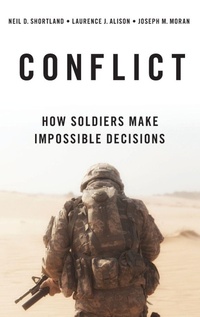
Conflict
How Soldiers Make Impossible Decisions
Published on 28. February 2019
Book
Hardback
248 pages
978-0-19-062344-9 (ISBN)
Description
Conflict: How Soldiers Make Impossible Decisions is about making hard choices--where all outcomes are potentially negative. The authors draw on interviews conducted with soldiers about the situations they faced and the decisions they made at war. These are vivid and sometimes distressing stories. They form the data from which the authors explore the cognitive processes associated with choice, commitment to action and (sometimes) error, as well as goal directed thinking, innovation and courage. By referring to real cases, Conflict invites readers to consider their own responses under extreme circumstances and ask themselves how they would choose between difficult options. In doing so this book will go some way to helping readers understand what it feels like when choosing between least-worst decisions.
Reviews / Votes
As a psychologist, professor, and researcher of military psychology, I find the concepts covered in this book to be especially applicable. Executives and business leadership may find this book valuable as well given the ways in which they operate. * Jacob N. Hyde, University of Denver *More details
Language
English
Place of publication
New York
United States
Dimensions
Height: 240 mm
Width: 161 mm
Thickness: 18 mm
Weight
534 gr
ISBN-13
978-0-19-062344-9 (9780190623449)
Copyright in bibliographic data and cover images is held by Nielsen Book Services Limited or by the publishers or by their respective licensors: all rights reserved.
Schweitzer Classification
Other editions
Additional editions
Neil D. Shortland | Laurence J. Alison | Joseph M. Moran
Conflict
How Soldiers Make Impossible Decisions
E-Book
01/2019
1st Edition
OUP eBook
€29.99
Available for download
Neil D. Shortland | Laurence J. Alison | Joseph M. Moran
Conflict
How Soldiers Make Impossible Decisions
E-Book
01/2019
1st Edition
OUP eBook
€29.99
Available for download
Persons
Neil Shortland, Laurence Alison, and Joseph Moran are interested in social cognition and the processes by which soldiers make sense of uncertain, high-risk, ambiguous, complex or contradictory information. They are especially interested in decision inertia and the use of simulated environments to study and train practitioners to overcome decision inertia.
Author
Director, Center for Terrorism and Security Studies, Assistant ProfessorDirector, Center for Terrorism and Security Studies, Assistant Professor, University of Massachusetts Lowell
Professor and Director, Centre for Critical and Major Incident Psychology, Applied Psychology GroupProfessor and Director, Centre for Critical and Major Incident Psychology, Applied Psychology Group, University of Liverpool
Cognitive Scientist, US Army Natick Soldier Research, Development, and Engineering CenterCognitive Scientist, US Army Natick Soldier Research, Development, and Engineering Center, Research Associate, Harvard University, Center for Brain Science
Content
- List of illustrations
- Acknowledgements
- Foreword by Col. Tim Collins
- Preface
- 1. Decisional Conflict: From Best to Least-Worst
- 2. Military Decision Making: Doctrine, Rationality and Field-Based Approaches
- 3. The Science of Selecting Least-Worst Options
- 4. Situational Awareness
- 5. Formulating Plans
- 6. Executing Plans
- 7. Team Learning
- 8. Least-Worst Decision Making 'in extremis'
- 9. Thoughts that Haunt
- 10. How do Soldiers Do What They Do and What Can We Learn From Them?
- References