

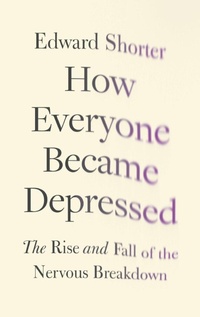
How Everyone Became Depressed
The Rise and Fall of the Nervous Breakdown
Published on 14. March 2013
Book
Hardback
272 pages
978-0-19-994808-6 (ISBN)
Description
This book argues that psychiatry's love affair with the diagnosis of depression has become a death grip. Depression is a real illness, especially in its melancholic form. But most patients who get the diagnosis of 'depression' are also anxious, fatigued, unable to sleep, have all kinds of physical symptoms, and tend to obsess about the whole thing. They do not have a disorder of 'mood'. It is a travesty to call them all 'depressed.' How did this happen? How did everyone become depressed?
A well-known historian, the author describes how in the 19th century patients with those symptoms were considered 'nervous,' and when they lost control it was a 'nervous breakdown.' Then psychiatry turned its back on the whole concept of nerves, and - first under the influence of Freud's psychoanalysis and then the influence of the pharmaceutical industry - the diagnosis of depression took center stage. The result has been a scientific disaster, leading to the misdiagnosis and inappropriate treatment (with antidepressants) of millions of patients. Urging that the diagnosis of depression be re-thought, the book turns a dramatic page in the understanding of psychiatric symptoms that are as common as the common cold.
The book makes an immediate contribution to the debate about DSM5, which is due to be released very soon, in terms of discussing the diagnosis of depression. The author controversially proposes replacing the diagnosis of 'major depression' with 'melancholia' and 'nonmelancholia'; he argues that depression and anxiety usually occur together and are really the same disease; and he says that patients with so-called mood disorders really have a disorder of the entire body.
The author's ability to make use of the enormous well of psychiatry's past history in several languages make this a unique book that contributes to the important discussions today of diagnosis and treatment.
A well-known historian, the author describes how in the 19th century patients with those symptoms were considered 'nervous,' and when they lost control it was a 'nervous breakdown.' Then psychiatry turned its back on the whole concept of nerves, and - first under the influence of Freud's psychoanalysis and then the influence of the pharmaceutical industry - the diagnosis of depression took center stage. The result has been a scientific disaster, leading to the misdiagnosis and inappropriate treatment (with antidepressants) of millions of patients. Urging that the diagnosis of depression be re-thought, the book turns a dramatic page in the understanding of psychiatric symptoms that are as common as the common cold.
The book makes an immediate contribution to the debate about DSM5, which is due to be released very soon, in terms of discussing the diagnosis of depression. The author controversially proposes replacing the diagnosis of 'major depression' with 'melancholia' and 'nonmelancholia'; he argues that depression and anxiety usually occur together and are really the same disease; and he says that patients with so-called mood disorders really have a disorder of the entire body.
The author's ability to make use of the enormous well of psychiatry's past history in several languages make this a unique book that contributes to the important discussions today of diagnosis and treatment.
Reviews / Votes
A fascinating and erudite volume Historians and practitioners of psychiatry, psychology, neuroscience, and many other mental health professions will find this book illuminating, interesting, and challenging at the same time. * PsycCRITIQUES * This is a highly learned historical study with much sensitivity to the interaction of scholarly, professional, and economic interests that shape research and clinical practice. * Years Work in Critical and Cultural Theory *More details
Language
English
Place of publication
New York
United States
Target group
College/higher education
Professional and scholarly
Psychiatrists, health care professionals, those interested in the history of medicine and psychiatry, and students of medicine.
Dimensions
Height: 240 mm
Width: 161 mm
Thickness: 19 mm
Weight
573 gr
ISBN-13
978-0-19-994808-6 (9780199948086)
Copyright in bibliographic data and cover images is held by Nielsen Book Services Limited or by the publishers or by their respective licensors: all rights reserved.
Schweitzer Classification
Other editions
Additional editions
E-Book
02/2013
1st Edition
OUP eBook
€32.99
Available for download
E-Book
02/2013
1st Edition
OUP eBook
€32.99
Available for download
Person
Edward Shorter is an internationally-recognized historian of psychiatry and the author of numerous books, including A History of Psychiatry from the Era of the Asylum to the Age of Prozac (1997) and Before Prozac (2009). Shorter is the Jason A. Hannah Professor in the History of Medicine and a Professor of Psychiatry in the Faculty of Medicine, University of Toronto.
Content
Table of contents ; Chapter 1 Introduction ; Chapter 2 Nerves as a Problem ; Chapter 3 Rise of Nervous Illness ; Chapter 4 Fatigue ; Chapter 5 Anxiety ; Chapter 6 Melancholia ; Chapter 7 Nervous Breakdown ; Chapter 8 Paradigm Shift ; Chapter 9 Something Wrong With the Label ; Chapter 10 Drugs ; Chapter 11 Return of the Two Depressions ; Chapter 12 Nerves Redux ; Chapter 13 Context