

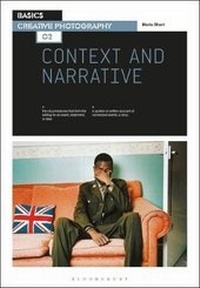
Basics Creative Photography 02: Context and Narrative
Published on 13. December 2018
Book
Paperback/Softback
184 pages
978-1-350-10674-1 (ISBN)
Description
Throughout this book, Maria Short guides you through the ideas and methods behind creating meaningful, communicative images. With case studies and dozens of examples from some of the world's most engaging photographers, this is a beautiful introduction to a fascinating aspect of photography.
Featured topics: The function of photographs; What is narrative?; Choosing your subject; Concept; Intention and interpretation; The single image; Series of photographs; Signs and symbols; Using text; The response of the audience.
Featured photographers: Berenice Abbott; Eve Arnold; Tina Barney; Robert Capa; Henri Cartier-Bresson; Jill Cole; Gregory Crewdson; Paul Fusco; Stuart Griffiths; Britta Jaschinski; Seba Kurtis; Jem Southam; Tom Stoddart; Newsha Tavakolian and Weegee.
Featured topics: The function of photographs; What is narrative?; Choosing your subject; Concept; Intention and interpretation; The single image; Series of photographs; Signs and symbols; Using text; The response of the audience.
Featured photographers: Berenice Abbott; Eve Arnold; Tina Barney; Robert Capa; Henri Cartier-Bresson; Jill Cole; Gregory Crewdson; Paul Fusco; Stuart Griffiths; Britta Jaschinski; Seba Kurtis; Jem Southam; Tom Stoddart; Newsha Tavakolian and Weegee.
Reviews / Votes
Context and Narrative is a really accessible and practical way to tackle some of the more conceptual and non-tangible parts of creating photographs. I really wish I had read it while in college, but no harm, it will benefit me now anyway! * Emma O'Brien, Dublin-based photographer * If you are interested in learning about how to use photography to tell a story, you can't go wrong with this book! * Barbara Taylor, UK-based photographer * The terms "narrative" and "context" were until recently relegated to the periphery in understanding photographic images. Maria Short's clearly written and structured book provides a unique convergence point for the study of a wide range of photographers and the events they confront. She combines the insights of the teacher and poet with an astute professional understanding of her craft. A series of well chosen case studies further illuminate photography for readers from all backgrounds. * Dr. Chris Mullen, writer and historian, author of FORTUNE's America, Director of The Visual telling of Stories website * I like this book for many reasons. In terms of its layout and design this is a book that boasts a consistent visual style where different design solutions are artfully combined. Framed images, full-bleed photographs, white backgrounds, black backgrounds, this book demonstrates how to combine images and text in a visually engaging and reader-friendly way. The deceptively concise style that this book shares with other titles in the Basics series is an excellent example of how to write analytically, which we positively know is one of the greatest challenges for students... Each chapter has clear and well-defined topics and includes case studies which support the author's opinions. At the end of each chapter there is a brief summary and some suggested exercises to consolidate what the reader learned.However, it is the the subject matter that the books deals with that I find particularly appealing. It is refreshing to read a book which is concerned with key tenets of photography such as context and narrative, which, regardless of the technology that we use, are crucial for photographs to act as more than just records or evidence.
But the most interesting aspect of this book is that the images that Maria Short selected to support her arguments were not primarily taken by iconic and well-known photographers but by a collective of new photographers who have a fresh look at the world. In doing so they have the potential to inspire established and aspiring photographers. And that's the main reason why you should buy this book. * Jose Navarro, Open College of the Arts, UK * This compact volume is one of a series of practical texts for the undergraduate college student in the applied visual arts. It uses an attractive magazine-like layout with concise, often bulleted text and striking color photographs. The contents are easy to digest and get at important issues for the emerging professional ... Each themed chapter is accompanied by creative exercises designed to help the student incorporate the concepts presented. Case studies that profile the work of a contemporary photographer, additional readings, and relevant websites are also included for each section ... useful for arts instructors and their students. * Nancy B. Turner, Syracuse University Library, New York, USA *
More details
Series
Language
English
Place of publication
United Kingdom
Publishing group
Taylor & Francis Ltd
Target group
College/higher education
Illustrations
200 colour illus
Dimensions
Height: 230 mm
Width: 160 mm
Weight
426 gr
ISBN-13
978-1-350-10674-1 (9781350106741)
Copyright in bibliographic data and cover images is held by Nielsen Book Services Limited or by the publishers or by their respective licensors: all rights reserved.
Schweitzer Classification
Other editions
New editions
Maria Short | Sri-Kartini Leet | Elisavet Kalpaxi
Context and Narrative in Photography
Book
11/2019
2nd Edition
Bloomsbury Visual Arts
€50.00
Shipment within 15-20 days
Person
Maria Short is a photographer, educator and writer. She currently runs photographic workshops in schools and colleges and is a part-time lecturer in photography at the University of Brighton. She has an MA in Sequential Design and her work takes its inspiration from the use of visual metaphors in pictorial story-telling. Much of her photographic practice is built around her knowledge of the equine industry; working to editorial and advertising briefs. Maria's current research work is photographing the use of horses to enrich the lives of disadvantaged teenagers.
Content
Introduction
The photograph: The function of the photograph; The photographic brief; Context and the photograph
Case study 'The Regency Project'- Richard Rowland
Exercises and summary
Subject: Choosing your subject; Concept; Equipment and materials; External factors
Case study 'Homeless Ex-service' - Stuart Griffiths
Exercises and summary
Audience: Audience and intention; Statement of intent; The response of the audience; Intention, interpretation and context
Case study 'The King Alfred' - Simon Carruthers
Exercises and summary
Narrative: What is narrative?; A series or set of photographs; The single image
Case study 'Average Subject' - Kim Sweet
Exercises and summary
Signs and symbols: Basic theory; Negotiating signs and symbols; Enigmas and truths; Practical techniques
Case study 'Les Moguichets' - Betsie Genou
Exercises and summary
Text: Using text; Integrated text; Text within the image; Accompanying information
Case study 'Uncertainty' - Trevor Williams
Exercises and summary
Conclusion
Recommended reading
Online resources
Picture credits
Index
Acknowledgements
Working with ethics
The photograph: The function of the photograph; The photographic brief; Context and the photograph
Case study 'The Regency Project'- Richard Rowland
Exercises and summary
Subject: Choosing your subject; Concept; Equipment and materials; External factors
Case study 'Homeless Ex-service' - Stuart Griffiths
Exercises and summary
Audience: Audience and intention; Statement of intent; The response of the audience; Intention, interpretation and context
Case study 'The King Alfred' - Simon Carruthers
Exercises and summary
Narrative: What is narrative?; A series or set of photographs; The single image
Case study 'Average Subject' - Kim Sweet
Exercises and summary
Signs and symbols: Basic theory; Negotiating signs and symbols; Enigmas and truths; Practical techniques
Case study 'Les Moguichets' - Betsie Genou
Exercises and summary
Text: Using text; Integrated text; Text within the image; Accompanying information
Case study 'Uncertainty' - Trevor Williams
Exercises and summary
Conclusion
Recommended reading
Online resources
Picture credits
Index
Acknowledgements
Working with ethics