

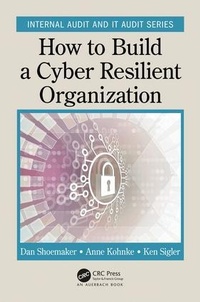
How to Build a Cyber-Resilient Organization
1st Edition
Published on 3. December 2018
Book
Paperback/Softback
296 pages
978-1-138-55819-9 (ISBN)
Description
This book presents a standard methodology approach to cyber-resilience. Readers will learn how to design a cyber-resilient architecture for a given organization as well as how to maintain a state of cyber-resilience in its day-to-day operation. Readers will know how to establish a state of systematic cyber-resilience within this structure and how to evolve the protection to correctly address the threat environment. This revolves around the steps to perform strategic cyber-resilience planning, implementation and evolution. Readers will know how to perform the necessary activities to identify, prioritize and deploy targeted controls and maintain a persistent and reliable reporting system.
More details
Series
Language
English
Place of publication
London
United Kingdom
Publishing group
Taylor & Francis Ltd
Target group
Professional and scholarly
Academic and Professional Practice & Development
Product notice
Paperback (trade)
Unsewn / adhesive bound
Dimensions
Height: 231 mm
Width: 155 mm
Thickness: 23 mm
Weight
476 gr
ISBN-13
978-1-138-55819-9 (9781138558199)
Copyright in bibliographic data and cover images is held by Nielsen Book Services Limited or by the publishers or by their respective licensors: all rights reserved.
Schweitzer Classification
Other editions
Additional editions
Dan Shoemaker | Anne Kohnke | Ken Sigler
How to Build a Cyber-Resilient Organization
E-Book
12/2018
1st Edition
Auerbach
€81.49
Available for download
Dan Shoemaker | Anne Kohnke | Ken Sigler
How to Build a Cyber-Resilient Organization
E-Book
12/2018
1st Edition
Auerbach
€81.49
Available for download
Persons
Daniel P Shoemaker, PhD, is principal investigator and senior research scientist at the University of Detroit Mercy's Center for Cyber Security and Intelligence Studies. Dan has served 30 years as a professor at UDM with 25 of those years as department chair. He served as a co-chair for both the Workforce Training and Education and the Software and Supply Chain Assurance Initiatives for the Department of Homeland Security, and was a subject matter expert for the NICE Workforce Framework 2.0. Dan has coauthored six books in the field of cybersecurity and has authored over one hundred journal publications. Dan earned his PhD from the University of Michigan.
Anne Kohnke, PhD, is an assistant professor of IT at Lawrence Technological University and teaches courses in both the information technology and organization development/change management disciplines at the bachelor through doctorate levels. Anne's research focus is in the areas of cybersecurity, risk management, threat modeling, and IT governance. After a 25-year career in IT, Anne transitioned from a Vice President of IT and Chief Information Security Officer (CISO) position into full-time academia in 2011. She earned her PhD from Benedictine University.
Ken Sigler is a faculty member of the Computer Information Systems (CIS) program at the Auburn Hills campus of Oakland Community College in Michigan. His primary research is in the areas of software management, software assurance, and cloud computing. He developed the college's CIS program option entitled "Information Technologies for Homeland Security." Until 2007, Ken served as the liaison for the college to the International Cybersecurity Education Coalition (ICSEC), of which he is one of three founding members. Ken is a member of IEEE, the Distributed Management Task Force (DMTF), and the Association for Information Systems (AIS).
Anne Kohnke, PhD, is an assistant professor of IT at Lawrence Technological University and teaches courses in both the information technology and organization development/change management disciplines at the bachelor through doctorate levels. Anne's research focus is in the areas of cybersecurity, risk management, threat modeling, and IT governance. After a 25-year career in IT, Anne transitioned from a Vice President of IT and Chief Information Security Officer (CISO) position into full-time academia in 2011. She earned her PhD from Benedictine University.
Ken Sigler is a faculty member of the Computer Information Systems (CIS) program at the Auburn Hills campus of Oakland Community College in Michigan. His primary research is in the areas of software management, software assurance, and cloud computing. He developed the college's CIS program option entitled "Information Technologies for Homeland Security." Until 2007, Ken served as the liaison for the college to the International Cybersecurity Education Coalition (ICSEC), of which he is one of three founding members. Ken is a member of IEEE, the Distributed Management Task Force (DMTF), and the Association for Information Systems (AIS).
Content
1. It's Time for a New Paradigm 2. Asset Identification and Classification 3. Establishing the Risk Status of the Corporate Infrastructure 4. Prioritization of Assets and Establishing a Plan for Resilient Change 5. Control Design and Deployment 6. Control Assessment and Assurance 7. Recovering the Non-Priority Assets 8. Ensuring a Continuously Cyber-Resilient Organization