

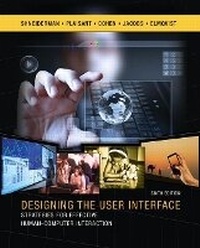
Designing the User Interface
Strategies for Effective Human-Computer Interaction
6th Edition
Published on 4. June 2016
Book
Hardback
616 pages
978-0-13-438038-4 (ISBN)
Description
For courses in Human-Computer Interaction
The Sixth Edition of Designing the User Interface provides a comprehensive, authoritative, and up-to-date introduction to the dynamic field of human-computer interaction (HCI) and user experience (UX) design. This classic book has defined and charted the astonishing evolution of user interfaces for three decades. Students and professionals learn practical principles and guidelines needed to develop high quality interface designs that users can understand, predict, and control. The book covers theoretical foundations and design processes such as expert reviews and usability testing.
By presenting current research and innovations in human-computer interaction, the authors strive to inspire students, guide designers, and provoke researchers to seek solutions that improve the experiences of novice and expert users, while achieving universal usability. The authors also provide balanced presentations on controversial topics such as augmented and virtual reality, voice and natural language interfaces, and information visualization.
Updates include current HCI design methods, new design examples, and totally revamped coverage of social media, search and voice interaction. Major revisions were made to EVERY chapter, changing almost every figure (170 new color figures) and substantially updating the references.
The Sixth Edition of Designing the User Interface provides a comprehensive, authoritative, and up-to-date introduction to the dynamic field of human-computer interaction (HCI) and user experience (UX) design. This classic book has defined and charted the astonishing evolution of user interfaces for three decades. Students and professionals learn practical principles and guidelines needed to develop high quality interface designs that users can understand, predict, and control. The book covers theoretical foundations and design processes such as expert reviews and usability testing.
By presenting current research and innovations in human-computer interaction, the authors strive to inspire students, guide designers, and provoke researchers to seek solutions that improve the experiences of novice and expert users, while achieving universal usability. The authors also provide balanced presentations on controversial topics such as augmented and virtual reality, voice and natural language interfaces, and information visualization.
Updates include current HCI design methods, new design examples, and totally revamped coverage of social media, search and voice interaction. Major revisions were made to EVERY chapter, changing almost every figure (170 new color figures) and substantially updating the references.
More details
Persons
BEN SHNEIDERMAN (http://www.cs.umd.edu/~ben) is a Distinguished University Professor in the Department of Computer Science, Founding Director (1983-2000) of the Human-Computer Interaction Laboratory (http://www.cs.umd.edu/hcil/), and a Member of the UM Institute for Advanced Computer Studies (UMIACS) at the University of Maryland. He is a Fellow of the AAAS, ACM, IEEE, NAI, and SIGCHI Academy and a Member of the National Academy of Engineering, in recognition of his pioneering contributions to human-computer interaction and information visualization.
CATHERINE PLAISANT (http://hcil.umd.edu/catherine-plaisant) is a Senior Research Scientist at the University of Maryland Institute for Advanced Computer Studies and Associate Director of Research of the Human-Computer Interaction Lab. Catherine Plaisant earned her Ph.D. in Industrial Engineering at the Universite Pierre et Marie Curie - Paris VI, France. She was elected to the ACM SIGCHI Academy in 2015 for her contributions to the field of human-computer interaction, medical informatics, and information visualization.
MAXINE COHEN (http://cec.nova.edu/faculty/cohen.html) is a Professor in the College of Engineering and Computing at Nova Southeastern University in Fort Lauderdale, FL. She teaches graduate courses (on campus and online) in Human-Computer Interaction, Interaction Design, and Social Media and advises doctoral students. Previously she worked for IBM (Endicott, NY and Boca Raton, FL) and taught at the Watson School of Engineering at Binghamton University. She has served as a meta-reviewer for ACM Computing Reviews for over 20 years. She earned her Ph.D. and M.S. from Binghamton University and her B.A. from the University of Vermont. She is a member of ACM, IEEE, and UPE.
STEVEN JACOBS (http://cefns.nau.edu/~smj93/) retired from the aerospace industry and is now a Lecturer in the School of Informatics, Computing, and Cyber Systems as well as University College Faculty Fellow at Northern Arizona University, Flagstaff, Arizona. He was with Northrop Grumman Information Systems (formerly TRW) in Carson, California for 25 years. He was also Adjunct Assistant Professor at the University of Southern California Department of Computer Science for 17 years, where he developed and taught their graduate courses in user interface design and human performance engineering. He received his M.S.C.S. from UCLA and B.A. in Mathematics from Monmouth University (NJ). Mr. Jacobs is a Senior Member of ACM.
NIKLAS ELMQVIST (http://sites.umiacs.umd.edu/elm/) is an Associate Professor in the College of Information Studies at University of Maryland, College Park, with affiliate appointments in the Department of Computer Science and the UM Institute for Advanced Computer Studies (UMIACS). He is also a member of the Human-Computer Interaction Laboratory (HCIL). Previously a faculty member at Purdue University, he received his Ph.D. from Chalmers University of Technology in Gothenburg, Sweden. He is a Senior Member of the ACM and the IEEE.
NICHOLAS DIAKOPOULOS (http://www.nickdiakopoulos.com/) is an Assistant Professor at the University of Maryland, College Park Philip Merrill College of Journalism with courtesy appointments in the College of Information Studies and Department of Computer Science. He is a member of the Human-Computer Interaction Lab (HCIL) and is director of the Computational Journalism Lab where he researches algorithmic accountability, narrative data visualization, and social computing in the news. He received his Ph.D. in Computer Science from the School of Interactive Computing at the Georgia Institute of Technology.
CATHERINE PLAISANT (http://hcil.umd.edu/catherine-plaisant) is a Senior Research Scientist at the University of Maryland Institute for Advanced Computer Studies and Associate Director of Research of the Human-Computer Interaction Lab. Catherine Plaisant earned her Ph.D. in Industrial Engineering at the Universite Pierre et Marie Curie - Paris VI, France. She was elected to the ACM SIGCHI Academy in 2015 for her contributions to the field of human-computer interaction, medical informatics, and information visualization.
MAXINE COHEN (http://cec.nova.edu/faculty/cohen.html) is a Professor in the College of Engineering and Computing at Nova Southeastern University in Fort Lauderdale, FL. She teaches graduate courses (on campus and online) in Human-Computer Interaction, Interaction Design, and Social Media and advises doctoral students. Previously she worked for IBM (Endicott, NY and Boca Raton, FL) and taught at the Watson School of Engineering at Binghamton University. She has served as a meta-reviewer for ACM Computing Reviews for over 20 years. She earned her Ph.D. and M.S. from Binghamton University and her B.A. from the University of Vermont. She is a member of ACM, IEEE, and UPE.
STEVEN JACOBS (http://cefns.nau.edu/~smj93/) retired from the aerospace industry and is now a Lecturer in the School of Informatics, Computing, and Cyber Systems as well as University College Faculty Fellow at Northern Arizona University, Flagstaff, Arizona. He was with Northrop Grumman Information Systems (formerly TRW) in Carson, California for 25 years. He was also Adjunct Assistant Professor at the University of Southern California Department of Computer Science for 17 years, where he developed and taught their graduate courses in user interface design and human performance engineering. He received his M.S.C.S. from UCLA and B.A. in Mathematics from Monmouth University (NJ). Mr. Jacobs is a Senior Member of ACM.
NIKLAS ELMQVIST (http://sites.umiacs.umd.edu/elm/) is an Associate Professor in the College of Information Studies at University of Maryland, College Park, with affiliate appointments in the Department of Computer Science and the UM Institute for Advanced Computer Studies (UMIACS). He is also a member of the Human-Computer Interaction Laboratory (HCIL). Previously a faculty member at Purdue University, he received his Ph.D. from Chalmers University of Technology in Gothenburg, Sweden. He is a Senior Member of the ACM and the IEEE.
NICHOLAS DIAKOPOULOS (http://www.nickdiakopoulos.com/) is an Assistant Professor at the University of Maryland, College Park Philip Merrill College of Journalism with courtesy appointments in the College of Information Studies and Department of Computer Science. He is a member of the Human-Computer Interaction Lab (HCIL) and is director of the Computational Journalism Lab where he researches algorithmic accountability, narrative data visualization, and social computing in the news. He received his Ph.D. in Computer Science from the School of Interactive Computing at the Georgia Institute of Technology.
Content
Brief Contents Part 1. Introduction
Usability of Interactive Systems
Universal Usability
Guidelines, Principles, and Theories
Part 2. Design Processes
Design
Evaluation and the User Experience
Design Case Studies
Part 3. Interaction Styles
Direct Manipulation and Immersive Environments
Fluid Navigation
Expressive Human and Command Languages
Devices
Communication and Collaboration
Part 4. Design Issues
Advancing the User Experience
The Timely User Experience
Documentation and User Support (a.k.a. Help)
Information Search
Data Visualization
Afterword. Societal and Individual Impact of User Interfaces
Usability of Interactive Systems
Universal Usability
Guidelines, Principles, and Theories
Part 2. Design Processes
Design
Evaluation and the User Experience
Design Case Studies
Part 3. Interaction Styles
Direct Manipulation and Immersive Environments
Fluid Navigation
Expressive Human and Command Languages
Devices
Communication and Collaboration
Part 4. Design Issues
Advancing the User Experience
The Timely User Experience
Documentation and User Support (a.k.a. Help)
Information Search
Data Visualization
Afterword. Societal and Individual Impact of User Interfaces