

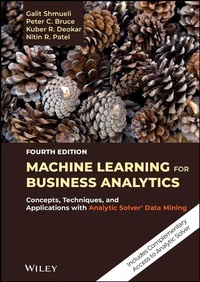
Machine Learning for Business Analytics - Concepts, Techniques, and Applications with Analytic Solver Data Mining, Fourth Edition
Description
Machine Learning for Business Analytics: Concepts, Techniques, and Applications in Analytic Solver Data Mining provides a comprehensive introduction and an overview of this methodology. The fourth edition of this best-selling textbook covers both statistical and machine learning algorithms for prediction, classification, visualization, dimension reduction, rule mining, recommendations, clustering, text mining, experimentation, time series forecasting and network analytics. Along with hands-on exercises and real-life case studies, it also discusses managerial and ethical issues for responsible use of machine learning techniques.
This fourth edition of Machine Learning for Business Analytics also includes:
An expanded chapter focused on discussion of deep learning techniques
A new chapter on experimental feedback techniques including A/B testing, uplift modeling, and reinforcement learning
A new chapter on responsible data science
Updates and new material based on feedback from instructors teaching MBA, Masters in Business Analytics and related programs, undergraduate, diploma and executive courses, and from their students
A full chapter devoted to relevant case studies with more than a dozen cases demonstrating applications for the machine learning techniques
End-of-chapter exercises that help readers gauge and expand their comprehension and competency of the material presented
A companion website with more than two dozen data sets, and instructor materials including exercise solutions, slides, and case solutions
This textbook is an ideal resource for upper-level undergraduate and graduate level courses in data science, predictive analytics, and business analytics. It is also an excellent reference for analysts, researchers, and data science practitioners working with quantitative data in management, finance, marketing, operations management, information systems, computer science, and information technology.
<b>Machine learning -also known as data mining or predictive analytics- is a fundamental part of data science. It is used by organizations in a wide variety of arenas to turn raw data into actionable information.</b>
<i>Machine Learning for Business Analytics: Concepts, Techniques, and Applications in Analytic Solver Data Mining</i> provides a comprehensive introduction and an overview of this methodology. The fourth edition of this best-selling textbook covers both statistical and machine learning algorithms for prediction, classification, visualization, dimension reduction, rule mining, recommendations, clustering, text mining, experimentation, time series forecasting and network analytics. Along with hands-on exercises and real-life case studies, it also discusses managerial and ethical issues for responsible use of machine learning techniques.
This fourth edition of Machine Learning for Business Analytics also includes:
<ul><li>An expanded chapter focused on discussion of deep learning techniques</li><li>A new chapter on experimental feedback techniques including A/B testing, uplift modeling, and reinforcement learning</li><li>A new chapter on responsible data science</li><li>Updates and new material based on feedback from instructors teaching MBA, Masters in Business Analytics and related programs, undergraduate, diploma and executive courses, and from their students</li><li>A full chapter devoted to relevant case studies with more than a dozen cases demonstrating applications for the machine learning techniques</li><li>End-of-chapter exercises that help readers gauge and expand their comprehension and competency of the material presented</li><li>A companion website with more than two dozen data sets, and instructor materials including exercise solutions, slides, and case solutions</li></ul>This textbook is an ideal resource for upper-level undergraduate and graduate level courses in data science, predictive analytics, and business analytics. It is also an excellent reference for analysts, researchers, and data science practitioners working with quantitative data in management, finance, marketing, operations management, information systems, computer science, and information technology.
More details
Other editions
Additional editions
Previous edition
Person
Peter C. Bruce, is Founder of the Institute for Statistics Education at Statistics.com, and Chief Learning Officer at Elder Research, Inc.
Kuber R. Deokar, is the Data Science Team Lead at UpThink Experts, India. He is also a faculty member at Statistics.com.
Nitin R. Patel, PhD, is cofounder and lead researcher at Cytel Inc. He was also a co-founder of Tata Consultancy Services. A Fellow of the American Statistical Association, Dr. Patel has served as a visiting professor at the Massachusetts Institute of Technology and at Harvard University. He is a Fellow of the Computer Society of India and was a professor at the Indian Institute of Management, Ahmedabad, for 15 years.
<b>Galit Shmueli, PhD,</b> is Distinguished Professor and Institute Director at National Tsing Hua University's Institute of Service Science. She has designed and instructed business analytics courses since 2004 at University of Maryland, Statistics.com, The Indian School of Business, and National Tsing Hua University, Taiwan.
<b>Peter C. Bruce,</b> is Founder of the Institute for Statistics Education at Statistics.com, and Chief Learning Officer at Elder Research, Inc.
<b>Kuber R. Deokar,</b> is the Data Science Team Lead at UpThink Experts, India. He is also a faculty member at Statistics.com.
<b>Nitin R. Patel, PhD,</b> is cofounder and lead researcher at Cytel Inc. He was also a co-founder of Tata Consultancy Services. A Fellow of the American Statistical Association, Dr. Patel has served as a visiting professor at the Massachusetts Institute of Technology and at Harvard University. He is a Fellow of the Computer Society of India and was a professor at the Indian Institute of Management, Ahmedabad, for 15 years.
Content
Foreword xix
Preface to the Fourth Edition xxi
Acknowledgments xxv
<b>PART I PRELIMINARIES</b>
CHAPTER 1 Introduction 3
CHAPTER 2 Overview of the Machine Learning Process 15
<b>PART II DATA EXPLORATION AND DIMENSION REDUCTION</b>
CHAPTER 3 Data Visualization 59
CHAPTER 4 Dimension Reduction 91
<b>PART III PERFORMANCE EVALUATION</b>
CHAPTER 5 Evaluating Predictive Performance 115
<b>PART IV PREDICTION AND CLASSIFICATION METHODS</b>
CHAPTER 6 Multiple Linear Regression 151
CHAPTER 7 k-Nearest-Neighbors (k-NN) 169
CHAPTER 8 The Naive Bayes Classifier 181
CHAPTER 9 Classification and Regression Trees 197
CHAPTER 10 Logistic Regression 229
CHAPTER 11 Neural Nets 257
CHAPTER 12 Discriminant Analysis 283
CHAPTER 13 Generating, Comparing, and Combining Multiple Models 303
<b>PART V INTERVENTION AND USER FEEDBACK</b>
CHAPTER 14 Experiments, Uplift Modeling, and Reinforcement Learning 319
<b>PART VI MINING RELATIONSHIPS AMONG RECORDS</b>
CHAPTER 15 Association Rules and Collaborative Filtering 341
CHAPTER 16 Cluster Analysis 369
<b>PART VII FORECASTING TIME SERIES</b>
CHAPTER 17 Handling Time Series 401
CHAPTER 18 Regression-Based Forecasting 415
CHAPTER 19 Smoothing Methods 445
<b>PART VIII DATA ANALYTICS</b>
CHAPTER 20 Social Network Analytics 467
CHAPTER 21 Text Mining 487
CHAPTER 22 Responsible Data Science 507
<b>PART IX CASES</b>
CHAPTER 23 Cases 537
References 575
Data Files Used in the Book 577
Index 579