

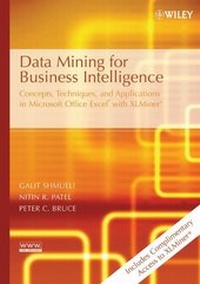
Data Mining for Business Intelligence
Concepts, Techniques, and Applications in Microsoft Office Excel with XLMiner
1st Edition
Published on 2. January 2007
Book
Hardback
298 pages
978-0-470-08485-4 (ISBN)
Description
Learn how to develop models for classification, prediction, and customer segmentation with the help of Data Mining for Business Intelligence
In today's world, businesses are becoming more capable of accessing their ideal consumers, and an understanding of data mining contributes to this success. Data Mining for Business Intelligence, which was developed from a course taught at the Massachusetts Institute of Technology's Sloan School of Management, and the University of Maryland's Smith School of Business, uses real data and actual cases to illustrate the applicability of data mining intelligence to the development of successful business models.
Featuring XLMiner, the Microsoft Office Excel add-in, this book allows readers to follow along and implement algorithms at their own speed, with a minimal learning curve. In addition, students and practitioners of data mining techniques are presented with hands-on, business-oriented applications. An abundant amount of exercises and examples are provided to motivate learning and understanding.
Data Mining for Business Intelligence:
* Provides both a theoretical and practical understanding of the key methods of classification, prediction, reduction, exploration, and affinity analysis
* Features a business decision-making context for these key methods
* Illustrates the application and interpretation of these methods using real business cases and data
This book helps readers understand the beneficial relationship that can be established between data mining and smart business practices, and is an excellent learning tool for creating valuable strategies and making wiser business decisions.
In today's world, businesses are becoming more capable of accessing their ideal consumers, and an understanding of data mining contributes to this success. Data Mining for Business Intelligence, which was developed from a course taught at the Massachusetts Institute of Technology's Sloan School of Management, and the University of Maryland's Smith School of Business, uses real data and actual cases to illustrate the applicability of data mining intelligence to the development of successful business models.
Featuring XLMiner, the Microsoft Office Excel add-in, this book allows readers to follow along and implement algorithms at their own speed, with a minimal learning curve. In addition, students and practitioners of data mining techniques are presented with hands-on, business-oriented applications. An abundant amount of exercises and examples are provided to motivate learning and understanding.
Data Mining for Business Intelligence:
* Provides both a theoretical and practical understanding of the key methods of classification, prediction, reduction, exploration, and affinity analysis
* Features a business decision-making context for these key methods
* Illustrates the application and interpretation of these methods using real business cases and data
This book helps readers understand the beneficial relationship that can be established between data mining and smart business practices, and is an excellent learning tool for creating valuable strategies and making wiser business decisions.
Reviews / Votes
"This book helps readers understand the beneficial relationship that can be established between data mining and smart business practices." (IT Professional, January/February 2007) "The book contains real case studies, providing yet further demonstrations of the extraordinary data wealth of the modern commercial world." (International Statistical Review, 2007) "...vivid and thought-provoking anecdotes...needs to be read by anyone with a serious interest in research and marketing." (Research Magazine, August 2007)More details
Edition
1., Auflage
Language
English
Place of publication
Hoboken
United Kingdom
Publishing group
John Wiley and Sons Ltd
Target group
Professional and scholarly
Edition type
New edition
Illustrations
Illustrations
Dimensions
Height: 25.4 cm
Width: 18.4 cm
Weight
675 gr
ISBN-13
978-0-470-08485-4 (9780470084854)
Schweitzer Classification
Other editions
New editions
Galit Shmueli | Nitin R. Patel | Peter C. Bruce
Data Mining for Business Intelligence
Concepts, Techniques, and Applications in Microsoft Office Excel with XLMiner
Book
11/2010
2nd Edition
Wiley
€122.00
Article is exhausted; no reprint
Persons
GALIT SHMUELI, PHD, is Assistant Professor of Statistics in the Decision and Information Technologies Department of the Robert H. Smith School of Business at the University of Maryland.
NITIN R. PATEL, PHD, is Chairman, Founder, and Chief Technology Officer of Cambridge-based Cytel Incorporated and a Visiting Professor in the Engineering Systems Division at the Massachusetts Institute of Technology.
PETER C. BRUCE is President and owner of statistics.com, the leading provider of professional development courses in statistics.
NITIN R. PATEL, PHD, is Chairman, Founder, and Chief Technology Officer of Cambridge-based Cytel Incorporated and a Visiting Professor in the Engineering Systems Division at the Massachusetts Institute of Technology.
PETER C. BRUCE is President and owner of statistics.com, the leading provider of professional development courses in statistics.
Content
Foreword.
Preface.
Acknowledgments.
1. Introduction.
2. Overview of the Data Mining Process.
3. Data Exploration and Dimension Reduction.
4. Evaluating Classification and Predictive Performance.
5. Multiple Linear Regression.
6. Three Simple Classification Methods.
7. Classification and Regression trees.
8. Logistic Regression.
9. Neural Nets.
10. Discriminant Analysis.
11. Association Rules.
12. Cluster Analysis.
13. Cases.
References.
Index.
Preface.
Acknowledgments.
1. Introduction.
2. Overview of the Data Mining Process.
3. Data Exploration and Dimension Reduction.
4. Evaluating Classification and Predictive Performance.
5. Multiple Linear Regression.
6. Three Simple Classification Methods.
7. Classification and Regression trees.
8. Logistic Regression.
9. Neural Nets.
10. Discriminant Analysis.
11. Association Rules.
12. Cluster Analysis.
13. Cases.
References.
Index.